Why Loose Skin Can Follow Weight Loss on Tirzepatide
Visible skin changes can follow substantial weight loss, but they don’t by themselves show that tirzepatide damages skin.
Loose skin can appear after substantial weight loss on tirzepatide. As underlying volume changes, skin may not contract enough to match the new shape. The amount of weight lost, age, and skin characteristics may all matter. Rapid and large weight loss are often discussed together, so the contribution of pace on its own remains unclear. 3 7
Why skin may look looser as your body changes
Tirzepatide can be part of a major change in body weight and shape. A 2026 review describes skin laxity, facial volume loss, and excess skin on the body after rapid, substantial weight loss. These changes don’t, by themselves, show that tirzepatide directly damages skin. They also aren’t unique to people taking medication or to women. 3
The change you see matters. A face that looks hollow, skin that looks less firm, and a fold that hangs from the abdomen or upper arm are different concerns. An approach that adds facial volume won’t necessarily address excess skin on the body. Clinician guidance on medication-associated weight loss emphasizes assessing each area separately. 3 7
What might affect how your skin adapts
The amount of weight lost is part of the picture: substantial loss can change the volume beneath the skin and leave more visible excess. There’s no established amount at which this will happen to everyone. 3
Pace is harder to judge on its own. A review links visible changes with weight loss described as both rapid and large, but doesn’t isolate how much the speed contributes apart from the amount lost. That’s a reason not to assume that changing pace would prevent loose skin. 3
Age and skin characteristics matter to treatment planning, too. A clinician consensus considers age, skin quality, and the area being treated when discussing facial changes after medication-associated weight loss. These factors can help explain why two people notice different changes, but they aren’t a formula for predicting how your skin will respond. 7
Match the option to the change you see
Facial texture or mild laxity: A topical product may be appealing, but the evidence is narrow. In a 12-week study of 25 people taking GLP-1 medicines, a specific topical regimen improved measured facial laxity after four weeks compared with a placebo applied to the other side of the face. Everyone then received focused ultrasound, so the later results can’t show what the topical regimen alone would do. This facial study doesn’t establish that a cream will prevent or reverse a hanging fold of body skin. 4
Facial hollowing or an area that looks less firm: Clinicians may discuss fillers or biostimulators to address lost facial volume, and skin-tightening technologies for laxity. Adding volume to a hollow cheek and treating loose skin are different aims. Aesthetic reviews and clinician consensus describe these approaches, but don’t establish one best treatment or prove that starting a procedure during weight loss prevents later laxity. The best timing remains uncertain. 6 7
Hanging skin on the body: Nonsurgical facial treatments shouldn’t be treated as evidence that a body-skin fold will disappear. After major weight loss, body-contouring surgery can involve removing excess skin. That makes it a more directly relevant discussion if the fold itself is the concern, rather than surface texture alone. Evidence about improvements in comfort and quality of life comes largely from people who lost weight after bariatric surgery, not specifically from people taking tirzepatide; results for a particular area or person can’t be assumed from those studies. 3 8
Surgery also means recovery and possible complications, including pain, infection, bleeding, or a reaction to anesthesia. In studies comparing people after bariatric surgery who did and didn’t have body contouring, those who chose contouring differed in how much weight they’d lost. Those nonrandomized comparisons can’t tell you exactly how much benefit surgery would add for you. 1 2 8
Research on surgical outcomes specifically in people taking GLP-1 medicines is limited. One retrospective study compared 196 people having lipoabdominoplasty, half of whom were taking semaglutide or tirzepatide. It found no statistically significant differences in the reported perioperative outcomes, but it wasn’t designed to prove that the groups had equivalent risks or to measure how well surgery treats excess skin. 5
Decide what result you’re looking for
Start with the change that bothers you most. If it’s a hanging fold, the useful comparison is whether an option can address that fold, not whether it improves facial texture. If it’s facial hollowing, a discussion about volume may be more relevant than one about skin removal. Ongoing weight changes can also affect how a treatment plan is made, while evidence on the best timing remains limited. 3 7
You don’t need a cosmetic treatment just because your body is changing. If a fold affects your comfort, or you want to know what an option could realistically change, that specific concern is a useful starting point for a discussion with a clinician experienced in post-weight-loss care. 8
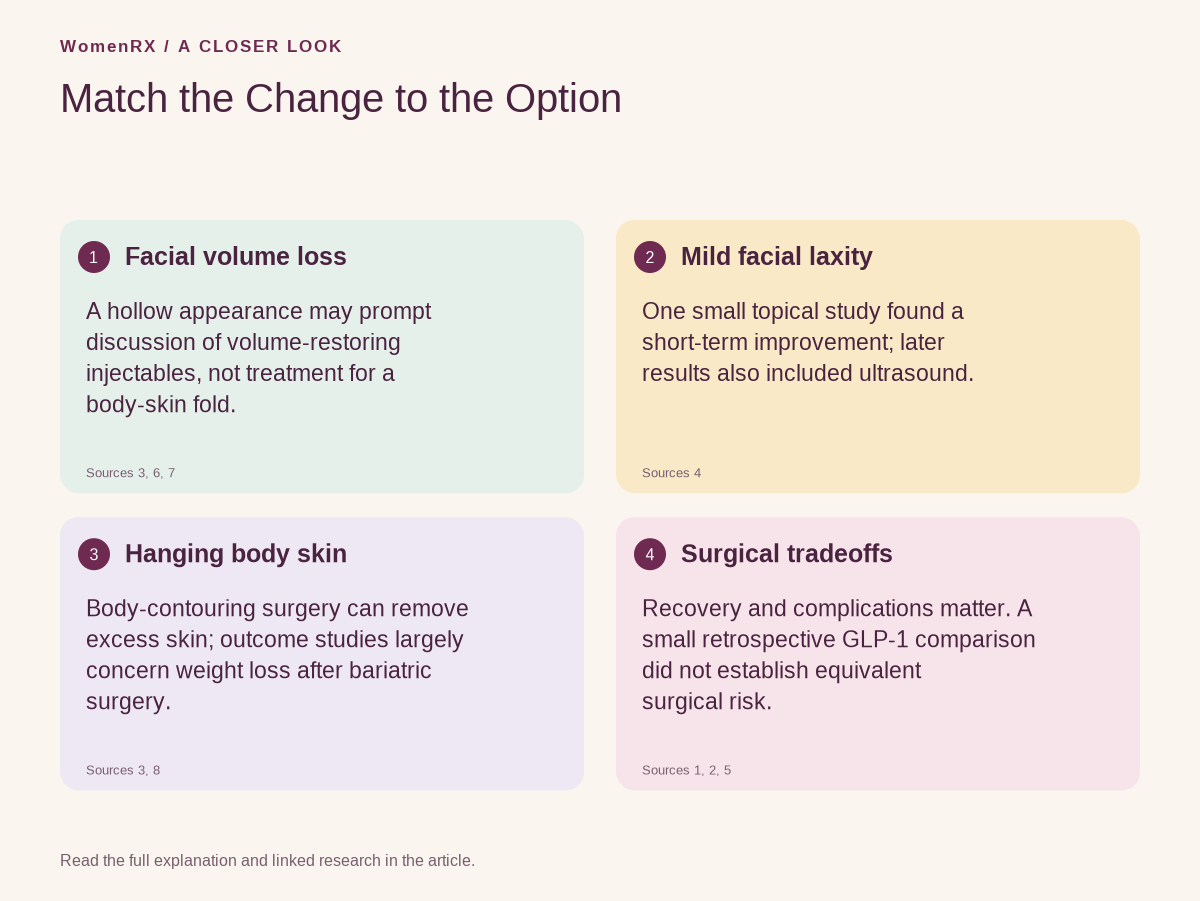
Match the Change to the Option
Facial volume loss: A hollow appearance may prompt discussion of volume-restoring injectables, not treatment for a body-skin fold.367
Mild facial laxity: One small topical study found a short-term improvement; later results also included ultrasound.4
Hanging body skin: Body-contouring surgery can remove excess skin; outcome studies largely concern weight loss after bariatric surgery.38
Surgical tradeoffs: Recovery and complications matter. A small retrospective GLP-1 comparison did not establish equivalent surgical risk.125
Read the figure as text
The evidence for a facial concern doesn’t automatically apply to a hanging fold of body skin.- Facial volume loss: A hollow appearance may prompt discussion of volume-restoring injectables, not treatment for a body-skin fold.367
- Mild facial laxity: One small topical study found a short-term improvement; later results also included ultrasound.4
- Hanging body skin: Body-contouring surgery can remove excess skin; outcome studies largely concern weight loss after bariatric surgery.38
- Surgical tradeoffs: Recovery and complications matter. A small retrospective GLP-1 comparison did not establish equivalent surgical risk.125
More questions, answered
Can a procedure during weight loss prevent loose skin?
That hasn’t been established. A clinician consensus discusses aesthetic treatment during medication-associated weight loss but says the best timing is uncertain and calls for longer-term studies to test prevention claims. 7
Sources you can check
- After Surgery: MedlinePlusAccessed 2026-09-25Return to first citation
- Surgery: MedlinePlusAccessed 2026-09-25Return to first citation
- Anti-Obesity Medications in Longevity and Aesthetic Medicine.Bijoch J. · Journal of clinical medicine · 2026Return to first citation
- Clinical Efficacy of a Flavo-Proxylane Topical Regimen Pre- and Post-ultrasound Procedure for Subjects Undergoing Glucagon-Like Peptide 1 (GLP-1) Receptor Agonist Therapy.Moradi A, Kim JH, Kim JM, Choudhary HN, Brieva PM. · Dermatology and therapy · 2026Return to first citation
- Anesthetic Safety and Perioperative Outcomes in GLP-1 Receptor Agonist-Treated Patients Undergoing Lipoabdominoplasty.Albanese R, Tomaselli F, Berkane Y, Bertheuil N, Tambasco D. · Aesthetic plastic surgery · 2026Return to first citation
- Losing Weight and Gaining Wrinkles: The Impact of Weight Loss Drugs on Facial Aesthetics.Barişkan S, Bayar Muluk N, Yazir M, Topan YE, Cingi C. · The Journal of craniofacial surgery · 2026Return to first citation
- Managing Aesthetic Needs in Prescription Medication-Driven Rapid Weight Loss Patients: Results of an International Consensus. The Clinician Perspective.Nikolis A, Somenek MT, Dayan S, Cartier H, Fabi SG, Avelar L, Franco J, Frank K, Haddad A, Alsufyani MA, Huang J, Prygova I, Safran T. · Journal of cosmetic dermatology · 2026Return to first citation
- Patient-Reported Outcome Measures following Postbariatric Body Contouring: A Systematic Review and Meta-Analysis.Mokhtar J, Akbarpoor F, Hadi M, Machado GF, Blanco K, Di Martino LG, Lellouch AG, Gurunian R, Kreutz-Rodrigues L, Bishop SN. · Plastic and reconstructive surgery · 2026Return to first citation