Loose Skin During Weight Loss: Causes and Options
Loose skin can follow substantial weight loss, but reports of changes after GLP-1-associated weight loss don’t establish whether the medicines themselves cause skin laxity.
Loose skin can become noticeable after substantial weight loss, while changes in facial fullness can also reflect lost fat volume. Clinicians report these concerns after GLP-1-associated weight loss, but that doesn’t prove the medicines themselves cause skin laxity. 2 4 5 If folds affect comfort, you can focus on rubbing and hygiene; if you’re considering skin removal, compare the scope and risks of surgical options. 1 3
Why skin may look looser after weight loss
Redundant, lax skin is described after substantial weight loss following bariatric surgery or lifestyle changes. 2 It doesn’t happen in the same way for everyone, and a change in one area doesn’t tell you what will happen elsewhere.
Facial changes can involve more than skin. A 2026 narrative review describes facial volume loss and changes in soft-tissue support after medical weight loss, which can make laxity or existing signs of aging more noticeable. That explanation concerns facial anatomy; it shouldn’t be treated as proof of the same mechanism or outcome across the body. 4
What GLP-1 medicines do, and what isn’t established
A survey of 406 health care professionals found that respondents perceived facial and body changes, including sagging body skin, among concerns after GLP-1-associated weight loss. It gathered clinicians’ reports about their practices and impressions. It did not compare skin outcomes in people taking these medicines with outcomes in similar people losing weight by other means, so it can’t show that semaglutide, liraglutide, or tirzepatide directly cause loose skin. 5
In practical terms, treat the visible change as something that may accompany weight loss, not as a proven drug-specific skin effect. If you’re considering changing a medication because of your appearance, a useful question for your prescriber is how that decision fits your treatment goals, rather than assuming the medicine is the sole cause.
Your history can provide context for what you’ve noticed. Post-pregnancy changes can resemble some lower-trunk concerns seen after major weight loss, and facial weight-loss changes may accentuate existing signs of aging. Neither observation establishes that pregnancy history or age predicts body skin laxity. If menopause happened around the same time, it’s context to mention, not proof of a menopause-specific cause. 3 4
Choose a next step by what’s bothering you
If the main issue is appearance and it isn’t causing a physical problem: You don’t have to treat loose skin. If your body is still changing, you can choose to wait and reassess before committing to a procedure, without assuming the skin will change in a particular way. A small study of one breast-reshaping technique required participants to have stable weight for at least 12 months; that was a study criterion, not a universal rule for when anyone should have surgery. 2 Ask a surgeon what timing makes sense for your health and goals.
If folds are uncomfortable or interfere with daily life: Redundant folds can be associated with dermatitis, hygiene difficulties, and clothing or activity challenges. 3 Notice where clothing rubs, whether cleaning beneath a fold is difficult, and whether irritation keeps returning. Trying clothing that doesn’t rub and a gentle cleaning-and-drying routine are practical comfort measures, not proven treatments for skin laxity. They won’t remove the fold. If irritation keeps returning, you can ask a clinician what care options fit.
A panniculectomy removes an overhanging fold of skin and fat; it is different from an abdominoplasty or a more extensive body lift, which aims to change contour in additional ways. Which, if any, fits your concern depends on an individual examination. 3
If you’re considering surgery for contour or skin removal: Ask what the proposed procedure is meant to improve, what it won’t change, where scars will be, and what recovery could involve. Surgery can involve pain, swelling, and soreness, and complications can include infection, bleeding, or anesthesia-related problems. 1 A study guide describes panniculectomy as focused on removing the overhanging fold, while abdominoplasty and belt lipectomy address broader contour goals. These are not interchangeable procedures. 3
A useful way to compare options
Start with your goal: less rubbing, easier hygiene, more comfortable movement, or a different contour. Then ask whether the option addresses that goal and what it asks of you in return. Clothing and gentle fold care are reasonable ways to try to manage everyday friction or hygiene difficulties, but they don’t remove excess skin. Surgery can remove selected excess skin 3, but it involves recovery and possible complications. 1 The procedure needs to match the area and goal. 3
For example, if a lower-abdominal fold is mainly causing repeated irritation, ask whether a focused skin-removal procedure addresses that functional concern, and how it differs from a larger contouring operation. If your concern is appearance alone, ask about the likely scar pattern and what changes are realistic for the specific procedure. A consultation is a chance to compare those trade-offs, not a commitment to surgery.
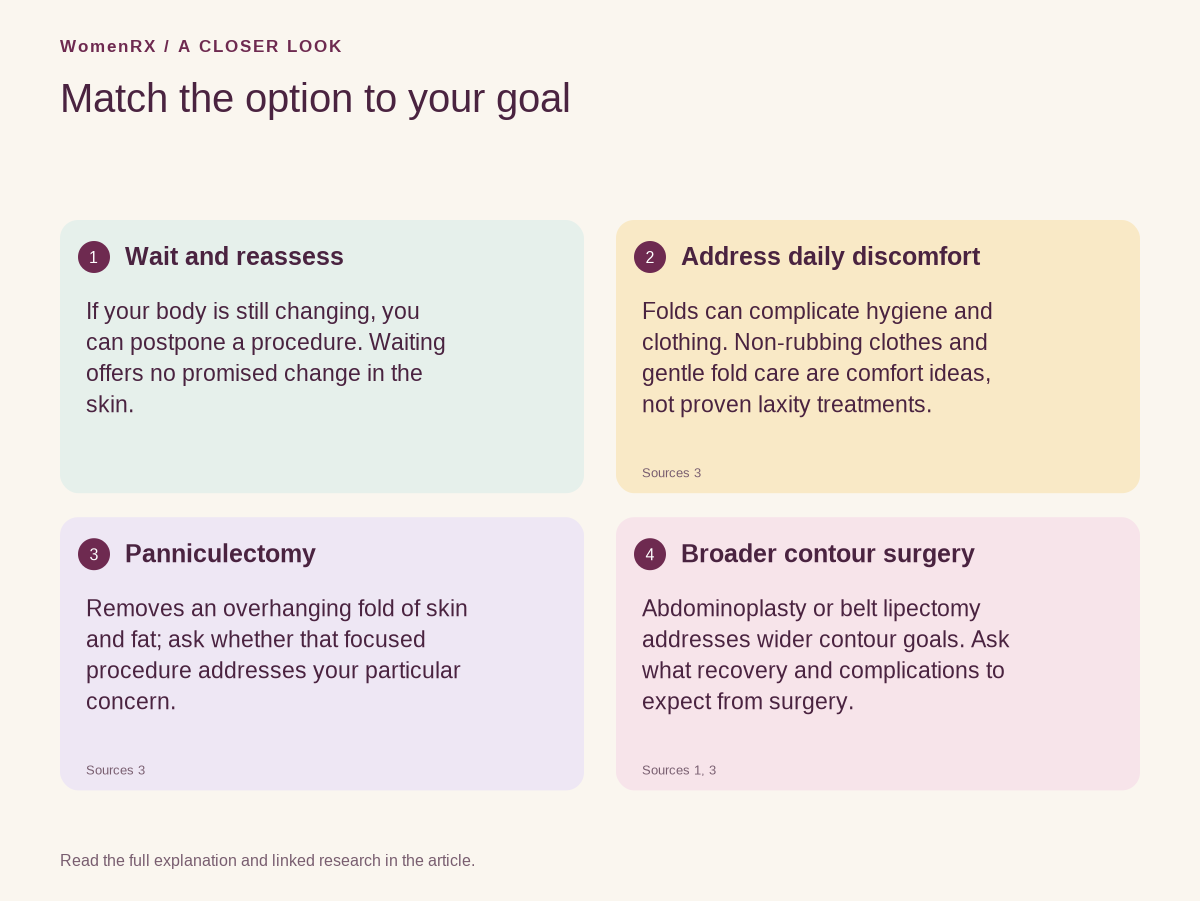
Match the option to your goal
Wait and reassess: If your body is still changing, you can postpone a procedure. Waiting offers no promised change in the skin.
Address daily discomfort: Folds can complicate hygiene and clothing. Non-rubbing clothes and gentle fold care are comfort ideas, not proven laxity treatments.3
Panniculectomy: Removes an overhanging fold of skin and fat; ask whether that focused procedure addresses your particular concern.3
Broader contour surgery: Abdominoplasty or belt lipectomy addresses wider contour goals. Ask what recovery and complications to expect from surgery.13
Read the figure as text
Loose skin can be an appearance concern, a comfort problem, or both. Compare what each next step addresses and what it cannot do.- Wait and reassess: If your body is still changing, you can postpone a procedure. Waiting offers no promised change in the skin.
- Address daily discomfort: Folds can complicate hygiene and clothing. Non-rubbing clothes and gentle fold care are comfort ideas, not proven laxity treatments.3
- Panniculectomy: Removes an overhanging fold of skin and fat; ask whether that focused procedure addresses your particular concern.3
- Broader contour surgery: Abdominoplasty or belt lipectomy addresses wider contour goals. Ask what recovery and complications to expect from surgery.13
More questions, answered
Does loose skin mean I should stop a GLP-1 medicine?
Not by itself. A clinician survey describes skin concerns after GLP-1-associated weight loss, but it doesn’t establish that the medicines directly cause laxity. 5 If you’re thinking of stopping, ask your prescriber how that choice fits your treatment goals.
Are panniculectomy and a tummy tuck the same?
No. A panniculectomy focuses on removing an overhanging fold of skin and fat. Abdominoplasty and belt lipectomy address broader contour goals, with differences in the extent of surgery. Ask the surgeon which procedure matches your concern. 3
Sources you can check
- After Surgery: MedlinePlusAccessed 2026-09-25Return to first citation
- Reshaping the Postbariatric Breast: A Single-center Experience With the Dermal Suspension Parenchymal Reshaping Mastopexy Technique.Massarwa S, Rittblat M, Tzur T, Margulis A, Amar D. · Plastic and reconstructive surgery. Global open · 2026Return to first citation
- Belt LipectomyMayo J, Cape JD. · 2024Return to first citation
- GLP-1-Induced Weight Loss and the Face: Anatomical Mechanisms and Rationale for Collagen-Stimulating and Volumizing Aesthetic Treatments.Frank K, Guertler A, Hoffmeister V, Kohler L, Nikolis A, Prantl L, Pupo D, Moellhoff N, Hopf M, Heiland M, Alfertshofer M. · Dermatologic surgery : official publication for American Society for Dermatologic Surgery [et al.] · 2026Return to first citation
- Aesthetic Concerns and Nonsurgical Treatment Trends in Patients With GLP-1 Agonist-Associated Weight Loss.Fabi S, Yoo J, Kaufman-Janette J, Dayan S, Boyd C, Sangha S, Ashourian N. · Dermatologic surgery : official publication for American Society for Dermatologic Surgery [et al.] · 2026Return to first citation