Why Weight Loss Changes Your Face and Body Skin
After substantial weight loss, loose body skin and a less-full face can call for different decisions.
Substantial weight loss can leave skin that doesn’t fully contract around a smaller body. In the face, losing fat beneath the skin can make cheeks look flatter or contours more pronounced. “Ozempic face” isn’t a diagnosis, and these changes haven’t been shown to be unique to semaglutide. Surgery can remove excess body skin; facial procedures address different concerns and have less direct outcome evidence after weight loss. 1356
The same weight loss can leave two different concerns
Skin doesn’t always contract enough to fit a smaller body after major weight loss. On the abdomen, arms, or thighs, the result may be loose folds of tissue. Studies of people after bariatric surgery describe effects that go beyond appearance, including discomfort, rashes, and difficulty with movement or daily activities. Those findings don’t predict how much loose skin any one person will have after losing weight. 23
The face is different. Fat beneath the skin helps give cheeks and other areas their shape. A narrative review of facial changes after medical weight loss describes reduced fullness in facial fat compartments, along with changes in tissue support and skin laxity. Together, these can make contours look flatter or lines between facial areas more noticeable. That’s an explanation for what you might see, not a way to diagnose its cause by looking at a face. 6
You may hear facial hollowing called “Ozempic face.” It’s a nickname, not a diagnosis. Semaglutide reduces body weight with greater fat-mass loss than lean-mass loss, but current facial reviews don’t establish that it has a unique skin-loosening effect apart from weight loss. Nor does everyone who loses weight develop the same facial changes. 156
Match the option to what has changed
If excess body skin is the problem: Exercise can build strength, but it can’t remove folds of excess skin after massive weight loss. Body-contouring surgery can remove excess tissue. Reviews of post-bariatric patients report improvements in measures of physical functioning, body image, and quality of life after contouring. Most comparisons are not randomized, and the results may not carry over directly to every person who loses weight by another route. Surgery also brings a real possibility of wound-healing complications, so its potential benefit needs to be weighed against recovery and risk. 234
If a fold repeatedly gets irritated or makes movement difficult, say so when discussing your options. That’s more useful than describing the concern only as cosmetic. 3
If your face looks less full: First separate lost volume from loose skin. A filler is intended to add volume; a skin-tightening treatment targets laxity. Reviews also discuss collagen-stimulating injectable treatments. These approaches don’t do the same job, and the facial reviews offer anatomical reasoning and descriptions of use rather than strong comparative results showing which works best specifically after weight loss. 56
If you’re considering collagen: A collagen-stimulating injection is a procedure, not the same thing as an oral collagen supplement. They’re separate options, so don’t assume information about one applies to the other. 6
Your life stage matters to the decision even though it doesn’t supply a formula for predicting loose skin. For example, if you’ve been pregnant before or hope to become pregnant, you may have different priorities about timing an elective body procedure. That’s personal context to bring into a procedure discussion, not evidence that pregnancy history determines your result.
The clearest dividing line is what you want changed. A fold of excess body skin, reduced facial fullness, and facial skin laxity are different concerns. Naming the one that affects you most makes it easier to judge whether a proposed option actually addresses it.
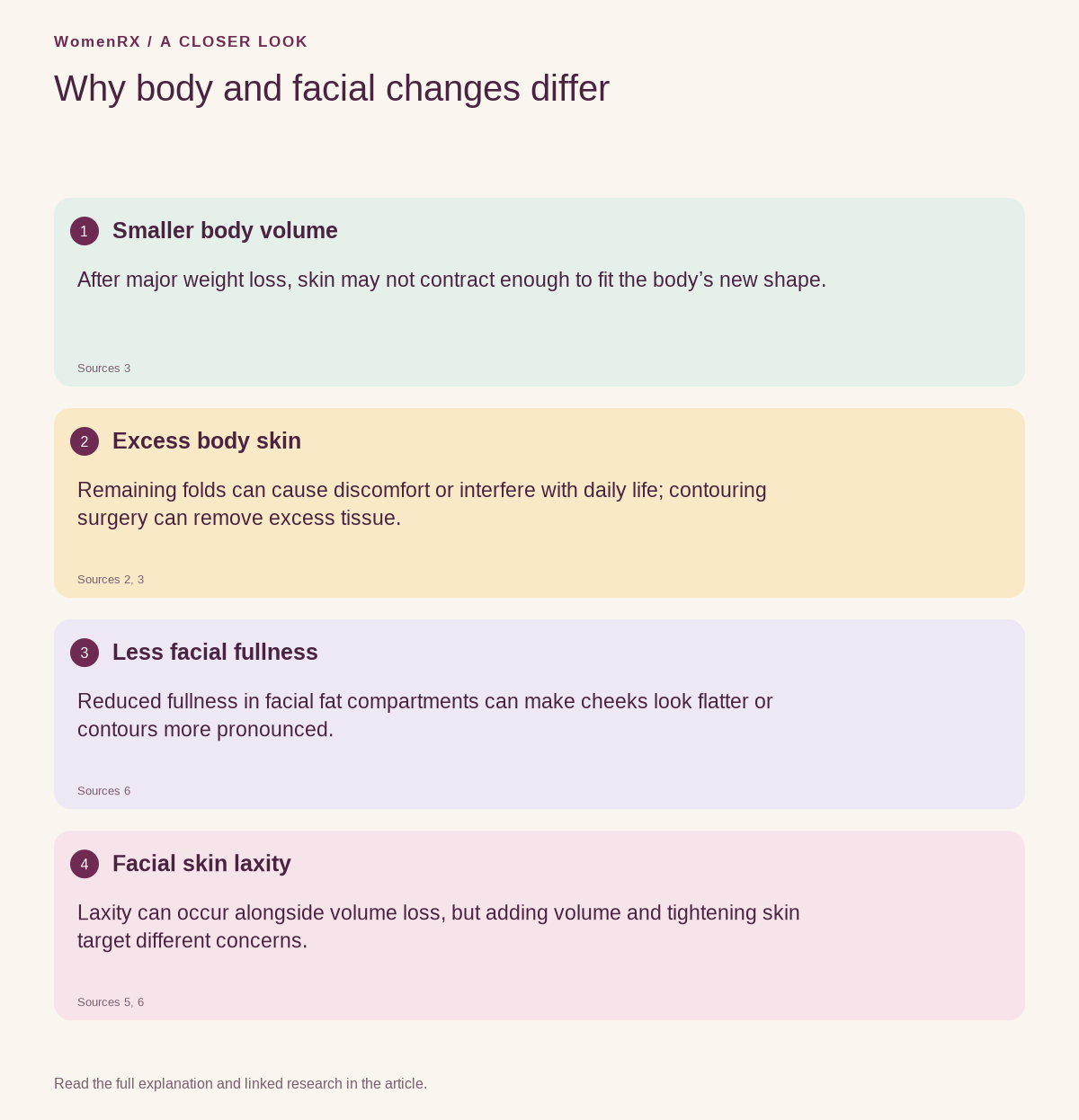
Why body and facial changes differ
Smaller body volume: After major weight loss, skin may not contract enough to fit the body’s new shape.3
Excess body skin: Remaining folds can cause discomfort or interfere with daily life; contouring surgery can remove excess tissue.23
Less facial fullness: Reduced fullness in facial fat compartments can make cheeks look flatter or contours more pronounced.6
Facial skin laxity: Laxity can occur alongside volume loss, but adding volume and tightening skin target different concerns.56
Read the figure as text
Losing volume can leave different concerns depending on where the tissue is and what has changed.- Smaller body volume: After major weight loss, skin may not contract enough to fit the body’s new shape.3
- Excess body skin: Remaining folds can cause discomfort or interfere with daily life; contouring surgery can remove excess tissue.23
- Less facial fullness: Reduced fullness in facial fat compartments can make cheeks look flatter or contours more pronounced.6
- Facial skin laxity: Laxity can occur alongside volume loss, but adding volume and tightening skin target different concerns.56
Sources you can check
- WEGOVY (SEMAGLUTIDE) INJECTION, SOLUTION WEGOVY (SEMAGLUTIDE) TABLET [NOVO NORDISK PHARMACEUTICAL INDUSTRIES, LP] | US prescribing information and patient instructionsAccessed 2026-09-25Return to first citation
- Patient-Reported Outcome Measures following Postbariatric Body Contouring: A Systematic Review and Meta-Analysis.Mokhtar J, Akbarpoor F, Hadi M, Machado GF, Blanco K, Di Martino LG, Lellouch AG, Gurunian R, Kreutz-Rodrigues L, Bishop SN. · Plastic and reconstructive surgery · 2026Return to first citation
- Does Body Contouring After Bariatric Weight Loss Enhance Quality of Life? A Systematic Review of QOL Studies.Toma T, Harling L, Athanasiou T, Darzi A, Ashrafian H. · Obesity surgery · 2018Return to first citation
- A comparative analysis and systematic review of the wound-healing milieu: implications for body contouring after massive weight loss.Albino FP, Koltz PF, Gusenoff JA. · Plastic and reconstructive surgery · 2009Return to first citation
- Losing Weight and Gaining Wrinkles: The Impact of Weight Loss Drugs on Facial Aesthetics.Barişkan S, Bayar Muluk N, Yazir M, Topan YE, Cingi C. · The Journal of craniofacial surgery · 2026Return to first citation
- GLP-1-Induced Weight Loss and the Face: Anatomical Mechanisms and Rationale for Collagen-Stimulating and Volumizing Aesthetic Treatments.Frank K, Guertler A, Hoffmeister V, Kohler L, Nikolis A, Prantl L, Pupo D, Moellhoff N, Hopf M, Heiland M, Alfertshofer M. · Dermatologic surgery : official publication for American Society for Dermatologic Surgery [et al.] · 2026Return to first citation