Can Collagen Help Loose Skin After Weight Loss?
Collagen supplements have been studied for skin hydration and elasticity, but those measurements don’t tell us whether they reduce excess skin after major weight loss.
The studies and reviews discussed here do not establish that collagen supplements reduce excess skin after substantial weight loss. Some report changes in skin hydration or elasticity, but those are different outcomes from changes in hanging or folded skin, and reviews disagree about how reliable the reported benefits are. If reducing excess skin is your goal, these results aren’t a reason to expect a supplement to do that. 1 3 4
A more elastic measurement isn’t the same as less excess skin
After substantial weight loss, your question may be straightforward: Will a supplement make the skin that hangs or folds look different? The collagen studies discussed here ask something else. They measure properties such as hydration, elasticity, and wrinkles. Those measurements can tell researchers something about how skin behaves, but they don’t show whether a supplement changes the amount or appearance of excess skin after weight loss. 1 3
For example, a randomized trial assigned 100 people with photoaged, dry skin to collagen peptides or a placebo for 12 weeks. Its efficacy analysis included 84 participants and reported improvements in facial wrinkles, hydration, and elasticity with collagen. It did not assess excess skin after weight loss. 1
That distinction doesn’t prove collagen could never make a difference. It means a positive result for facial skin cannot answer the question you’re asking about post-weight-loss skin.
Why the promising results need a closer look
A review pooling 10 randomized trials with 646 participants found improvements in measured skin hydration and elasticity. Its authors also noted that study quality was generally unclear and results varied across trials. 3
A separate review analyzed 23 randomized trials with 1,474 participants. It found benefits when all trials were combined, but no significant benefit for hydration, elasticity, or wrinkles in its higher-quality studies or in studies without pharmaceutical-company funding. 4
So even for the skin-aging outcomes researchers did measure, the strength of the evidence is debated. Neither review establishes that collagen reduces excess skin after major weight loss. A trial in 77 healthy women also assessed skin properties rather than post-weight-loss excess skin; it doesn’t answer whether results differ by menopause status or weight-loss method. 2 3 4
Make the decision about the result you want
If your main reason for buying collagen is to reduce hanging or folded skin, these findings don’t give you a sound basis to expect that result. A useful test is to ask yourself: Would I still want to pay for it if the excess skin looked the same? If the answer is no, a reported change in hydration or an elasticity measurement probably isn’t the benefit you’re looking for.
If you’re interested in those measured skin qualities instead, keep the expectations modest. Some trials found improvements, while a review’s higher-quality and studies without pharmaceutical-company funding subgroups did not show significant benefits. Results from a particular collagen-peptide trial also don’t establish that every product will work the same way. 1 4 5
To answer the post-weight-loss question directly, studies would need to measure changes in excess skin among people who have lost substantial weight. Reporting results by sex, menopause status, and weight-loss method would help show whom any finding applies to. The studies and reviews discussed here measure other skin outcomes, so they don’t establish that collagen reduces excess skin after weight loss. 1 2 3 4
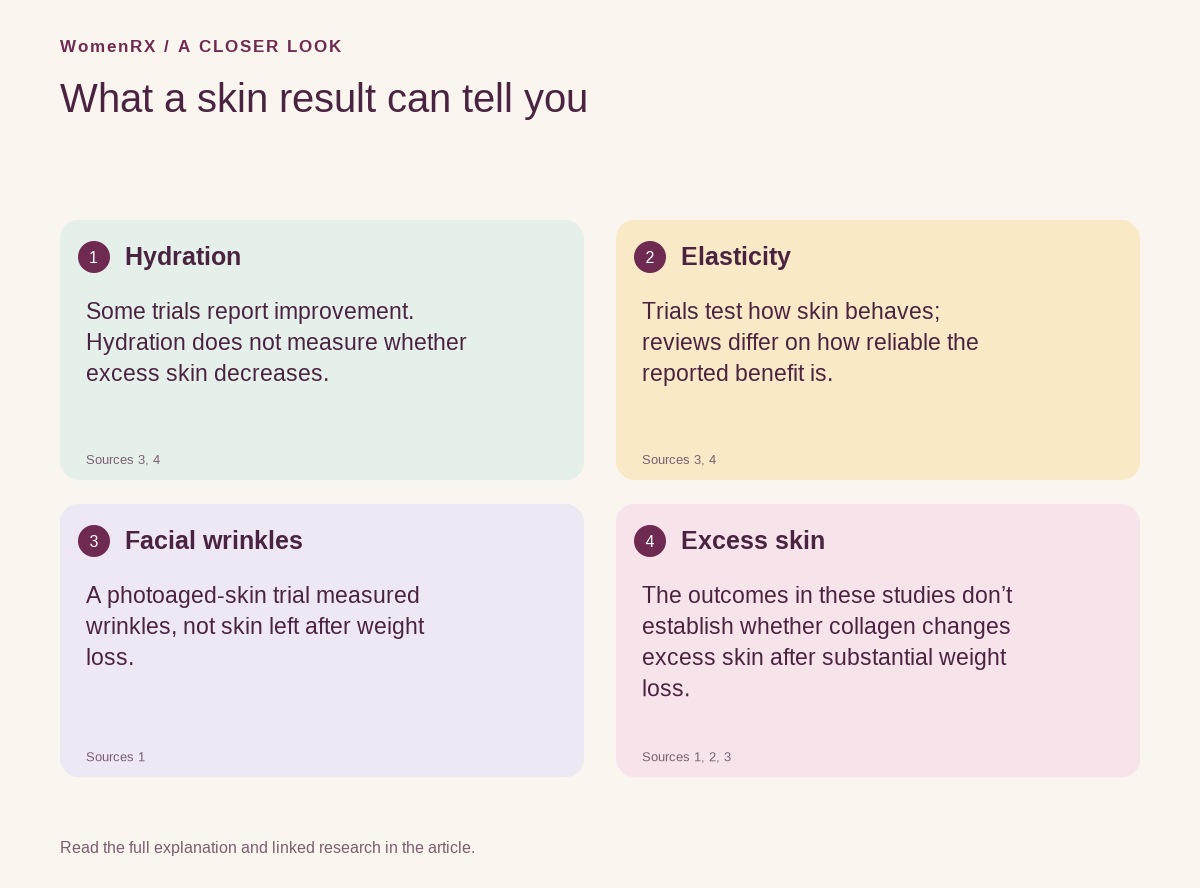
What a skin result can tell you
Hydration: Some trials report improvement. Hydration does not measure whether excess skin decreases.34
Elasticity: Trials test how skin behaves; reviews differ on how reliable the reported benefit is.34
Facial wrinkles: A photoaged-skin trial measured wrinkles, not skin left after weight loss.1
Excess skin: The outcomes in these studies don’t establish whether collagen changes excess skin after substantial weight loss.123
Read the figure as text
Collagen research measures several skin qualities, but the weight-loss question requires a different outcome.- Hydration: Some trials report improvement. Hydration does not measure whether excess skin decreases.34
- Elasticity: Trials test how skin behaves; reviews differ on how reliable the reported benefit is.34
- Facial wrinkles: A photoaged-skin trial measured wrinkles, not skin left after weight loss.1
- Excess skin: The outcomes in these studies don’t establish whether collagen changes excess skin after substantial weight loss.123
Sources you can check
- Oral Supplementation of Low-Molecular-Weight Collagen Peptides Reduces Skin Wrinkles and Improves Biophysical Properties of Skin: A Randomized, Double-Blinded, Placebo-Controlled Study.Kim J, Lee SG, Lee J, Choi S, Suk J, Lee JH, Yang JH, Yang JS, Kim J. · Journal of medicinal food · 2022Return to first citation
- The Sustained Effects of Bioactive Collagen Peptides on Skin Health: A Randomized, Double-Blind, Placebo-Controlled Clinical Study.Wang Y, Zhu W, Luo W, Ma Y, Zhou Y. · Journal of cosmetic dermatology · 2025Return to first citation
- Effects of collagen-based supplements on skin's hydration and elasticity: A systematic review and meta-analysis.Danessa G, Notario D, Regina R. · Indian journal of dermatology, venereology and leprology · 2025Return to first citation
- Effects of Collagen Supplements on Skin Aging: A Systematic Review and Meta-Analysis of Randomized Controlled Trials.Myung SK, Park Y. · The American journal of medicine · 2025Return to first citation
- Dietary Collagen Supplementation as a Strategy for Skin Health: A Narrative Review of Clinical Effects on Skin, Hair, Nails, and Wound Healing.Biełach-Bazyluk A, Jurga M, Flisiak I, Zbroch E. · Nutrients · 2026Return to first citation