What Helps Loose Skin After Weight Loss?
The useful distinction is between caring for excess skin, trying to tighten it, and removing it with surgery.
If loose skin isn’t bothering you, you may choose to leave it alone. If it causes rubbing, hygiene problems, or distress, an assessment can help clarify your options. A small trial of ultrasound for excess upper-arm skin found no statistically significant objective improvement, although some participants reported symptom relief. Body-contouring surgery can remove skin, but brings scars, recovery, and surgical risks. 561
First, what do you want to change?
“Loose skin” can describe different problems. You might notice a little looseness in one area, or folds of skin that make clothing uncomfortable. Excess upper-arm skin, for example, can be associated with rubbing, difficulty keeping the area clean, and skin irritation or infection. Those practical concerns matter just as much as appearance when you’re deciding whether to do anything. 6
The location matters, too. An upper-arm lift, called a brachioplasty, removes excess skin from the upper arm and may extend toward the side of the chest. An abdominoplasty addresses the abdomen and can remove excess skin and fat and repair weakened or separated abdominal muscles. Someone with concerns in several areas may need a different discussion from someone bothered by one small area. 647
What can you try without surgery?
Observation is an option, not a failure to act. If your skin isn’t causing problems, you don’t have to pursue a procedure. If folds make hygiene difficult or irritation keeps returning, those are useful reasons to seek an assessment rather than judging the concern by appearance alone. How much your skin may change with time is uncertain, so waiting does not promise a particular result.
Supportive care addresses comfort, not skin removal. If a fold is hard to keep clean, you could try gently washing and drying it. If clothing rubs, you could try a different fit or fabric. These are simple comfort measures, not treatments that remove a hanging fold. Keep track of irritation that returns so you can explain the problem if you seek an assessment. If a cream is marketed as a “tightening” product, ask what change it has been shown to make in substantial excess skin after weight loss.
Ask a precise question about any device treatment: Does it improve the amount of excess skin in this area, or mainly how the skin feels or looks? In a randomized trial of 14 people with excess upper-arm skin after bariatric surgery, researchers treated one arm with therapeutic ultrasound and used the other as a control. After five treatments, they found no statistically significant difference in objective measures such as arm size or drooping, although some participants reported symptom relief. That small trial cannot settle the effectiveness of every device, but it did not show a statistically significant objective improvement with ultrasound for excess upper-arm skin. 5
Facial changes associated with GLP-1-related weight loss are a separate question. A review of that setting discusses focused ultrasound, radiofrequency, fillers, and surgery for facial volume loss and laxity, but says systematic evidence on the effectiveness and safety of these approaches is lacking. A treatment discussed for the face shouldn’t be assumed to work for hanging skin on the abdomen or arms. 3
When does body-contouring surgery enter the picture?
Surgery becomes a reasonable topic to explore when the amount or location of excess skin makes removal your goal, especially if a fold is causing persistent practical problems. A surgeon’s assessment distinguishes skin from underlying fat and helps determine which procedure, if any, fits the area involved. For the upper arms, that assessment also affects the length and placement of the scar. Surgery is not one interchangeable “skin-tightening” procedure, and no consultation can promise a particular result. 6
Removal has a different tradeoff from a non-surgical treatment: incisions and recovery. Pain, swelling, and soreness are common after operations; possible complications include infection, bleeding, and reactions to anesthesia. Recovery restrictions and the help you might need at home depend on the operation and your circumstances. Ask what skin the proposed procedure would remove, where the scars would be, what it would not change, and what the first days and weeks of recovery would require. 12
If several areas bother you, ask whether procedures would be considered separately or together. A study of 75 people who had two or three post-weight-loss contouring procedures in one operation reported wound openings, fluid collections, infections, and bleeding among its complications. It describes outcomes in a selected group, not a reason to assume combined surgery is the best approach for you. 7
How do future changes affect the decision?
Bring up expected weight changes and, if relevant to you, pregnancy plans before choosing an elective procedure. Weight fluctuations and pregnancy can affect the abdomen. 4 If your weight is still changing, ask the surgeon how that might affect the operation you’re considering and whether its timing makes sense for you.
Pregnancy after abdominoplasty is possible. In a retrospective study using US health records, 304 people with a history of abdominoplasty were compared with people without that history. After statistical matching, prior abdominoplasty was associated with higher odds of preterm delivery. An association cannot tell you what would happen in an individual pregnancy or establish that the surgery caused the difference. If future pregnancy is on your mind, discuss that uncertainty alongside your reasons for considering surgery now. 4
If you’re breastfeeding, discuss how the proposed operation and its recovery needs would fit with feeding and care at home. Your circumstances and plans matter when deciding on the timing of an elective procedure.
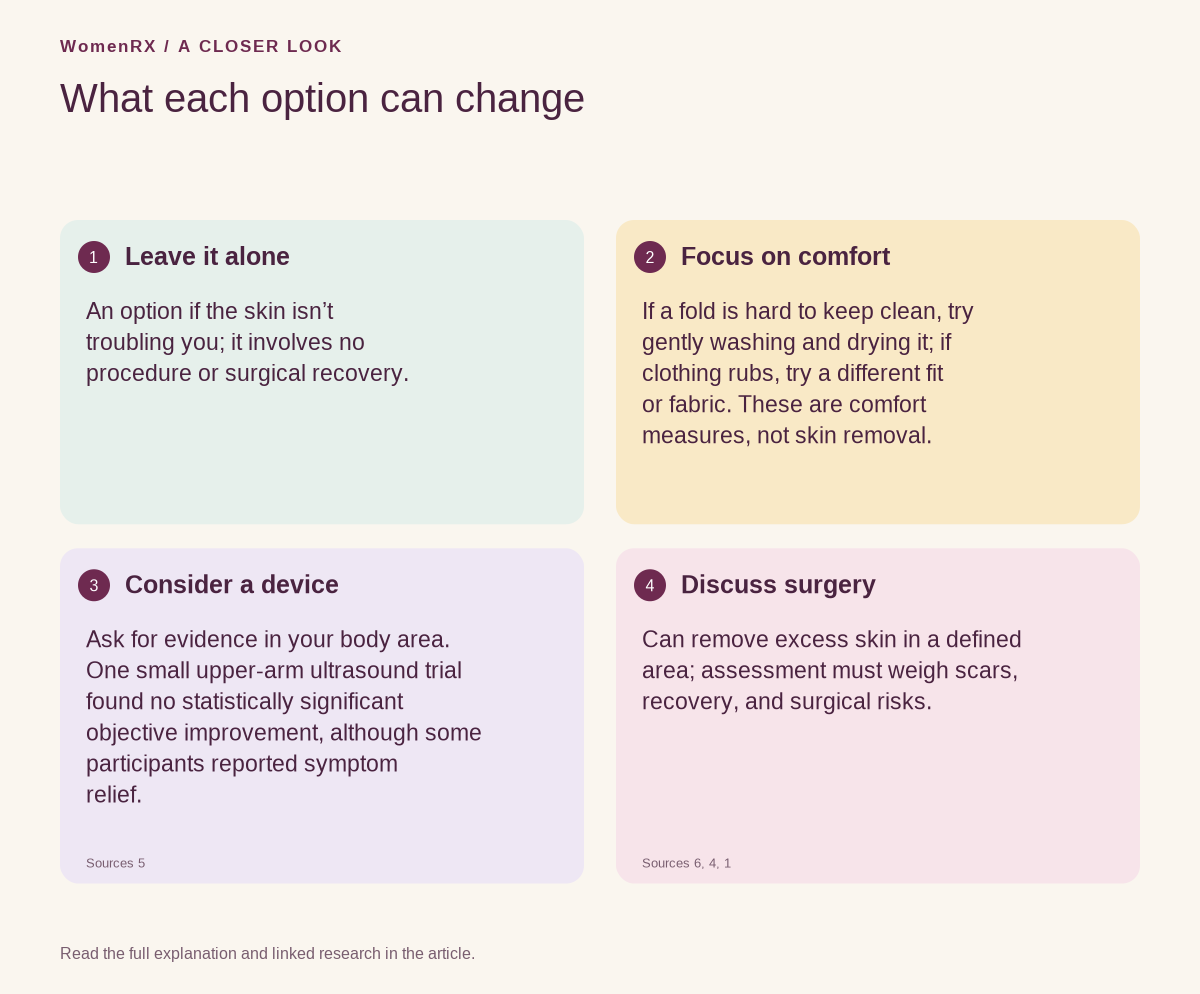
What each option can change
Leave it alone: An option if the skin isn’t troubling you; it involves no procedure or surgical recovery.
Focus on comfort: If a fold is hard to keep clean, try gently washing and drying it; if clothing rubs, try a different fit or fabric. These are comfort measures, not skin removal.
Consider a device: Ask for evidence in your body area. One small upper-arm ultrasound trial found no statistically significant objective improvement, although some participants reported symptom relief.5
Discuss surgery: Can remove excess skin in a defined area; assessment must weigh scars, recovery, and surgical risks.641
Read the figure as text
Match the option to the problem you want to address, rather than expecting every approach to remove skin.- Leave it alone: An option if the skin isn’t troubling you; it involves no procedure or surgical recovery.
- Focus on comfort: If a fold is hard to keep clean, try gently washing and drying it; if clothing rubs, try a different fit or fabric. These are comfort measures, not skin removal.
- Consider a device: Ask for evidence in your body area. One small upper-arm ultrasound trial found no statistically significant objective improvement, although some participants reported symptom relief.5
- Discuss surgery: Can remove excess skin in a defined area; assessment must weigh scars, recovery, and surgical risks.641
More questions, answered
Does weight loss by medication change which surgery I need?
The area and amount of excess skin still need an individual assessment. A retrospective study found different patterns of body-contouring procedures among people who had used GLP-1 medicines and those who had bariatric surgery, but those patterns do not determine the right procedure for any one person. 86
Sources you can check
- After Surgery: MedlinePlusAccessed 2026-09-25Return to first citation
- Surgery: MedlinePlusAccessed 2026-09-25Return to first citation
- [Rapid weight loss through GLP-1 receptor agonists as lifestyle phenomenon and implications for plastic esthetic medicine].Seidel DU, Bode S. · HNO · 2025Return to first citation
- Perinatal outcomes following abdominoplasty: a retrospective study and review of current literature.Cheng C, Martin SA, Perez JA, March MI. · American journal of obstetrics & gynecology MFM · 2024Return to first citation
- Therapeutic ultrasound treatment for excessive skin on the upper arms due to extensive weight loss after bariatric surgery: A single blind, randomised, controlled trial.Bjerså K, Biörserud C, Fagevik Olsén M. · Journal of plastic surgery and hand surgery · 2015Return to first citation
- BrachioplastySzymanski KD, Sequeira Campos MB. · 2025Return to first citation
- Outcome of Multiple Combined Post-bariatric Surgery in Massive Weight Loss Patients.Burgic M, Begic A, Rifatbegovic A, Burgic M, Umihanic F. · Aesthetic plastic surgery · 2026Return to first citation
- Outcomes of Body Contouring Surgery After Bariatric Surgery vs. GLP-1 Receptor Agonist-Induced Weight Loss: A Propensity Score Matched Analysis.Smith JE, Garbaccio NC, Mehdizadeh M, Schonebaum DI, Foster L, Cordero JJ, Lin SJ. · Aesthetic plastic surgery · 2026Return to first citation