Can Non-Surgical Treatments Tighten Skin After Weight Loss?
A treatment that changes skin texture or body contour may not do much for the folds of excess skin left after weight loss.
Non-surgical treatments may be worth discussing if your concern is mild looseness, but the evidence does not establish how much radiofrequency or ultrasound tightens skin specifically after weight loss. For substantial hanging skin, a procedure that removes excess skin addresses a different problem. The first step is to identify whether you want a small change in skin appearance or removal of a fold. 21
Start with the change you want to see
“Loose skin” can describe different things. You might notice a slightly crepey surface on your upper arms, or you might have a fold of skin that hangs over your abdomen. Those aren’t interchangeable treatment goals. A review of noninvasive treatments for areas beyond the face discusses radiofrequency, microfocused ultrasound, CO2 laser, and combinations, while noting that surgery may be indicated after major weight loss. It does not establish that any one noninvasive option will remove substantial excess skin. 2
Try putting your goal into one sentence before considering a device: I’d be happy with a subtle improvement in this area, or I want this fold gone. That distinction makes it easier to judge a proposed result. Tightening the skin that remains is not the same as cutting away skin that hangs. 1
Radiofrequency and ultrasound aren’t single treatments
A treatment name tells you less than it seems. The cited research covers noninvasive radiofrequency modalities, radiofrequency microneedling using needles, and radiofrequency-assisted liposuction. These are not interchangeable approaches. 251 In one study of radiofrequency microneedling, 30 people were treated on the lower face and under the chin. Researchers measured changes in three-dimensional volume, but those findings cannot predict what the treatment will do for loose abdominal or arm skin after weight loss. 5
Ultrasound needs the same scrutiny. A retrospective study of nonfocused ultrasound assessed a treatment intended to reduce fat. It reported changes in abdominal circumference and physician-rated appearance, with follow-up two to three weeks after the last session. A smaller circumference does not, by itself, show that excess skin was tightened or removed. 3
These studies also aren’t a reliable session guide for you. The facial microneedling study involved one to three sessions; the fat-focused ultrasound study included people who received up to eight. Neither range is an established course of treatment for post-weight-loss skin laxity. Ask what the proposed number of sessions is based on for your body area, degree of looseness, and specific device. 53
Be clear when a procedure involves liposuction
Radiofrequency-assisted liposuction sometimes appears in discussions of “non-surgical” tightening because it can avoid a long skin-removal incision. It still involves liposuction. In a prospective study from one private clinic, 120 people sought upper-arm remodeling for cosmetic reasons or after weight loss. The researchers reported improved arm measurements and satisfaction at six months, but there was no comparison group receiving a noninvasive radiofrequency treatment or skin-removal surgery. The results cannot be used as a promise for noninvasive treatment. 1
That study also gives a concrete reason to ask about tradeoffs rather than focusing only on scars: the authors reported complications in 27.5% of their 120 patients, including altered skin sensation and fat necrosis. That rate describes this clinic’s radiofrequency-assisted liposuction patients, not your risk from another procedure. 1
If a provider suggests a device-assisted procedure, ask plainly: Will anything enter my skin? Will you remove fat? Will you remove any skin? The answers matter more than whether the treatment is described as “scarless” or “non-surgical.”
What to ask before paying for a plan
Ask the person who would perform the treatment to show results for the same body area and a similar amount of excess skin, not just a similar starting weight. Find out whether the images show one treatment or a series, when the after-photo was taken, and whether liposuction or skin removal was also performed. This helps separate a possible change in texture or contour from the removal of a fold. 21
Then get a written explanation of what is included: the exact procedure and device, the proposed number of sessions, the total quoted cost, and what happens if the result falls short. Ask who performs each part of the procedure and how they handle complications. There isn’t a supported standard price or session count for post-weight-loss tightening in this research, so a specific quote is more useful than a generic estimate.
If you’re pregnant, recently postpartum, or breastfeeding, make that part of the conversation before scheduling an elective procedure. A small postpartum study examined combined abdominal treatments, not a single device for loose skin after weight loss; it does not establish a safe timing interval during pregnancy or breastfeeding. 4
A useful decision rule is to judge any proposal against the problem you actually see. If you’d value a possible, limited change in skin appearance, ask for evidence tied to that device and body area. If the fold itself is what you want removed, ask for an assessment that includes skin-removal surgery as a comparison, so you can weigh the likely result against its scars and other risks. 21
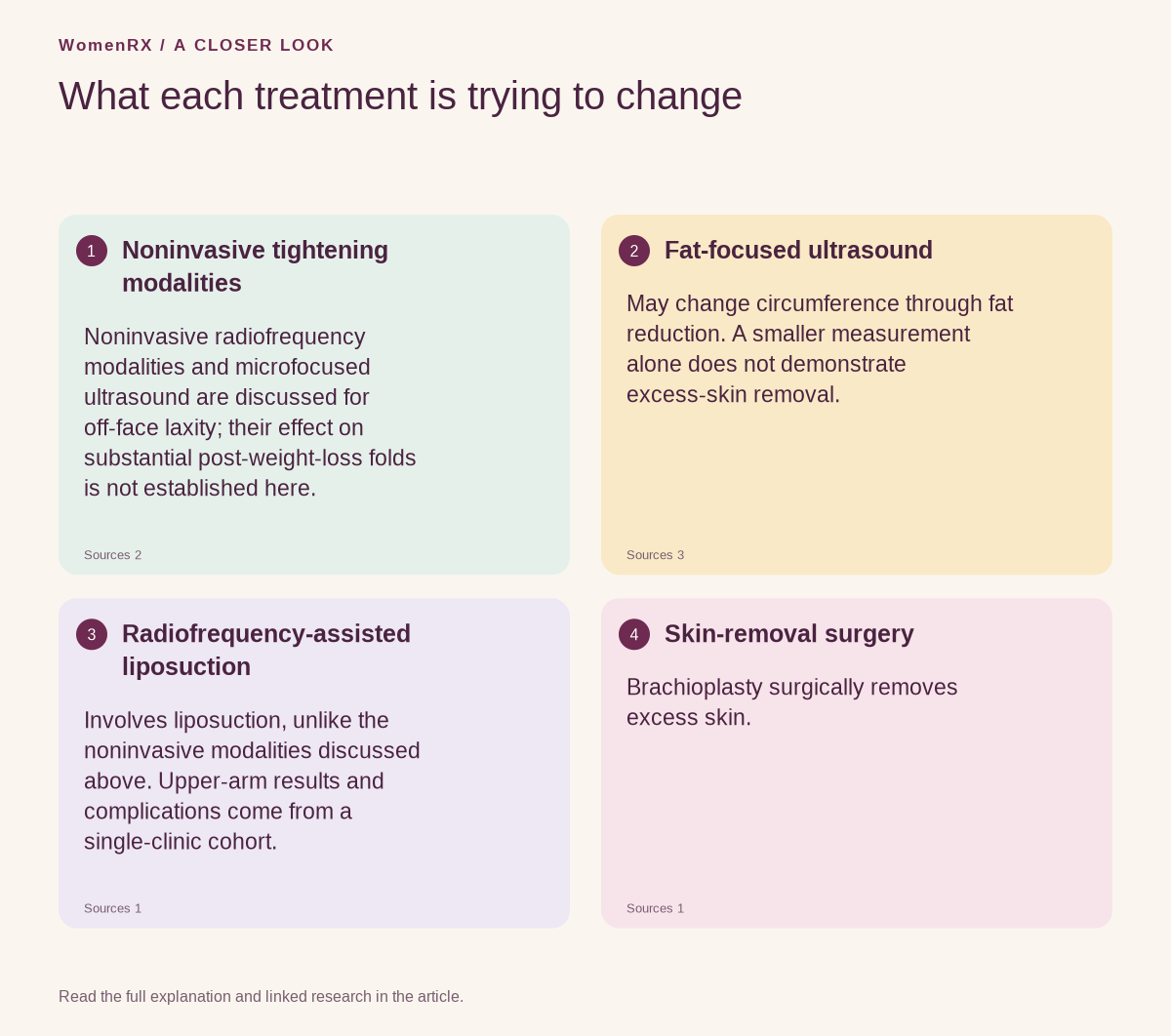
What each treatment is trying to change
Noninvasive tightening modalities: Noninvasive radiofrequency modalities and microfocused ultrasound are discussed for off-face laxity; their effect on substantial post-weight-loss folds is not established here.2
Fat-focused ultrasound: May change circumference through fat reduction. A smaller measurement alone does not demonstrate excess-skin removal.3
Radiofrequency-assisted liposuction: Involves liposuction, unlike the noninvasive modalities discussed above. Upper-arm results and complications come from a single-clinic cohort.1
Skin-removal surgery: Brachioplasty surgically removes excess skin.1
Read the figure as text
These categories answer different questions about skin, fat, and folds after weight loss.- Noninvasive tightening modalities: Noninvasive radiofrequency modalities and microfocused ultrasound are discussed for off-face laxity; their effect on substantial post-weight-loss folds is not established here.2
- Fat-focused ultrasound: May change circumference through fat reduction. A smaller measurement alone does not demonstrate excess-skin removal.3
- Radiofrequency-assisted liposuction: Involves liposuction, unlike the noninvasive modalities discussed above. Upper-arm results and complications come from a single-clinic cohort.1
- Skin-removal surgery: Brachioplasty surgically removes excess skin.1
More questions, answered
Does a smaller waist measurement mean the skin tightened?
Not necessarily. An ultrasound study designed around fat reduction reported smaller abdominal circumference, but that measure cannot distinguish fat loss from a meaningful reduction in excess skin. 3
Sources you can check
- Use of Radiofrequency-Assisted Liposuction (BodyTite) for Upper Arms Lifting.Tettamanzi M, Pili N, Rodio M, Serra PL, Trignano C, Rubino C, Trignano E. · Aesthetic plastic surgery · 2023Return to first citation
- A noninvasive approach to off-face skin laxity and tightening: a review of the literature.Jerdan K, Fabi S. · Seminars in cutaneous medicine and surgery · 2015Return to first citation
- Body Contouring By Ultrasound-Induced Lipolysis.Kapxhiu G, Blokh A, Orenstein A. · Journal of drugs in dermatology : JDD · 2026Return to first citation
- Clinical Evaluation of a Combination of Non-Invasive Technologies to Improve the Effectiveness of Postpartum Abdominal Treatment.Jun HLF, Lim T, Yue GTW, Hwee CC, Jie TX, Ong G, Shi YC, Wen DS, Wah LS. · Journal of cosmetic dermatology · 2025Return to first citation
- Histological and clinical dose-response analysis of radiofrequency microneedling treatment for skin rejuvenation.Nguyen L, Bartholomeusz J, Schneider SW, Herberger K. · Lasers in medical science · 2025Return to first citation