Facial Changes After Weight Loss: Options Beyond Fillers
Substantial weight loss can leave your face looking less full, but fillers aren’t the only way to respond.
“Ozempic face” is an informal label, not a diagnosis. Substantial weight loss can change facial fullness and leave skin looking looser, whether the weight loss comes from medication or another approach. 1 You can choose to do nothing, use skincare or makeup for appearance concerns, or seek an assessment if you’re considering a procedure. The useful first question is what, if anything, you want to change.
What changed: fullness, skin, or both?
A face that looks different after weight loss doesn’t point to a condition unique to semaglutide. People in a small study whose rapid weight loss followed medication, surgery, or behavioral changes reported concerns including reduced facial volume, reduced firmness, and loose skin. 1
Those descriptions aren’t interchangeable. Less fat beneath the skin can change the shape of a cheek or make a transition beneath the eye look more pronounced. Skin laxity affects how the skin sits over that shape. Surface concerns, such as dryness or visible wrinkles, are different again. They can happen together, which is why a product that improves how skin feels may not address the change in contour you notice. 1 2 3
You don’t need to fix any of these changes. If one bothers you, though, naming it makes the options easier to compare.
Four choices with different purposes
Wait. If you’re still getting used to your changed appearance, you can leave the decision open. Waiting avoids committing to a cosmetic treatment now. It isn’t a promise that lost fullness will return: neither the small cream study nor the injectable study below tested waiting as a way to restore facial volume. 1 3
Focus skincare on the surface. Skincare may be worth considering if your main concern is how dry your skin feels or how wrinkles look. In a 12-week study, 33 people experiencing rapid weight loss were given the same multi-ingredient cream; 29 completed the study. Researchers reported improvements in wrinkle appearance and measures including hydration. With no comparison group and only one product tested, the results can’t tell you whether another cream would do the same. They also don’t establish that a cream replaces lost facial fat. 1
Change the look without treating the tissue. Makeup, a different hairstyle, or neither may feel like the right choice. Makeup and styling can change which facial features you emphasize, but they aren’t treatments for lost volume. This is a matter of preference, not a step you have to try before asking about other options.
Get an assessment if you’re considering a procedure. Describe the specific change you see, such as flatter cheeks, looser-looking skin, or dryness. Ask what a proposed procedure is meant to address and what it’s unlikely to change. Facial changes after weight loss can involve more than one layer of tissue, so a treatment aimed at volume isn’t automatically the answer to every skin concern. 2
What procedure research does and doesn’t settle
Fillers aren’t necessary simply because you’ve lost weight. In one multicenter, open-label study, 41 people with facial changes after GLP-1 medication-related weight loss received a combination of poly-L-lactic acid and hyaluronic acid injectables. Researchers reported improvements in facial contour and skin-quality measures during follow-up. The study didn’t compare that regimen with waiting, skincare, or a single treatment, so it can’t tell you which choice is best or which injectable contributed most to the results. 3
If you want to discuss procedures without assuming you want filler, ask: Is the concern mainly contour, loose-looking skin, or surface texture? What is each proposed treatment intended to change? What would choosing no procedure mean for me? Those questions keep the conversation centered on your goal rather than the nickname for your face.
Does menopause change the decision?
The cream study included mostly women, with an average participant age of 49, but the overall results presented do not show whether outcomes varied by menopausal status. Don’t assume an option will work differently, or the same way, because you’re perimenopausal or postmenopausal. 1 Start with the change you actually notice and the amount of intervention you want, if any.
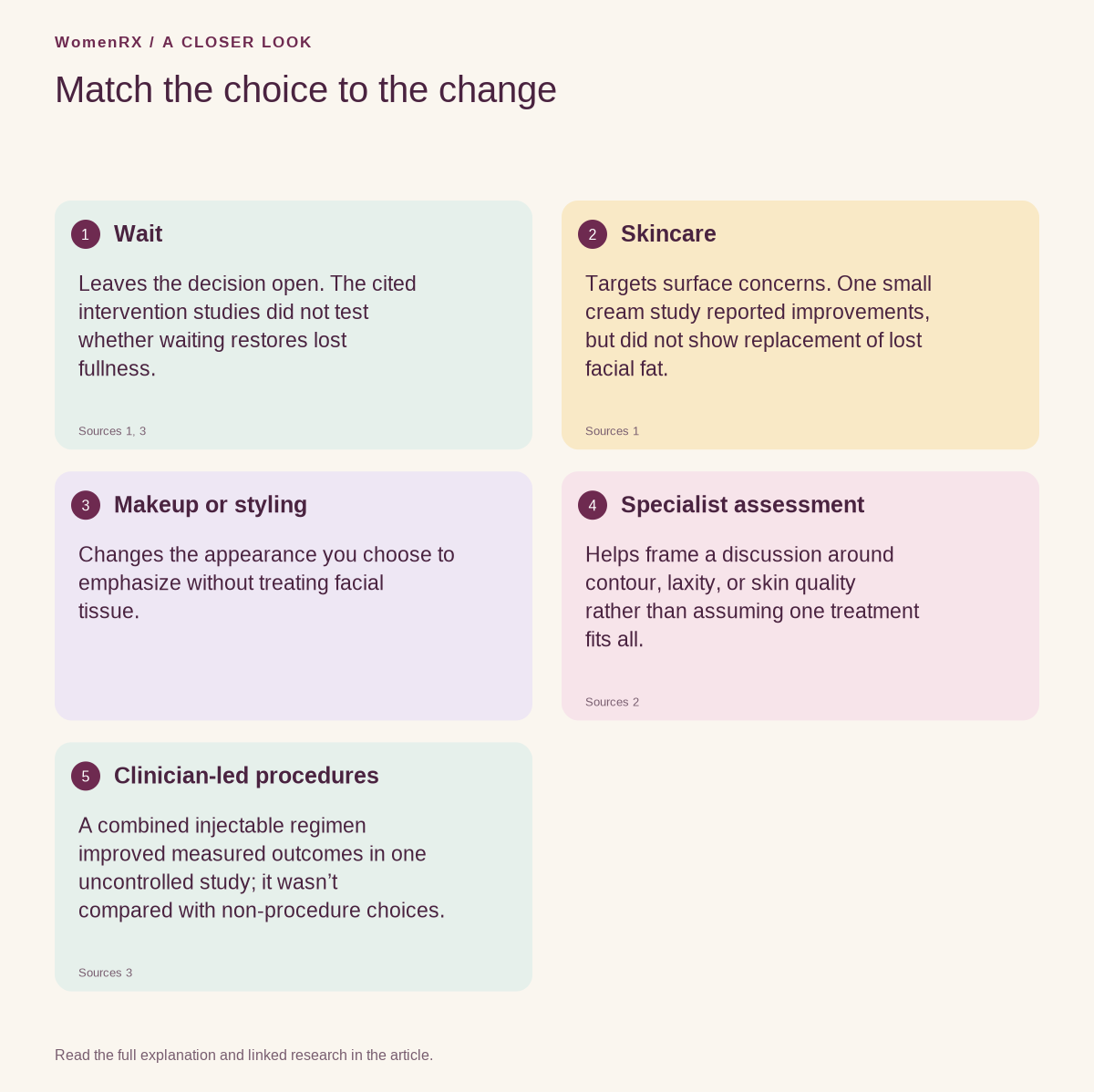
Match the choice to the change
Wait: Leaves the decision open. The cited intervention studies did not test whether waiting restores lost fullness.13
Skincare: Targets surface concerns. One small cream study reported improvements, but did not show replacement of lost facial fat.1
Makeup or styling: Changes the appearance you choose to emphasize without treating facial tissue.
Specialist assessment: Helps frame a discussion around contour, laxity, or skin quality rather than assuming one treatment fits all.2
Clinician-led procedures: A combined injectable regimen improved measured outcomes in one uncontrolled study; it wasn’t compared with non-procedure choices.3
Read the figure as text
Options differ in what they can address and how much they ask of you.- Wait: Leaves the decision open. The cited intervention studies did not test whether waiting restores lost fullness.13
- Skincare: Targets surface concerns. One small cream study reported improvements, but did not show replacement of lost facial fat.1
- Makeup or styling: Changes the appearance you choose to emphasize without treating facial tissue.
- Specialist assessment: Helps frame a discussion around contour, laxity, or skin quality rather than assuming one treatment fits all.2
- Clinician-led procedures: A combined injectable regimen improved measured outcomes in one uncontrolled study; it wasn’t compared with non-procedure choices.3
More questions, answered
Does semaglutide itself cause a distinct kind of facial aging?
Facial volume and skin changes have been described after substantial weight loss from medication and other approaches. The evidence cited here doesn’t establish a facial condition unique to semaglutide. 1 2
Sources you can check
- Topical Volumizing Cream Improves Facial Volume and Skin Health in Adults With Rapid Weight Loss From Pharmacologic (GLP-1/GIP Agonists), Surgical, or Behavioral Interventions.Nguyen N, Aguilar A, Afzal N, Lee A, Akram W, Duong MN, Sivamani RK. · Journal of cosmetic dermatology · 2026Return to first citation
- GLP-1-Induced Weight Loss and the Face: Anatomical Mechanisms and Rationale for Collagen-Stimulating and Volumizing Aesthetic Treatments.Frank K, Guertler A, Hoffmeister V, Kohler L, Nikolis A, Prantl L, Pupo D, Moellhoff N, Hopf M, Heiland M, Alfertshofer M. · Dermatologic surgery : official publication for American Society for Dermatologic Surgery [et al.] · 2026Return to first citation
- A Multicenter, Open-Label Study of Combined Poly-L-Lactic Acid and Hyaluronic Midface Filler Regimen Enhances Facial Harmony and Skin Quality in GLP-1 Medication Users.Lorenc ZP, Somenek M, Nguyen TQ, Garimella S, Hicks J, Le JHTD, Meckfessel MH. · Aesthetic surgery journal · 2026Return to first citation