Supporting Muscle During GLP-1-Associated Weight Loss
Lean-mass measurements can fall during GLP-1-based weight loss, but that change alone doesn’t tell you whether strength or physical function has declined.
Studies of GLP-1-based weight-loss treatment have found reductions in lean mass alongside larger reductions in fat mass. A lean-mass measurement and a strength test are different outcomes, so one doesn’t automatically tell you what happened to the other. Resistance exercise and adequate nutrition are sensible topics to discuss, but current evidence doesn’t show that either fully prevents lean-mass loss during treatment. 3 4 5
What a lean-mass change does, and doesn’t, tell you
Weight loss on GLP-1-based medicines can include decreases in both fat mass and lean mass. In a review summarizing a network meta-analysis of 22 randomized trials, the average reductions were 3.55 kg in total body weight, 2.95 kg in fat mass, and 0.86 kg in lean mass. The review reported that lean-mass loss was about one-quarter of total weight loss, while lean mass as a proportion of body weight was largely preserved. These are group averages across treatments and studies, not a forecast for any one person. 3
The term “lean mass” needs care. DXA-derived lean mass includes more than skeletal muscle, including other soft tissues and water. And a change in measured lean mass is not the same outcome as a change in strength or physical performance. That’s why a body-composition result, by itself, can’t establish that someone has developed muscle weakness or sarcopenia. 3
Short- to medium-term studies described in a review found that handgrip strength was generally preserved even when lean soft tissue decreased. The same review notes concerning findings from some longer-term observational research in older adults with type 2 diabetes, including reports of reduced grip strength with prolonged semaglutide use. These different kinds of evidence don’t settle the question for every patient, particularly people who already have less muscle or strength to spare. 4 5
Exercise and nutrition: worthwhile, not guaranteed protection
Resistance exercise and adequate nutrition are reasonable parts of a muscle-conscious weight-loss plan. Reviews identify resistance training and attention to protein intake as possible ways to support muscle during GLP-1 treatment. But the evidence that these measures prevent lean-mass loss specifically during treatment is limited. A review of muscle-strength studies also describes a study in young men and says adding tirzepatide to resistance and aerobic exercise may not confer additional strength benefits beyond exercise alone. That isn’t evidence that exercise is useless; it’s a reminder not to promise a medication-specific protective effect that hasn’t been established. 4 5
A review’s proposed supportive-care approach includes nutrition counseling, attention to adequate protein and overall nutritional intake, resistance exercise, and management of gastrointestinal symptoms. It doesn’t establish a universal protein target or a training prescription for everyone. Your needs may depend on your health, usual diet, activity, symptoms, and muscle reserve. 2
A useful conversation is specific. For example: “I’m eating less and finding it hard to get enough nutritious food. What would help me meet my needs while I’m on this treatment?” If food choices or meal size have become difficult, ask whether a registered dietitian could help adapt your eating pattern. The aim is to find an approach you can manage, not to force a particular food or exercise plan.
Track function alongside the scale
The scale can’t show whether weight lost came from fat, lean tissue, bone, or water. Body-composition measurements can add information, but their meaning depends on what was measured and how. For older adults, maintaining muscle and strength is a particular health priority. 1
Ask your care team which measures would be useful for you. Depending on your situation, that discussion might include changes in strength or everyday physical function as well as weight. Grip strength and usual walking speed are examples of measures highlighted in the muscle-health literature as relevant to function and health outcomes. A change in a scan or scale reading should be interpreted alongside how you’re doing physically, not treated as a diagnosis by itself. 3
What can these findings tell women at different life stages?
The pooled body-composition finding combines results across treatments and studies; it isn’t a comparison of cycling years, perimenopause, and postmenopause. It can’t, on its own, show whether lean-mass changes differ by menopause stage or are uniquely female. When a particular study seems relevant to you, useful questions are whether it included women your age and whether it reported their outcomes separately. 3
One strength-training study discussed in a review involved young men, which can’t answer how the same combination works for women or older adults. And a review of higher-risk groups identifies limited evidence on body composition in older adults and people with certain chronic conditions. If you’re older, have noticed declining strength, or have a condition that affects eating or muscle, it’s reasonable to ask how those factors shape your plan and what functional changes your care team wants to monitor. 4 5
The practical takeaway is not that muscle loss is inevitable, or that protein and exercise can prevent it completely. It’s that weight, body composition, and function answer different questions. Discuss a sustainable way to support nutrition and resistance activity, and pay attention to how your strength and everyday movement are changing as well as what the scale says.
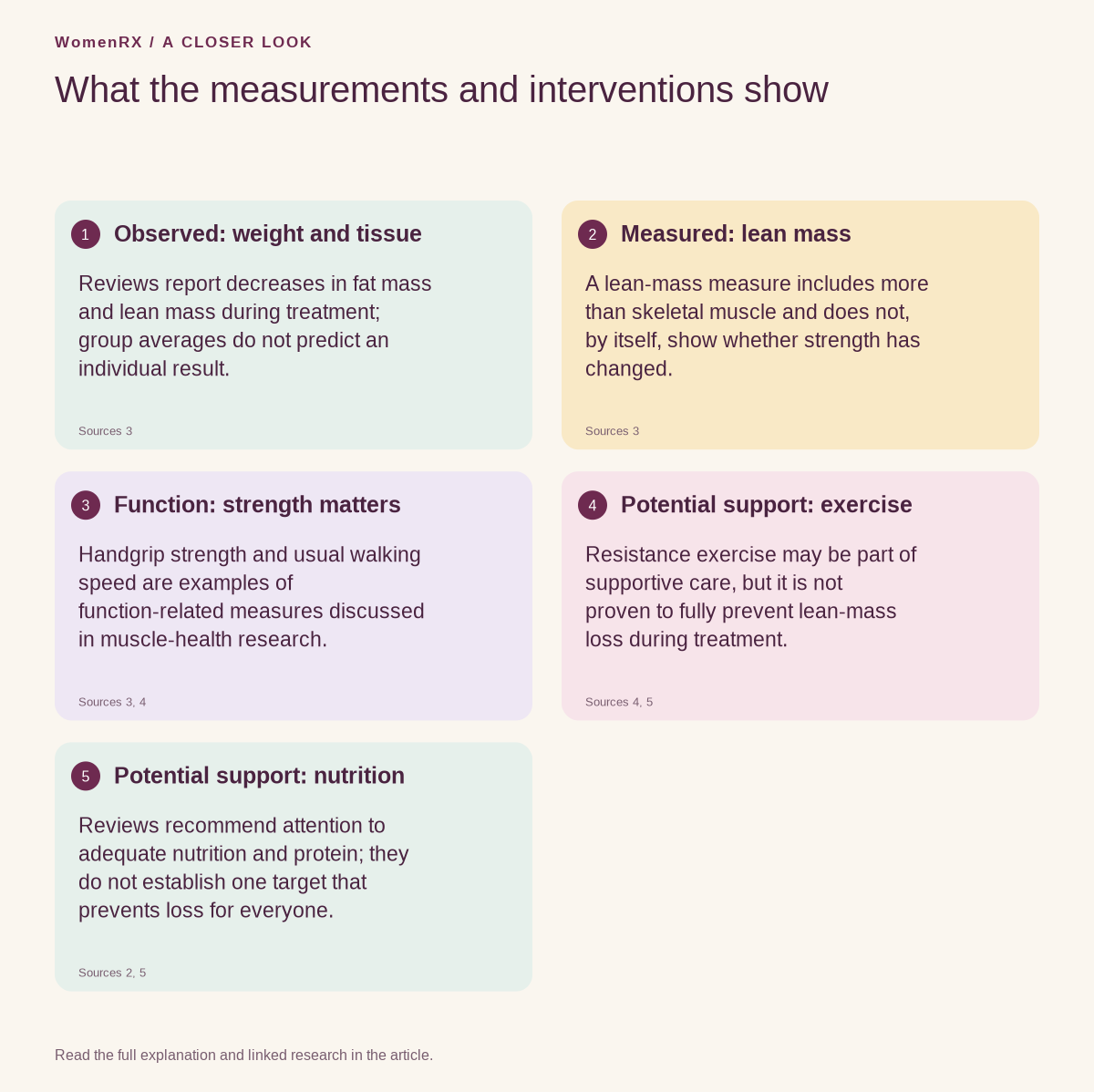
What the measurements and interventions show
Observed: weight and tissue: Reviews report decreases in fat mass and lean mass during treatment; group averages do not predict an individual result.3
Measured: lean mass: A lean-mass measure includes more than skeletal muscle and does not, by itself, show whether strength has changed.3
Function: strength matters: Handgrip strength and usual walking speed are examples of function-related measures discussed in muscle-health research.34
Potential support: exercise: Resistance exercise may be part of supportive care, but it is not proven to fully prevent lean-mass loss during treatment.45
Potential support: nutrition: Reviews recommend attention to adequate nutrition and protein; they do not establish one target that prevents loss for everyone.25
Read the figure as text
These distinctions help separate observed changes during treatment from evidence about what may support muscle health.- Observed: weight and tissue: Reviews report decreases in fat mass and lean mass during treatment; group averages do not predict an individual result.3
- Measured: lean mass: A lean-mass measure includes more than skeletal muscle and does not, by itself, show whether strength has changed.3
- Function: strength matters: Handgrip strength and usual walking speed are examples of function-related measures discussed in muscle-health research.34
- Potential support: exercise: Resistance exercise may be part of supportive care, but it is not proven to fully prevent lean-mass loss during treatment.45
- Potential support: nutrition: Reviews recommend attention to adequate nutrition and protein; they do not establish one target that prevents loss for everyone.25
More questions, answered
Does a lower lean-mass reading mean I have sarcopenia?
No. A lean-mass measurement alone doesn’t establish sarcopenia or show whether your strength has declined. Muscle strength and physical performance are also relevant to assessing muscle health. 3
Should I use a body-composition scan to monitor treatment?
A scan can provide body-composition information, but the result needs context: lean mass is not a direct measure of skeletal muscle or function. Ask whether a body-composition test would change decisions in your situation, and consider discussing strength or physical function too. 3
Sources you can check
- Body Weight: MedlinePlusAccessed 2026-09-25Return to first citation
- Lean Mass and Musculoskeletal Preservation in GLP-1-Based Obesity Treatment: Nutrition, Exercise, Supplementation, and Monitoring Strategies.Šantić R, Martinović L, Pavlović N, Rušić D, Kumrić M, Martinović D, Tičinović Kurir T, Božić J. · Metabolites · 2026Return to first citation
- Beyond Fat Loss: Addressing the Sarcopenia Challenge of Incretin-Based Therapies.Kim JY, Kim NH. · Diabetes & metabolism journal · 2026Return to first citation
- Glucagon-like peptide-1 receptor agonists and muscle strength changes in older adults: Risks beyond muscle mass reductions.Prokopidis K. · British journal of pharmacology · 2026Return to first citation
- Impact of GLP- 1 Receptor Agonist Therapy in Patients High Risk for Sarcopenia.Memel Z, Gold SL, Pearlman M, Muratore A, Martindale R. · Current nutrition reports · 2025Return to first citation