Understanding Muscle Changes During Tirzepatide Weight Loss
A change in measured lean mass isn’t the same as a measured loss of muscle strength or function.
Tirzepatide-related weight loss can include losses in both fat and lean mass, but a lean-mass measurement doesn’t tell you exactly how much skeletal muscle changed or whether your strength declined. Studies measure body composition in different ways, and results vary by outcome and analysis. Notice changes in everyday function as well as weight, and discuss nutrition and resistance activity in a way that fits your health and abilities. 2 5 6
What a lean-mass result can tell you
Weight loss isn’t made up entirely of fat. In its prescribing information, tirzepatide is described as reducing more fat mass than lean mass. That does not mean every person loses the same mix, or that a lean-mass change is automatically a loss of muscle strength. 2
“Lean mass” and “skeletal muscle” are related but not interchangeable terms. Body-composition research may report lean mass or total lean tissue, while skeletal muscle is a more specific tissue. One study in mice measured lean mass and separately assessed skeletal muscle using CT, illustrating that these are distinct measurements. That animal study doesn’t tell us what happens in people, but it shows why the measure named in a study matters. 3 6
A number on the scale is less specific still: body weight includes muscle, bone, fat, and water. It can’t show which of those changed. 1
Why study findings don’t all look the same
Two 2026 reviews offer different views of the body-composition results. A network meta-analysis of 41 trials involving several diabetes medicines found tirzepatide was associated with a reduction in lean body mass compared with placebo. A separate analysis of 43 randomized trials of GLP-1 medicines found reductions in lean mass for some treatments, including tirzepatide in certain analyses, but no significant difference in change in total lean tissue overall. 5 6
These results shouldn’t be treated as a direct estimate of what will happen to you. The reviews included different trial collections and outcomes: one compared a broader range of diabetes medicines, while the other focused on GLP-1-based medicines and reported several body-composition measures. Neither result tells you whether a particular person’s strength or daily function changed. 5 6
That distinction matters in practice. A scan or other body-composition result describes a measured tissue category. It does not, by itself, tell you whether you’re having more trouble getting up from a chair, carrying groceries, or doing an activity that used to feel manageable. Those examples aren’t a diagnostic test; they’re concrete changes you can mention when discussing your progress.
Make function part of the conversation
If you’re monitoring weight loss, consider noting whether everyday activities feel stable, easier, or harder, alongside the scale or any body-composition results. If you notice a change in strength or function, bring that detail to the person managing your treatment. Functional outcomes add context that a lean-mass figure alone cannot provide. A menopause-focused expert position statement also recommends considering muscle health and monitoring functional outcomes as part of care. 4
Age and starting health can shape what deserves attention. MedlinePlus notes that preserving muscle and strength is key for older adults. A menopause-focused position statement also calls for attention to skeletal muscle health and fracture risk in peri- and postmenopausal care. These points support taking baseline muscle health seriously, but they don’t establish that tirzepatide affects muscle differently for every age or menopause group. 1 4
Support that’s individualized, not one-size-fits-all
A 2026 position statement on incretin-based treatments in peri- and postmenopausal women includes resistance exercise and adequate protein intake in its recommended care framework. It does not establish a universal protein target or show that one routine prevents lean-mass change for everyone taking tirzepatide. Your food intake, exercise capacity, medical history, and starting muscle health all belong in the conversation. 4
You can ask what kind of movement is appropriate for your current strength and health, and how to make meals work when appetite is lower. If eating enough or doing your usual activities has become difficult, say so plainly. The goal isn’t to chase a particular scan result; it’s to understand what is changing and support your health and function while weight changes.
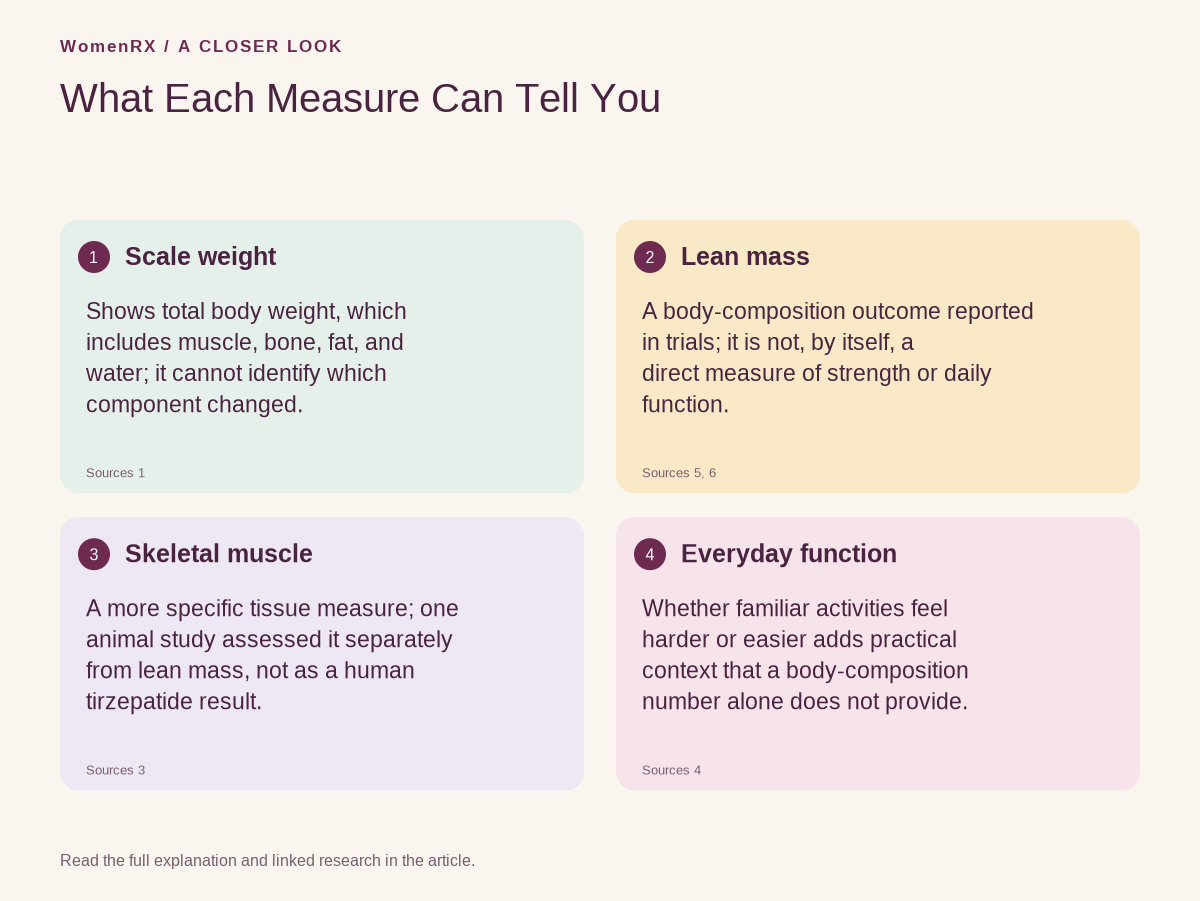
What Each Measure Can Tell You
Scale weight: Shows total body weight, which includes muscle, bone, fat, and water; it cannot identify which component changed.1
Lean mass: A body-composition outcome reported in trials; it is not, by itself, a direct measure of strength or daily function.56
Skeletal muscle: A more specific tissue measure; one animal study assessed it separately from lean mass, not as a human tirzepatide result.3
Everyday function: Whether familiar activities feel harder or easier adds practical context that a body-composition number alone does not provide.4
Read the figure as text
Body weight, lean-mass results, and everyday function answer different questions. Keeping them distinct makes changes easier to discuss.- Scale weight: Shows total body weight, which includes muscle, bone, fat, and water; it cannot identify which component changed.1
- Lean mass: A body-composition outcome reported in trials; it is not, by itself, a direct measure of strength or daily function.56
- Skeletal muscle: A more specific tissue measure; one animal study assessed it separately from lean mass, not as a human tirzepatide result.3
- Everyday function: Whether familiar activities feel harder or easier adds practical context that a body-composition number alone does not provide.4
More questions, answered
Does a lower lean-mass number prove I lost muscle?
No. Lean mass and total lean tissue are body-composition outcomes, not direct measures of strength or everyday function. The measure used matters, and body weight alone also includes water, bone, fat, and muscle. 1 6
Is muscle loss known to be different after menopause?
The menopause-focused position statement recommends attention to muscle health and functional outcomes, but says tirzepatide needs menopause-specific evaluation. Current information here doesn’t establish a different muscle response by menopause status. 4
Sources you can check
- Body Weight: MedlinePlusAccessed 2026-09-25Return to first citation
- ZEPBOUND (TIRZEPATIDE) INJECTION, SOLUTION ZEPBOUND (TIRZEPATIDE) INJECTION, SOLUTION ZEPBOUND KWIKPEN (TIRZEPATIDE) INJECTION, SOLUTION [ELI LILLY AND COMPANY] | US prescribing information and patient instructionsAccessed 2026-09-25Return to first citation
- Efficacy of GLP-1 analog peptides, semaglutide, tirzepatide, and retatrutide on MC4R deficient obesity and their comparison.Hitaka K, Sugawara T, Matsumoto M, Nio Y. · International journal of obesity (2005) · 2026Return to first citation
- Incretin-based therapies in peri- and postmenopausal women with obesity: an expert position statement from the Spanish Menopause Society.Sánchez-Prieto M, Romero-Domínguez M, Orozco R, Lilue M, Lubián-López DM, González SP, Nieto A, Coronado P, Sánchez-Borrego R, Cano A, Castelo-Branco C, Palacios S, Young Investiga... · Maturitas · 2026Return to first citation
- Comparative Effects of Antidiabetic Drugs on Body Composition: A Systematic Review and Network Meta-Analysis.Rakhsha SS, Shahinfar H, Ebrahimi-Mousavi S, Kosari A, Aali Y, Mirzababaei A, Hosseini SA, Jadidi P, Shafiee G, MansourZadeh MJ, Heshmat R, Mastouri D. · Diabetes, obesity & metabolism · 2026Return to first citation
- Comparative Effects of Individual Glucagon-Like Peptide-1 Receptor Agonist-Based Medications on Direct Measurement of Body Composition Among Adults With Overweight or Obesity With or Without Type 2 Diabetes: A Systematic Review and Network Meta-Analysis of Randomised Controlled Trials.Wachiraphansakul N, Vongchaiudomchoke T, Manosroi W, Ruengorn C, Noppakun K, Ngamvichchukorn T, Sood MM, Thavorn K, Hutton B, Nochaiwong S. · Diabetes, obesity & metabolism · 2026Return to first citation