Creatine During GLP-1 Treatment: What Muscle Evidence Shows
Creatine has been studied in other weight-loss and exercise settings, but its ability to preserve muscle during GLP-1 treatment hasn’t been established.
It’s not known whether creatine preserves muscle during treatment with a GLP-1 medicine. A review estimates that lean mass accounts for part of the weight lost with these medicines, but that estimate doesn’t tell you how strength or function changes. Studies of creatine in other settings offer clues, not proof for this combination. Nutrition and resistance exercise are useful parts of the discussion, too. 5 3 4
Weight loss and muscle are related, but not interchangeable
The scale can show that your weight changed, but not whether the change came from fat, muscle, bone, or water. A review of incretin-based weight-loss treatments estimates that 25-40% of weight lost may be lean mass. That’s a review-level estimate, not a prediction for an individual, and lean mass isn’t the same measure as muscle strength or everyday function. The review says strength and function remain underexplored. 5 2
That distinction matters when asking whether a supplement is helping. A change in lean mass alone doesn’t tell you whether you’re getting stronger, finding everyday activities easier, or preserving physical function.
What creatine studies can, and can’t, tell us
The key question is whether creatine protects muscle specifically during GLP-1 treatment. That benefit hasn’t been established. A review discusses creatine among possible muscle-preserving strategies, but also calls for more research on approaches to preserve muscle during incretin-based treatment. Results from other settings can’t fill that gap. 5
One small study offers a result in women, but not in women using a GLP-1 medicine. Fifteen women recovering from bariatric surgery completed an eight-week strength-training program and were assigned to creatine or placebo. Researchers found no significant difference between the groups in muscle-mass loss. Surgery and recovery are different from medication-assisted weight loss, so this study can’t settle the GLP-1 question. 3
Another study included 64 adults ages 45-65, 40 women and 24 men. During a 12-week exercise and weight-loss diet intervention, the creatine group showed an increase in lean tissue and improvements in strength and endurance. Those findings were reported for the group overall, not separately for women and men. The study didn’t test GLP-1 treatment, and it doesn’t show whether the results apply to a particular woman or life stage. 4
Keep food and strength activity in the picture
Creatine is only one part of the question. The review discusses exercise and adequate protein intake as strategies relevant to preserving muscle during weight loss. In the mixed-sex study, creatine was examined as part of an exercise and diet program, not as a replacement for either. These findings don’t set a personal protein target or exercise plan, but they support discussing both alongside any supplement. 5 4
If treatment makes it hard to eat enough to meet your energy and nutrient needs, bring that up directly. A healthy eating plan should meet those needs while taking your preferences and circumstances into account. 1
You might ask your prescribing clinician or a registered dietitian:
- “What are we looking at besides my weight, such as strength or how I’m functioning?”
- “How can I meet my nutrition needs while my appetite or eating pattern is changing?”
- “What resistance exercise is appropriate for my health and abilities?”
- “Would creatine make sense for me, given my health and treatment?”
Those questions keep the focus on your actual goals. Current findings don’t show that adding creatine will offset muscle changes during GLP-1 treatment.
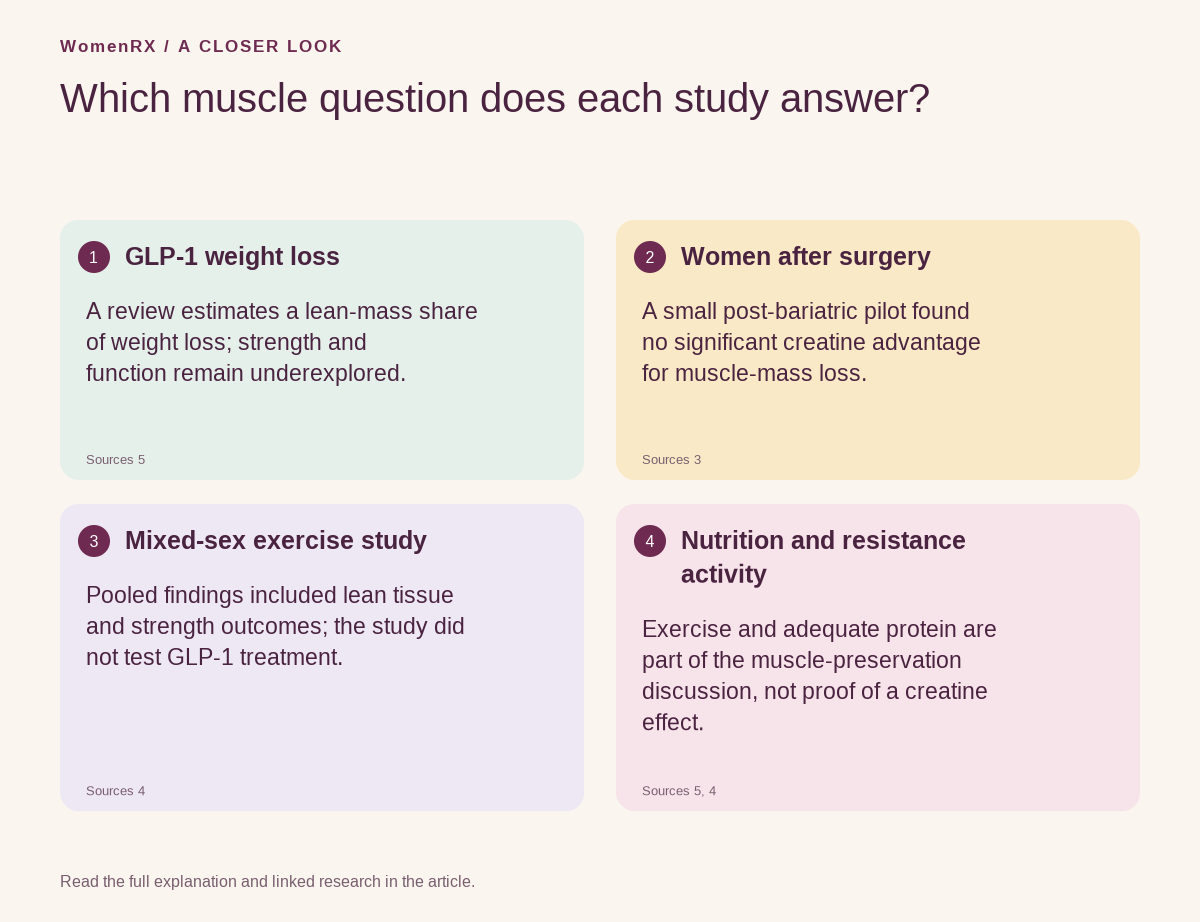
Which muscle question does each study answer?
GLP-1 weight loss: A review estimates a lean-mass share of weight loss; strength and function remain underexplored.5
Women after surgery: A small post-bariatric pilot found no significant creatine advantage for muscle-mass loss.3
Mixed-sex exercise study: Pooled findings included lean tissue and strength outcomes; the study did not test GLP-1 treatment.4
Nutrition and resistance activity: Exercise and adequate protein are part of the muscle-preservation discussion, not proof of a creatine effect.54
Read the figure as text
These findings come from different settings. The comparison shows why creatine results outside GLP-1 treatment don’t establish a benefit during it.- GLP-1 weight loss: A review estimates a lean-mass share of weight loss; strength and function remain underexplored.5
- Women after surgery: A small post-bariatric pilot found no significant creatine advantage for muscle-mass loss.3
- Mixed-sex exercise study: Pooled findings included lean tissue and strength outcomes; the study did not test GLP-1 treatment.4
- Nutrition and resistance activity: Exercise and adequate protein are part of the muscle-preservation discussion, not proof of a creatine effect.54
Sources you can check
- Nutrition: MedlinePlusAccessed 2026-09-25Return to first citation
- Body Weight: MedlinePlusAccessed 2026-09-25Return to first citation
- Creatine Supplementation Prior to Strength Exercise Training Is Not Superior in Preventing Muscle Mass Loss Compared with Standard Nutritional Recommendations in Females After Bariatric Surgery: A Pilot Study.Diaz-Pizarro M, Pino-Zúñiga J, Gálvez MO, Vesga CR, Tello RL, Seguro JCD, Cancino-Lopez J. · Obesity surgery · 2024Return to first citation
- Effects of creatine supplementation with and without exercise and diet intervention on body composition, cognitive function, and markers of health in middle-aged and older adults.Chun J, Liu Y, Kibler GL, Lee H, Babakhani K, Rhoades N, Bivins I, Ko J, Dickerson B, Gonzalez DE, Sowinski RJ, Rasmussen CJ, Kreider RB. · Journal of the International Society of Sports Nutrition · 2026Return to first citation
- Preserving the Metabolic Engine: Muscle as the Therapeutic Target for Cardiovascular Prevention in Obesity Pharmacotherapy.Sanchis-Gomar F, Neeland IJ, Ruiz-Lozano P, Alnahar O, Rodriguez F. · Current cardiology reports · 2025Return to first citation