Creatine After Menopause: What the Evidence Shows
For postmenopausal women, creatine’s clearest possible benefit is a modest gain in muscle alongside resistance training, not a proven boost to bone density.
Studies in postmenopausal women suggest creatine may add a small amount of lean mass and improve leg-press strength, with benefits most evident when it’s paired with resistance training. The evidence is about postmenopause, not perimenopause specifically. Results for bone density are not convincing, and creatine is best viewed as an optional add-on to strength training, not a replacement for it. 23
What the postmenopause studies suggest
The most directly relevant evidence is a 2026 systematic review and meta-analysis of seven randomized trials involving 608 postmenopausal women. Participants’ mean age was about 62, and the studies lasted from 12 weeks to two years. Across five trials, creatine was associated with an average 0.37 kg more lean mass than placebo. The confidence interval was 0.05 to 0.69 kg, while the range of effects expected across settings included no benefit. That points to a modest average effect, not a guaranteed change for an individual. 2
For strength, three trials involving 111 women found an average 7.5 kg advantage in leg-press one-repetition maximum with creatine. The review reported benefits most clearly when creatine was combined with resistance training; trials using lower amounts without resistance training showed no measurable effect. Those findings describe the study conditions. They aren’t a personal dose recommendation. 2
Menopausal status matters when interpreting this evidence. The review specifically included postmenopausal women. A separate review of strength-training studies defined postmenopause as at least one year without menstruation. These findings shouldn’t be assumed to show the same effect during perimenopause, when the transition is still underway. 23
The training context is part of the answer
If your goal is to get stronger, resistance training is the foundation, not the supplement. A systematic review of postmenopausal women found that structured strength training consistently improved strength and body composition, and could improve bone mineral density. Evidence for adding nutritional supplements, including creatine, was much more limited. 3
That makes creatine most relevant if you’re already working toward a strength goal and want to consider a possible extra gain in muscle or performance. It can’t substitute for the training stimulus. And the group averages don’t tell you whether you personally will notice a difference, or how quickly.
Bone density and other menopause symptoms
Creatine hasn’t shown a dependable bone-density benefit in this evidence. The postmenopause-specific meta-analysis found bone density unchanged overall, while noting that evidence on bone health remained unclear. If bone health is your main reason for considering creatine, the current findings don’t establish it as a bone-building strategy. 2
The reviewed outcomes centered on lean mass, strength, bone health, physical function, and safety. They don’t establish creatine as a treatment for hot flashes, sleep changes, or other menopause symptoms. 2
Safety: what the studies can and can’t tell you
In the postmenopausal trials summarized by the meta-analysis, reported adverse events were mild and similar between creatine and placebo, and kidney-related measures were unchanged. These are reassuring findings for the participants studied, but they don’t settle suitability for every person or every health situation. 2
A broader systematic review of human studies across different ages, sexes, and health conditions found no statistically significant change in glomerular filtration rate overall. It also explains that creatine can affect blood creatinine, a marker used in some kidney-function estimates, so a creatinine result alone may not give the full picture in someone taking creatine. 1
If you’re weighing creatine, the practical question is whether its possible, modest contribution to a strength goal is worth adding to your routine. Your health history and the medicines or supplements you already use may affect that decision. If you do discuss it with a clinician, mention creatine before kidney-related blood tests so the result can be interpreted in context. These findings support a conversation about individual suitability, not a universal safety verdict. 12
A useful way to decide
Start with the outcome you care about. For a strength or muscle goal, the postmenopausal evidence is more encouraging when creatine is paired with resistance training. For bone density, the evidence doesn’t show a clear added benefit. For perimenopause specifically, these studies don’t give a direct answer. That distinction can help you decide whether creatine is relevant to your goal, rather than treating it as a general menopause supplement. 23
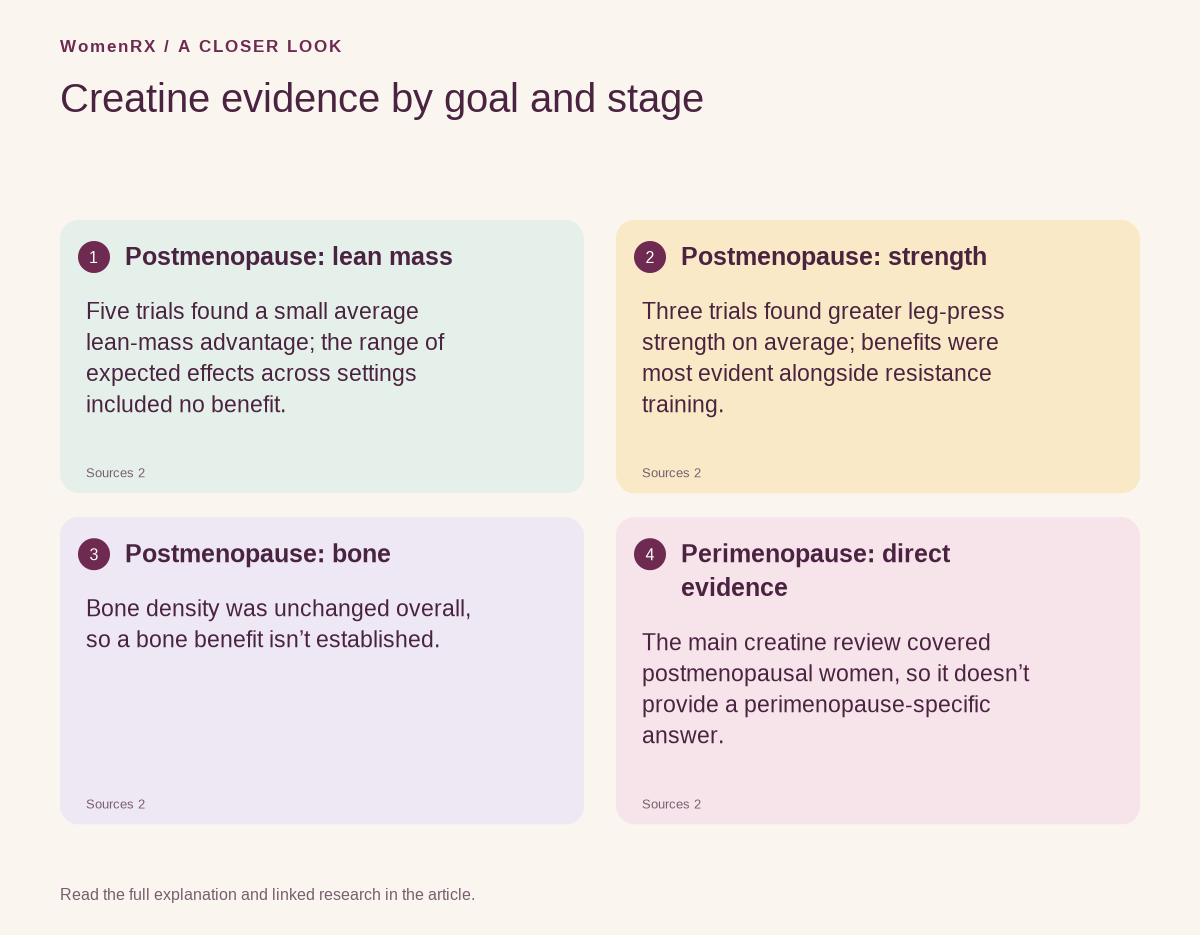
Creatine evidence by goal and stage
Postmenopause: lean mass: Five trials found a small average lean-mass advantage; the range of expected effects across settings included no benefit.2
Postmenopause: strength: Three trials found greater leg-press strength on average; benefits were most evident alongside resistance training.2
Postmenopause: bone: Bone density was unchanged overall, so a bone benefit isn’t established.2
Perimenopause: direct evidence: The main creatine review covered postmenopausal women, so it doesn’t provide a perimenopause-specific answer.2
Read the figure as text
The strongest direct evidence is in postmenopausal women; the outcome and training context change how useful the findings may be.- Postmenopause: lean mass: Five trials found a small average lean-mass advantage; the range of expected effects across settings included no benefit.2
- Postmenopause: strength: Three trials found greater leg-press strength on average; benefits were most evident alongside resistance training.2
- Postmenopause: bone: Bone density was unchanged overall, so a bone benefit isn’t established.2
- Perimenopause: direct evidence: The main creatine review covered postmenopausal women, so it doesn’t provide a perimenopause-specific answer.2
More questions, answered
Does the research show the same benefit during perimenopause?
The main review summarized trials in postmenopausal women; it doesn’t establish a specific effect during perimenopause. You shouldn’t assume the results apply equally across both stages. 2
Is creatine a substitute for strength training?
No. Strength training itself has consistent benefits for strength and body composition in postmenopausal women. The creatine findings are best understood as a possible add-on, especially alongside resistance training. 23
Sources you can check
- Effect of creatine supplementation on kidney function: a systematic review and meta-analysis.Naeini EK, Eskandari M, Mortazavi M, Gholaminejad A, Karevan N. · BMC nephrology · 2025Return to first citation
- Creatine monohydrate for lean mass, strength, and bone density in postmenopausal women: a systematic review and meta-analysis.Naddafha S, Antonio J, Kreider RB, Stout JR. · Journal of the International Society of Sports Nutrition · 2026Return to first citation
- Analysis of the Additive Effects of Nutritional Strategies in Strength Training Interventions on Body Composition, Muscle Strength and Bone Mineral Density in Postmenopausal Women: A Systematic Review.Walter F, Schalla J, Bloch W, Diel P, Geisler S, Isenmann E. · Sports medicine - open · 2026Return to first citation