Creatine for Strength: What It Can and Can’t Do
Creatine may help with repeated high-intensity exercise, while its healthy-aging benefits depend on the outcome measured.
Creatine monohydrate has its clearest evidence for strength, power, and repeated high-intensity efforts, not endurance exercise. In postmenopausal women, a review found small average gains in lean mass and leg-press strength, but no overall bone-density benefit. A creatinine blood-test result is a separate question: creatine use is relevant context, but a study average can’t explain your individual result. 1 5 2
Match the supplement to the goal
Creatine helps supply muscles with energy for short, intense efforts. Across numerous trials, the NIH Office of Dietary Supplements finds generally favorable results for high-intensity, intermittent activity, including measures of strength, power, and work during maximal muscle contractions. It finds little value for endurance sports. If your goal is getting more from repeated lifting efforts, creatine is more relevant than it is for a long, steady workout. Responses still vary. 1
A useful distinction is what a study measured. In a 14-day randomized trial of 29 healthy young adults, including 12 women, creatine monohydrate increased creatine content in muscle compared with the study’s other groups. That shows the supplement reached the target tissue; the trial did not establish lasting strength gains or healthier aging. 3
What changes after menopause?
The most directly relevant review for postmenopausal women combined seven randomized, placebo-controlled trials with 608 participants. For lean mass, five trials involving 338 women found an average between-group difference of 0.37 kg favoring creatine. For leg-press strength, three trials involving 111 women found a 7.5 kg difference favoring creatine. Those are averages comparing groups, not amounts an individual woman should expect to gain. The review found no overall improvement in bone density. 5
These findings make strength training and creatine a more plausible pairing than creatine alone as a broad anti-aging strategy. In the review, benefits were evident in trials that combined resistance training with at least 5 g of creatine per day; trials using 3 g per day or less without resistance training found no measurable effect. Because both the amount and the training differed, that comparison doesn’t prove that the larger amount alone produced the benefit or establish a regimen for everyone. Most included trials had some risk-of-bias concerns, and the range of effects predicted for a future lean-mass study included no benefit. 5
A separate 10-week trial enrolled 45 older men and women. Both groups doing resistance training gained strength, with a larger average gain across the tested exercises in the creatine group than in the placebo group. It did not report a women-specific result or participants’ menopause stage, so it cannot show whether that difference applies specifically to older women. 2
Research spanning women’s reproductive stages is less clear than a pooled headline might suggest. One review included 14 trials of supplements paired with exercise, but only three tested creatine; the rest assessed other nutritional supplements. Its combined strength results therefore cannot be attributed to creatine alone. The postmenopausal findings shouldn’t be assumed to apply unchanged during cycling years or perimenopause. 4 5
Choosing a product without buying extra claims
Creatine monohydrate is the form with the clearest support in these studies. In the young-adult trial, monohydrate increased muscle creatine content, while creatyl-L-leucine did not. That doesn’t test every product or prove every other form ineffective. It does give you a practical question for a label: is this the form that was studied, or is the product asking you to assume another form works the same way? 3
A single-ingredient product is also easier to compare with creatine research than a proprietary blend. Combination products may contain widely varying amounts, and some labels don’t disclose how much of each ingredient a blend contains. Evidence for creatine by itself cannot establish the benefits or safety of a combination that hasn’t been tested. 1
Weight gain from water retention is a reported effect of creatine. If you’re using the scale to judge a training plan, an early change in weight isn’t, by itself, proof of new muscle. 1
Creatine use and a creatinine test
The names are easy to mix up: creatine is the supplement, while creatinine is a measurement that can appear on blood tests. In the small trial of older adults, creatinine rose in the resistance-training group taking creatine. By contrast, the review of postmenopausal trials reported no overall change in renal indices and found adverse events were mild and similar to placebo. These results don’t settle what a change in your own test means or establish long-term safety for every health situation. If you have kidney-related lab work, tell the person interpreting it that you use creatine. 2 5
The training studies also don’t answer whether creatine is appropriate during pregnancy. Exercise-performance findings and trials in postmenopausal women should not be used as pregnancy-safety evidence. 1 5
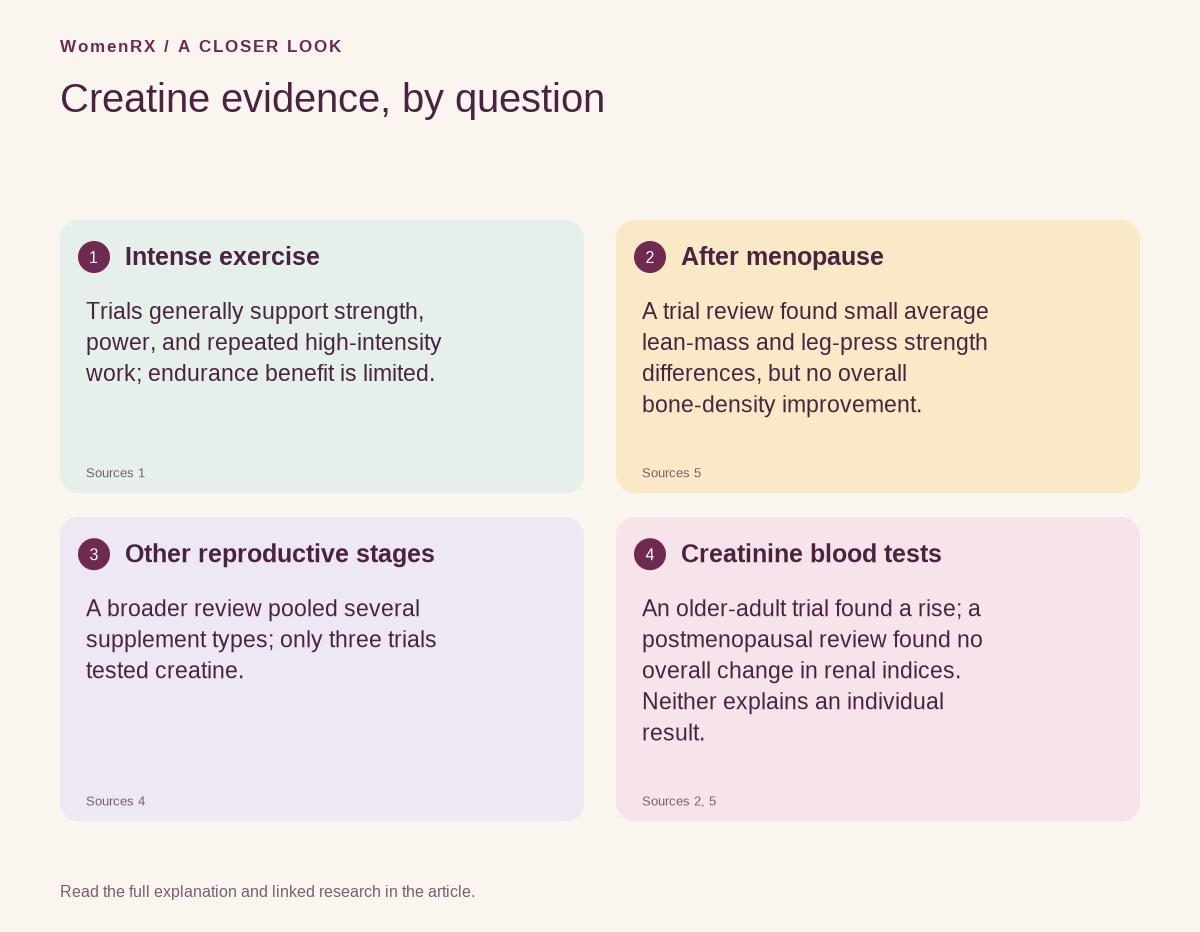
Creatine evidence, by question
Intense exercise: Trials generally support strength, power, and repeated high-intensity work; endurance benefit is limited.1
After menopause: A trial review found small average lean-mass and leg-press strength differences, but no overall bone-density improvement.5
Other reproductive stages: A broader review pooled several supplement types; only three trials tested creatine.4
Creatinine blood tests: An older-adult trial found a rise; a postmenopausal review found no overall change in renal indices. Neither explains an individual result.25
Read the figure as text
The answer changes depending on who was studied and what the researchers measured.- Intense exercise: Trials generally support strength, power, and repeated high-intensity work; endurance benefit is limited.1
- After menopause: A trial review found small average lean-mass and leg-press strength differences, but no overall bone-density improvement.5
- Other reproductive stages: A broader review pooled several supplement types; only three trials tested creatine.4
- Creatinine blood tests: An older-adult trial found a rise; a postmenopausal review found no overall change in renal indices. Neither explains an individual result.25
Sources you can check
- Dietary Supplements for Exercise and Athletic Performance - Health Professional Fact SheetAccessed 2026-09-25Return to first citation
- The role of resistance training and creatine supplementation on oxidative stress, antioxidant defense, muscle strength, and quality of life in older adults.Amiri E, Sheikholeslami-Vatani D. · Frontiers in public health · 2023Return to first citation
- Creatine Monohydrate Supplementation, but not Creatyl-L-Leucine, Increased Muscle Creatine Content in Healthy Young Adults: A Double-Blind Randomized Controlled Trial.Askow AT, Paulussen KJM, McKenna CF, Salvador AF, Scaroni SE, Hamann JS, Ulanov AV, Li Z, Paluska SA, Beaudry KM, De Lisio M, Burd NA. · International journal of sport nutrition and exercise metabolism · 2022Return to first citation
- Nutritional Supplementation Combined with Exercise for Musculoskeletal Health in Women: A Systematic Review and Meta-Analysis Evaluating Proteins, Amino Acids, and Creatine across Reproductive Stages.Chen KH, Yeh TP, Lin SC, Liu PJ, Bai D, Chen IH. · International journal of medical sciences · 2026Return to first citation
- Creatine monohydrate for lean mass, strength, and bone density in postmenopausal women: a systematic review and meta-analysis.Naddafha S, Antonio J, Kreider RB, Stout JR. · Journal of the International Society of Sports Nutrition · 2026Return to first citation