Creatine and Strength: How to Track What Changes
Creatine’s value is best judged by your training results, not a promised timeline or a change on the scale.
If you’re considering creatine, decide what you want to improve, then record the same lifts and training details consistently. Research suggests some strength and power measures improve with creatine plus resistance training, but results vary by test and population. In a large review, several outcomes improved overall, while the female subgroups did not show significant changes in the measures reported. 2
Creatine isn’t necessary to get stronger, and the strength findings below don’t establish a predictable timeline for when you might notice a difference. A useful way to judge it is to separate how you perform in training from what the scale says, and keep the rest of your routine as consistent as you can.
Choose an outcome before you start
Pick one or two results that matter to you. For example, you might want to do more repetitions at a familiar weight, lift more while keeping your form consistent, or produce more power in a sport-specific effort. Write down your starting point and how you’ll measure progress.
A training log can include the exercise, weight, repetitions, sets, and how challenging the work felt. Also note changes in your program, such as missed sessions, new exercises, or a change in technique. These details help you avoid crediting creatine for progress that may reflect a different training plan or more consistent workouts.
Try to compare like with like: the same exercise, equipment, range of motion, and testing approach. Strength-test results aren’t interchangeable. A 2025 meta-analysis of 69 studies and 1,937 adults found small average improvements with creatine plus resistance training in bench or chest press and squat strength, vertical jump, and Wingate peak power compared with placebo. It did not find statistically significant overall improvements in handgrip or leg-press strength. 2
Those findings are averages across studies, not a prediction for you. They also show why it helps to choose a measure that matches your goal rather than treating one lift, a jump test, or a scale reading as a complete picture of progress.
Keep training results separate from body weight
If body composition matters to you, record it separately from performance. A change in body weight doesn’t by itself tell you whether your strength improved, and a stronger lift doesn’t reveal what caused a weight change.
One two-year randomized trial studied 237 postmenopausal women who followed resistance training and walking while taking creatine monohydrate or placebo. Both groups improved their bench press and hack squat strength, but creatine did not add a significant strength benefit on those tests. Lean tissue mass was higher with creatine in a subanalysis of participants who completed the study, a result that shouldn’t be treated as a prediction of scale change for an individual. 3
If you track weight, use the same conditions each time and look at the pattern rather than interpreting one reading. You can keep that record private or skip it if it doesn’t help you make a decision. It isn’t a substitute for measuring the outcome you actually care about.
What the evidence says about women
The broad strength meta-analysis included a subgroup analysis by sex. It reported significant improvements for males in some measures, including leg press, squat, vertical jump, and Wingate peak power, but did not find significant improvements in those measures for females. That does not prove women can’t benefit; it means the results reported for women were less conclusive. The review called for more well-powered studies in underrepresented groups, including women. 2
Evidence in postmenopausal women is also specific to the setting and outcomes studied. In the two-year trial, creatine did not add to strength gains on the measured lifts, although the completer subanalysis found a difference in lean tissue mass. A smaller randomized study of older adults included both women and men, but its reported results don’t provide a women-only estimate. 3 1
These findings don’t establish whether effects differ across menstrual-cycle phases or apply during pregnancy. Nor should results in postmenopausal women be assumed to apply to every woman. If one of those contexts applies to you, raise it when discussing whether supplementation fits your circumstances.
Make the decision about your actual routine
Creatine is a possible addition to training, not a replacement for training or a guarantee of a particular result. Before starting, clarify what product and ingredient you’re considering and discuss whether your health history, medicines, other supplements, or pregnancy plans affect your decision. The exercise studies summarized here don’t answer those personal safety questions or establish a safety plan for every situation.
If you do decide to try it, keep your training plan and tracking approach steady enough to interpret what happens. Don’t change several supplements or major parts of your program at once if your goal is to judge creatine’s contribution. At review points you choose, ask: Did the outcome I selected change? Was my training consistent? Did I also change my program, diet, or routine? If the result isn’t useful to you, that matters too.
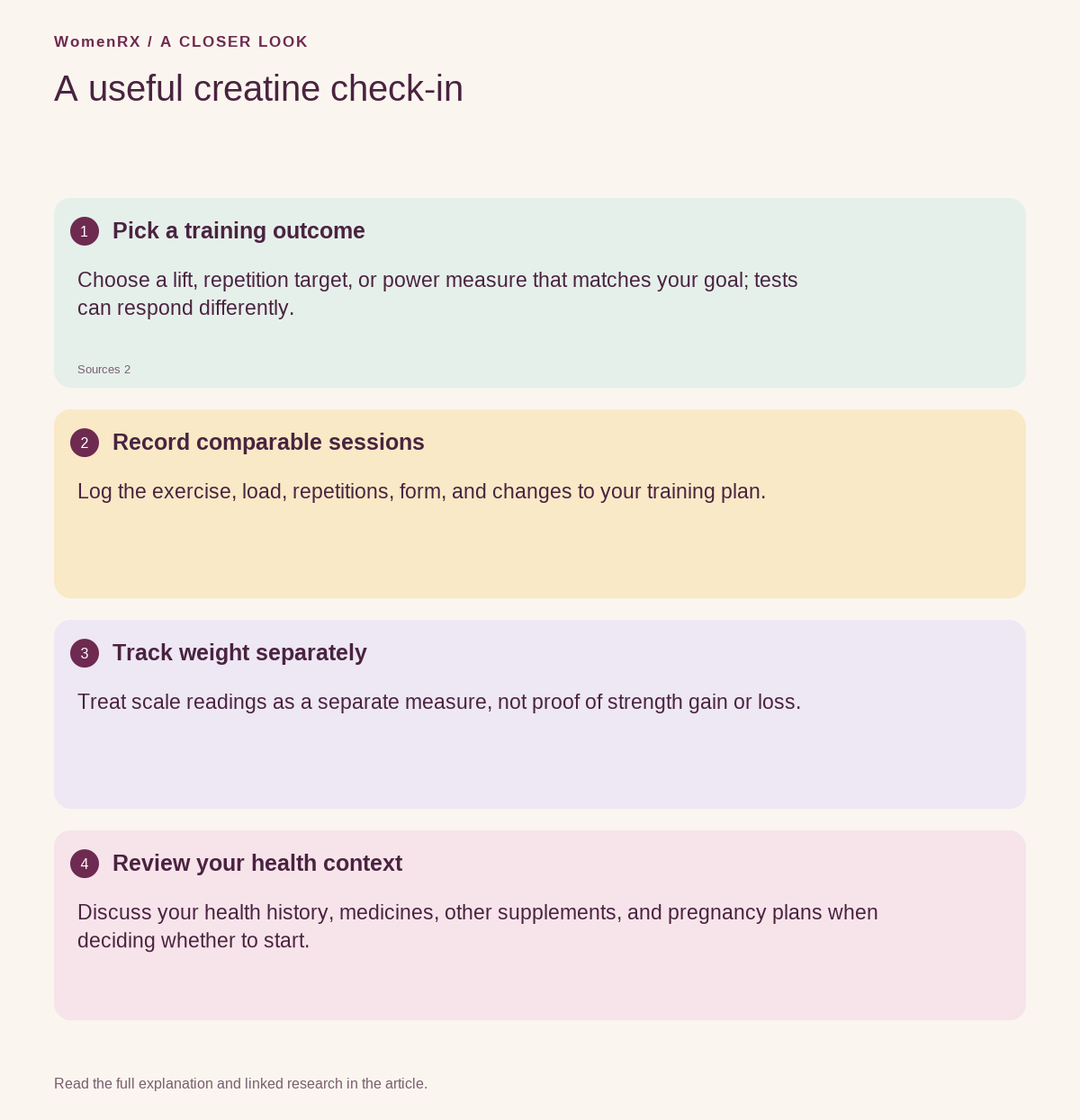
A useful creatine check-in
Pick a training outcome: Choose a lift, repetition target, or power measure that matches your goal; tests can respond differently.2
Record comparable sessions: Log the exercise, load, repetitions, form, and changes to your training plan.
Track weight separately: Treat scale readings as a separate measure, not proof of strength gain or loss.
Review your health context: Discuss your health history, medicines, other supplements, and pregnancy plans when deciding whether to start.
Read the figure as text
Keep training outcomes, body weight, and personal health questions distinct so each record answers a different question.- Pick a training outcome: Choose a lift, repetition target, or power measure that matches your goal; tests can respond differently.2
- Record comparable sessions: Log the exercise, load, repetitions, form, and changes to your training plan.
- Track weight separately: Treat scale readings as a separate measure, not proof of strength gain or loss.
- Review your health context: Discuss your health history, medicines, other supplements, and pregnancy plans when deciding whether to start.
Sources you can check
- The role of resistance training and creatine supplementation on oxidative stress, antioxidant defense, muscle strength, and quality of life in older adults.Amiri E, Sheikholeslami-Vatani D. · Frontiers in public health · 2023Return to first citation
- The Effects of Creatine Supplementation on Upper- and Lower-Body Strength and Power: A Systematic Review and Meta-Analysis.Kazeminasab F, Kerchi AB, Sharafifard F, Zarreh M, Forbes SC, Camera DM, Lanhers C, Wong A, Nordvall M, Bagheri R, Dutheil F. · Nutrients · 2025Return to first citation
- A 2-yr Randomized Controlled Trial on Creatine Supplementation during Exercise for Postmenopausal Bone Health.Chilibeck PD, Candow DG, Gordon JJ, Duff WRD, Mason R, Shaw K, Taylor-Gjevre R, Nair B, Zello GA. · Medicine and science in sports and exercise · 2023Return to first citation