What Creatine Actually Helps With
Creatine’s clearest exercise benefit is for repeated, intense efforts, while strength results vary by test and findings in women are less settled.
Creatine helps muscles supply energy for short, intense activity. Research generally supports a benefit for repeated high-intensity efforts and some strength and power measures, especially alongside training, but not for every test or endurance sport. A large review found several gains in men that weren’t observed in its female subgroup, while a small trial in trained women found no added benefit over protein alone. 1 4 5
The clearest fit is repeated, intense effort
Creatine helps supply muscles with energy for short-term, predominantly anaerobic activity. That makes it most relevant to repeated hard efforts, such as lifting sets or brief bursts of power, rather than steady endurance exercise. Research generally shows benefits for high-intensity, intermittent activity and little value for endurance sports. Individual responses can vary. 1
This is a useful way to assess a creatine claim: first ask what someone actually did. A result from repeated maximal efforts may matter to you if your goal is lifting or a sport with short bursts of activity. It tells you much less about whether creatine will help with a long, steady walk or run. 1
“Strength” depends on the test
A 2025 systematic review and meta-analysis included 69 studies involving 1,937 adults. Compared with placebo, creatine combined with resistance training produced small average improvements in bench or chest press strength, squat strength, vertical jump, and Wingate peak power. It did not find significant differences for handgrip or leg press strength. So “improves strength” is too broad without saying which movement was measured. 4
The review’s sex subgroup results matter here. Significant gains in leg press, squat, vertical jump, and Wingate peak power were reported for men, but weren’t observed in the female subgroup. That does not establish that creatine cannot help women. It means this analysis did not demonstrate those gains in women; the researchers called for larger, better-powered studies in underrepresented groups. 4
One small trial studied women directly. Seventeen resistance-trained women completed eight weeks of resistance training while receiving whey protein alone or whey protein plus creatine. Both groups improved, but adding creatine produced no significant extra improvement in the measured strength, power, or lean-mass outcomes. Because the study was small and tested creatine on top of protein, it cannot settle how women in other training situations might respond. 5
Taken together, these findings make creatine a possible training aid, not a guaranteed extra gain. They also show why an average result across adults should not be presented as a proven result for women.
What about function and health with age?
A stronger lift in a gym is not the same outcome as easier everyday movement, sharper thinking, or better overall health. Those claims need to be judged on the outcomes researchers actually measured.
In a 16-week trial of 103 community-dwelling older adults, including 57 women, participants were assigned to resistance-training or control groups with creatine or placebo. Training improved several measures, and creatine provided additional improvements in some strength and physical-function measures when combined with exercise. Although the study measured cognitive performance, its reported creatine findings do not establish a cognitive benefit. Women were included, but separate creatine results for women were not reported. 3
A different trial involved 30 physically active adults aged 60 or older, including 10 women. It compared creatine plus HMB alongside supervised exercise with placebo alongside the same exercise program, and functional test results improved with the combined supplements. Because both supplements were given together, the trial cannot attribute any added effect to creatine alone. 2
These studies make age-related physical function a reasonable question for further research. They do not establish creatine as a treatment for memory problems, inflammation, or general health in women, or provide a clear answer for postmenopausal women specifically. 2 3
A practical tradeoff if you watch the scale
Weight gain from water retention is a reported effect of creatine. That distinction can matter if you compete in a weight-class sport or use scale weight to judge your training progress: a change on the scale does not, by itself, show a change in body fat. How much your own weight might change is not established by that general finding. 1
If your goal is repeated high-intensity exercise, creatine has a clearer rationale than it does for endurance or broad health claims. For strength, look past the word benefit to the specific test and the people studied. That’s especially worthwhile when a claim is presented as a sure thing for women. 1 4 5
What each creatine finding measures
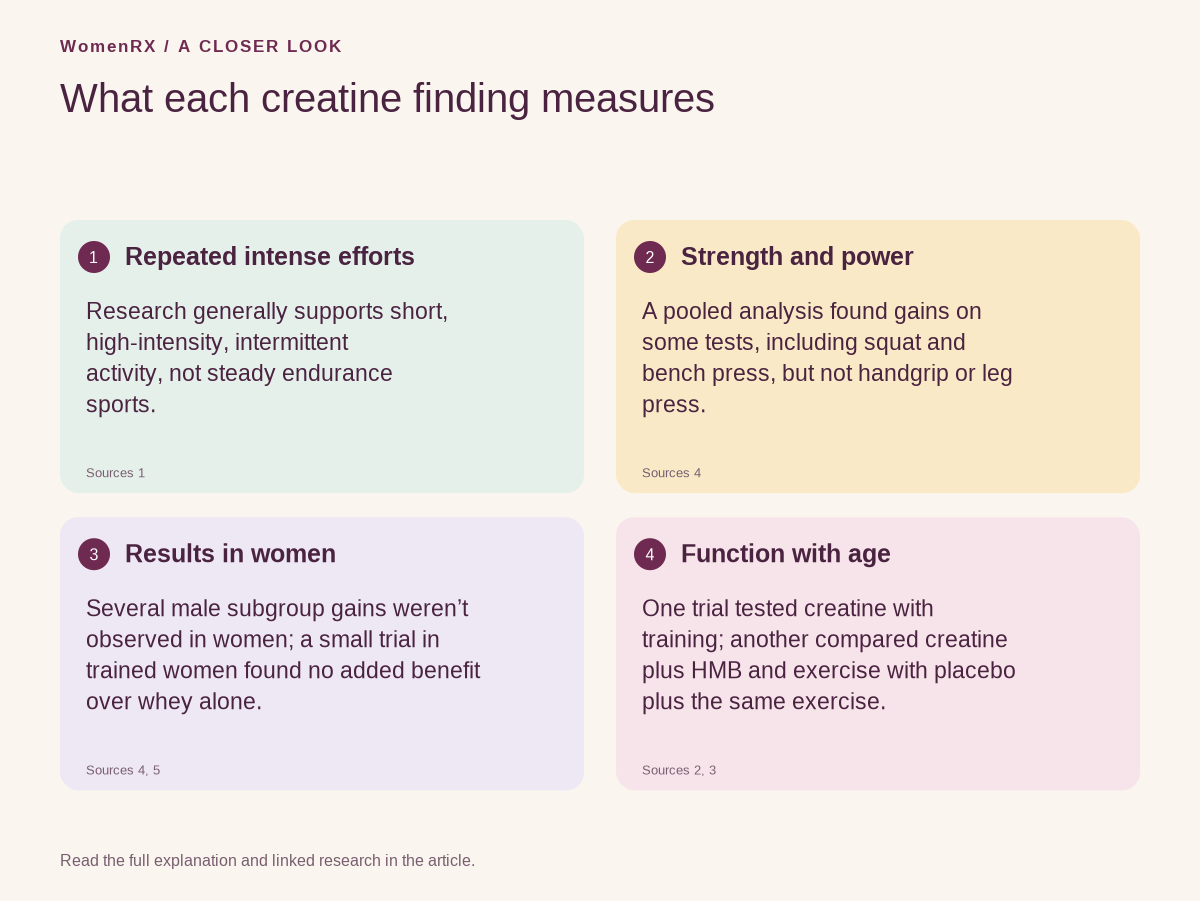
Repeated intense efforts: Research generally supports short, high-intensity, intermittent activity, not steady endurance sports.1
Strength and power: A pooled analysis found gains on some tests, including squat and bench press, but not handgrip or leg press.4
Results in women: Several male subgroup gains weren’t observed in women; a small trial in trained women found no added benefit over whey alone.45
Function with age: One trial tested creatine with training; another compared creatine plus HMB and exercise with placebo plus the same exercise.23
Read the figure as text
Read a creatine claim alongside the activity tested, the people studied, and whether other interventions were involved.- Repeated intense efforts: Research generally supports short, high-intensity, intermittent activity, not steady endurance sports.1
- Strength and power: A pooled analysis found gains on some tests, including squat and bench press, but not handgrip or leg press.4
- Results in women: Several male subgroup gains weren’t observed in women; a small trial in trained women found no added benefit over whey alone.45
- Function with age: One trial tested creatine with training; another compared creatine plus HMB and exercise with placebo plus the same exercise.23
Sources you can check
- Dietary Supplements for Exercise and Athletic Performance - Health Professional Fact SheetAccessed 2026-09-25Return to first citation
- Combined creatine and β-hydroxy-β-methylbutyrate supplementation with integral conditioning exercise enhances functional performance and metabolic health in physically active older adults: A randomized controlled crossover trial.Ramos-Hernández R, Busto N, Miguel-Ortega Á, Martínez-Ferrán M, Santamaría-Peláez M, Saiz-Rodríguez M, Mielgo-Ayuso J. · Aging clinical and experimental research · 2026Return to first citation
- Effects of high-load, velocity-intentional variable resistance training combined with creatine supplementation on neuroplasticity, oxidative stress, inflammation, physical function, cognitive performance and quality of life in older adults: A randomized, double-blind, placebo-controlled trial.Fernandez-Garrido J, Martin EG, Saez-Berlanga A, Gargallo-Bayo P, Gene-Morales J, Alix-Fages C, Jiménez-Martínez P, Caballero O, Salvador-Palmer R, Colado JC. · Experimental gerontology · 2026Return to first citation
- The Effects of Creatine Supplementation on Upper- and Lower-Body Strength and Power: A Systematic Review and Meta-Analysis.Kazeminasab F, Kerchi AB, Sharafifard F, Zarreh M, Forbes SC, Camera DM, Lanhers C, Wong A, Nordvall M, Bagheri R, Dutheil F. · Nutrients · 2025Return to first citation
- A Pilot Study Examining the Effects of 8-Week Whey Protein versus Whey Protein Plus Creatine Supplementation on Body Composition and Performance Variables in Resistance-Trained Women.Wilborn CD, Outlaw JJ, Mumford PW, Urbina SL, Hayward S, Roberts MD, Taylor LW, Foster CA. · Annals of nutrition & metabolism · 2016Return to first citation