When to Take Creatine: Before, After, or Anytime?
For long-term training results, research hasn’t established a clear pre- or post-workout advantage, so a time you can stick with may be the simplest fit.
Studies comparing creatine before and after resistance training haven’t found a consistent winner for strength or muscle gains. One small pilot study in men found better strength during a single workout when creatine was taken beforehand, but that result needs confirmation. A repeatable daily routine is a practical choice, not a proven timing advantage; menstrual phase and menopause haven’t been tested as timing factors in these studies. 124
The workout clock probably doesn’t need to run your routine
If you’re deciding between taking creatine before or after a workout, the longer-term training studies don’t point to one clearly better time. In a small, 8-week study of recreationally active young adults, taking creatine immediately before training on one side of the body and immediately after training on the other led to similar changes in muscle thickness and strength. 1
A separate 8-week study of 34 male and female resistance-trained athletes also found no added benefit from taking creatine within an hour before versus within an hour after training. All groups improved on several measured outcomes, but the timing groups didn’t differ. The study included women, but its abstract doesn’t report women’s results separately. 4
Taken together, these studies don’t support rearranging your day around a narrow workout window. They also don’t prove that every timing approach is identical for every person: the studies were small and examined particular groups, training programs, and schedules.
Why you may see claims favoring before or after
Timing findings aren’t perfectly uniform. A 32-week trial in adults aged 50 to 71 found that the group taking creatine after resistance training gained more lean tissue than the placebo group, while the pre- and post-training creatine groups had similar strength improvements. That result offers a possible signal for post-workout timing in that study, but it doesn’t establish that taking creatine after exercise is generally better. 3
There’s also a different question: could taking creatine right before a workout affect that workout, rather than long-term training gains? In a randomized crossover pilot study, 11 physically active men performed better on bench press and squat measures in the pre-exercise condition than in the placebo and no-supplement conditions. The researchers described the findings as exploratory and called for larger studies. It involved men only and tested a single session, so it doesn’t show that pre-workout timing produces better results over months of training or in women. 2
That distinction matters: an acute result from one workout and a difference in strength or muscle gains after weeks of training aren’t interchangeable outcomes.
Make timing fit the life you actually have
If you’ve decided creatine fits your routine, choose a time that’s easy to remember rather than treating the workout itself as a deadline. For example, you might pair it with a regular meal or another daily habit. That’s a convenience strategy, not a timing method shown to improve results.
The research here mostly compares taking creatine near a workout. It doesn’t directly compare workout-based timing with a routine-based schedule or establish that a particular time of day is best. So there’s no evidence here to recommend morning over evening, or the reverse. Follow the directions for your specific product, and don’t change a clinician-directed plan based on workout timing alone.
What the studies say about women and life stages
Some timing research has included women: three of the ten participants in one young-adult trial were female, and the 34-athlete study included both women and men. Neither abstract provides a separate estimate of timing effects for women. 14
The older-adult study could be relevant to people in later life, but the reported results don’t establish whether timing effects differ by sex or menopause status. The studies summarized here didn’t report testing menstrual-cycle phase or menopause as factors in creatine timing. That means there isn’t a basis here for changing the timing of creatine by cycle phase or menopause stage. It doesn’t mean those factors have been ruled out; the research described doesn’t answer that question.
Bottom line: Before or after training can both fit a routine. The long-term comparisons don’t establish a dependable winner, and a small single-session finding in men isn’t enough to make pre-workout timing a rule. Pick a convenient, repeatable time rather than chasing an unproven clock advantage.
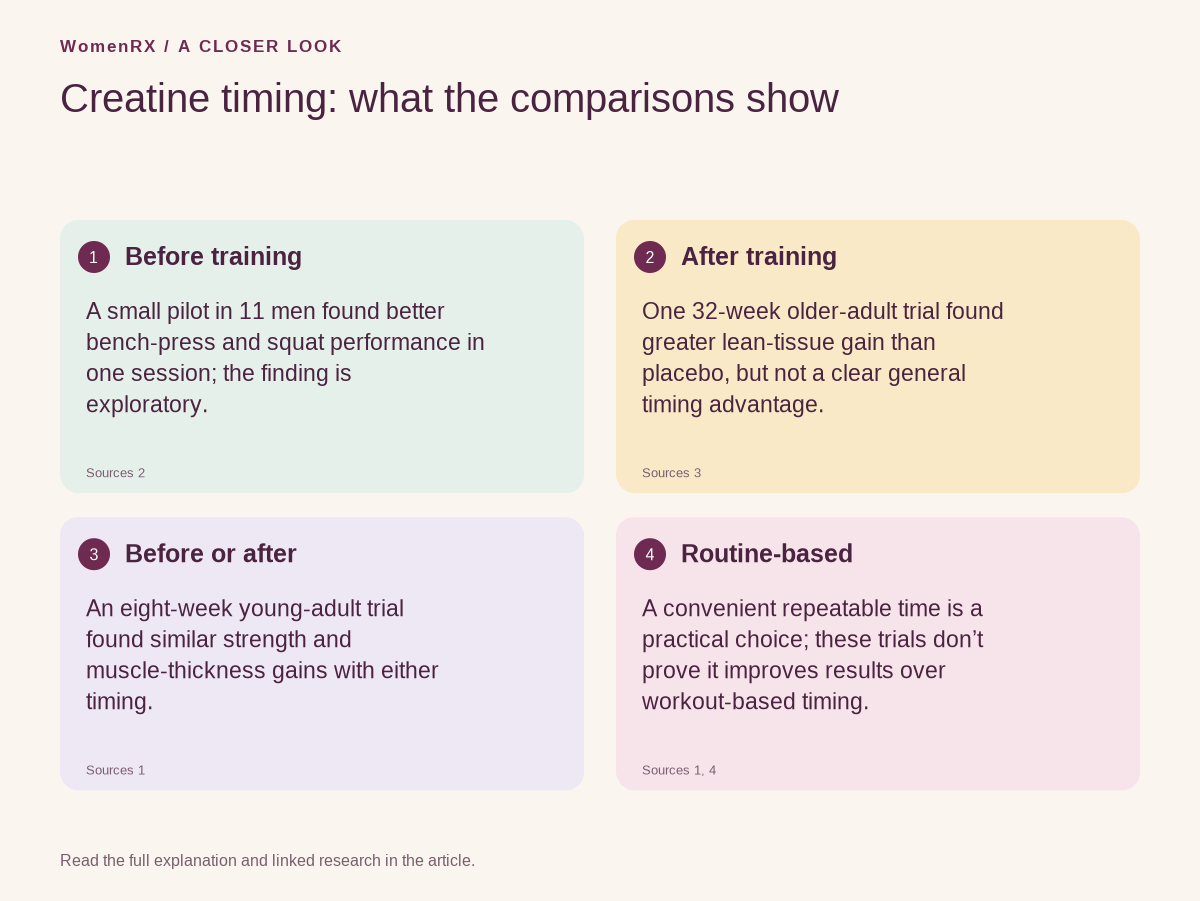
Creatine timing: what the comparisons show
Before training: A small pilot in 11 men found better bench-press and squat performance in one session; the finding is exploratory.2
After training: One 32-week older-adult trial found greater lean-tissue gain than placebo, but not a clear general timing advantage.3
Before or after: An eight-week young-adult trial found similar strength and muscle-thickness gains with either timing.1
Routine-based: A convenient repeatable time is a practical choice; these trials don’t prove it improves results over workout-based timing.14
Read the figure as text
The evidence differs depending on whether a study measures one workout or longer-term training changes.- Before training: A small pilot in 11 men found better bench-press and squat performance in one session; the finding is exploratory.2
- After training: One 32-week older-adult trial found greater lean-tissue gain than placebo, but not a clear general timing advantage.3
- Before or after: An eight-week young-adult trial found similar strength and muscle-thickness gains with either timing.1
- Routine-based: A convenient repeatable time is a practical choice; these trials don’t prove it improves results over workout-based timing.14
More questions, answered
Is there a proven best time of day to take creatine?
These studies compared timing around workouts, not morning versus evening. They don’t establish a best time of day. Choose a time that fits your routine rather than treating a specific hour as evidence-based.
Sources you can check
- Timing of creatine supplementation does not influence gains in unilateral muscle hypertrophy or strength from resistance training in young adults: a within-subject design.Forbes SC, Krentz JR, Candow DG. · The Journal of sports medicine and physical fitness · 2021Return to first citation
- Acute Creatine Ingestion Before Resistance Training Enhances Strength Performance More than Ingestion During or After Training: A Randomized Crossover Pilot Trial.Ben Maaoui K, Delleli S, Jebabli A, Mahdi N, Del Coso J, Chtourou H, Ardigò LP, Ouergui I. · Nutrients · 2026Return to first citation
- Strategic creatine supplementation and resistance training in healthy older adults.Candow DG, Vogt E, Johannsmeyer S, Forbes SC, Farthing JP. · Applied physiology, nutrition, and metabolism = Physiologie appliquee, nutrition et metabolisme · 2015Return to first citation
- Effects of creatine monohydrate timing on resistance training adaptations and body composition after 8 weeks in male and female collegiate athletes.Dinan NE, Hagele AM, Jagim AR, Miller MG, Kerksick CM. · Frontiers in sports and active living · 2022Return to first citation