Creatine After 40: When Might It Be Worthwhile?
For postmenopausal women, creatine’s clearest muscle-related results came when it was paired with resistance training.
Age alone isn’t a reason to take creatine. In trials involving postmenopausal women, creatine modestly improved average lean mass and leg-press strength, with the clearest benefits alongside resistance training. It hasn’t shown an overall bone-density benefit, and these studies don’t establish what happens during perimenopause. Your training plan and goal matter more than your birthday. 1 3
The training plan changes the question
If you’re lifting weights and wondering whether creatine could help you gain strength, there’s a reasonable case for considering it. If you’re hoping a supplement will preserve muscle without resistance training, or improve bone density, the findings are less encouraging. That distinction is more useful than a rule about turning 40.
The postmenopausal trials studied creatine monohydrate. It increases muscle stores of phosphocreatine, which helps support short, high-intensity efforts. That explains why researchers have studied it alongside resistance training, but the mechanism alone can’t tell you how much benefit you’ll get. 1
What the postmenopausal trials found
A systematic review and meta-analysis included seven randomized, placebo-controlled trials with 608 postmenopausal women. Their mean age was about 62, and the trials lasted from 12 to 104 weeks. In the five studies that measured lean mass, the creatine groups averaged 0.37 kg more than the placebo groups. In three studies that measured leg-press strength, the average difference favored creatine by 7.5 kg. These are averages from different subsets of studies, not results you should expect personally. 1
The clearest benefits appeared when creatine was combined with resistance training. Trials using lower amounts of creatine without resistance training found no measurable effect. Because both the amount taken and the training context differed, these findings don’t isolate training as the only reason for the difference. They do make one point clear: the results aren’t a case for treating creatine as a substitute for strength training. 1
Strength training has the more established role. A separate systematic review of studies in postmenopausal women found consistent improvements in strength and body composition with systematic strength training, while it judged evidence for added nutritional strategies, including creatine, insufficient for specific recommendations. 2
Why the older-women trial matters
One two-year randomized trial tested creatine against placebo in 200 postmenopausal women with osteopenia. It found no added benefit for bone health, lean mass, or muscle function. The trial studied a particular group and approach, so it doesn’t cancel out every finding from creatine-plus-training studies. It does give a direct answer to a common hope: creatine alone shouldn’t be counted on to improve bone density. 3
Across the postmenopausal trials in the meta-analysis, bone density was unchanged overall. If bone health is your main reason for considering creatine, the muscle findings don’t establish a bone benefit. 1
What age comparisons can and can’t tell you
Research discussed in the postmenopausal review also describes muscle and strength gains when younger populations combined creatine with resistance training. But those younger studies weren’t compared head-to-head with the postmenopausal trials, and the review passage doesn’t specify their sex composition. You can’t use them to conclude that creatine works better, worse, or differently after menopause. 1
There’s a distinction within midlife, too. The trials above enrolled postmenopausal women, mostly around their early 60s on average. They don’t establish the same effect for someone in perimenopause or for a woman over 40 who’s still cycling. Nor do they show that menopause itself, rather than a person’s training and other characteristics, determines the response. 1
Decide by the outcome you want
If you’re already doing resistance training and want to improve strength or lean mass, creatine is a possible addition to consider, with modest average benefits in the postmenopausal studies. If you aren’t strength training, there’s less reason to expect the same result. If bone density is the goal, the trial findings don’t support choosing creatine for that purpose. 1 2 3
Reported adverse events in the postmenopausal review were mild and similar to placebo, and measures of kidney function did not change in those trials. That’s reassuring for the studied groups, not an answer to every individual health question. If a kidney concern or another health circumstance affects your decision, that’s worth raising when you discuss the supplement with your clinician. 1
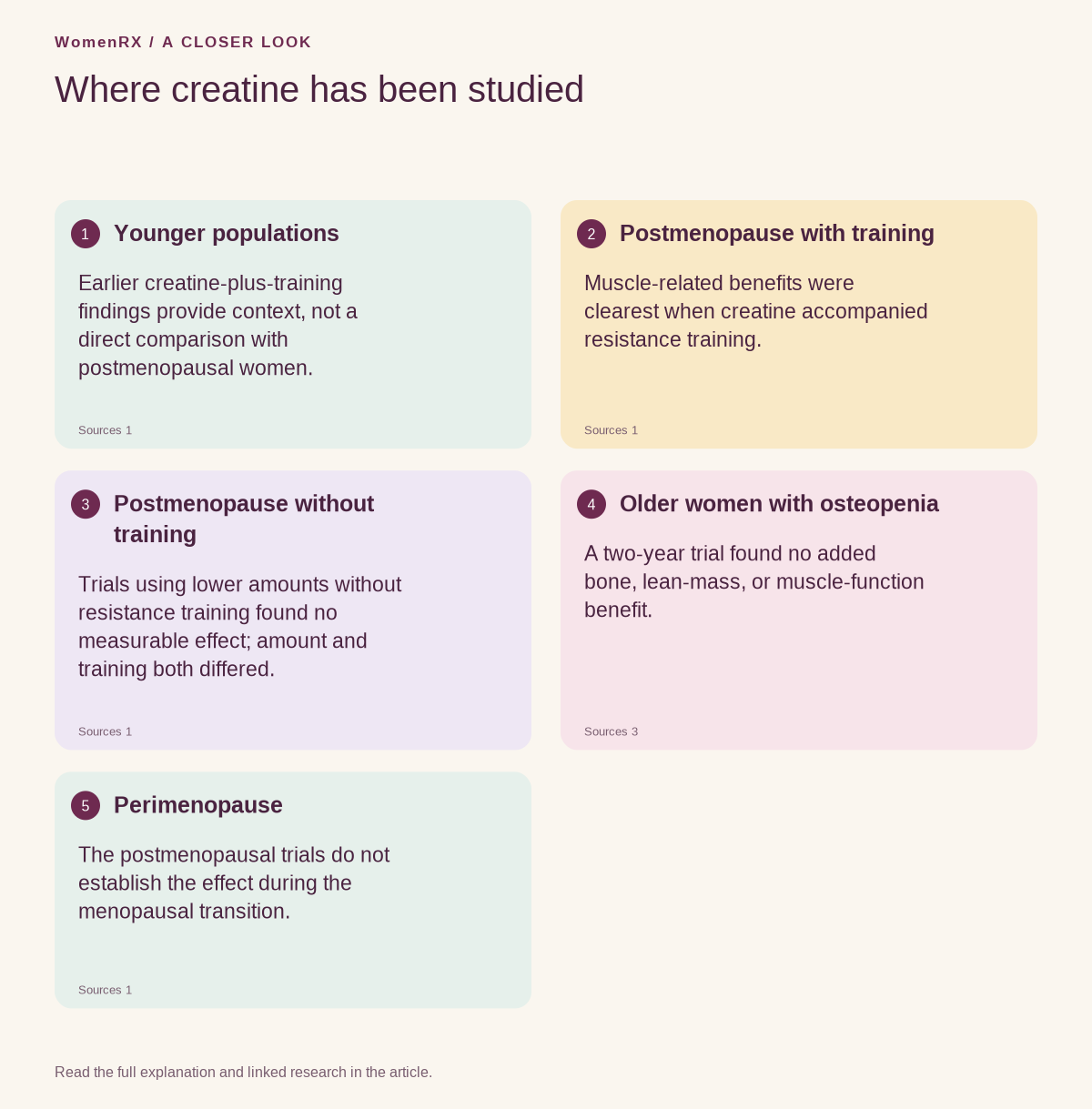
Where creatine has been studied
Younger populations: Earlier creatine-plus-training findings provide context, not a direct comparison with postmenopausal women.1
Postmenopause with training: Muscle-related benefits were clearest when creatine accompanied resistance training.1
Postmenopause without training: Trials using lower amounts without resistance training found no measurable effect; amount and training both differed.1
Older women with osteopenia: A two-year trial found no added bone, lean-mass, or muscle-function benefit.3
Perimenopause: The postmenopausal trials do not establish the effect during the menopausal transition.1
Read the figure as text
Age group, resistance training, and the outcome measured all affect how useful a study is for your decision.- Younger populations: Earlier creatine-plus-training findings provide context, not a direct comparison with postmenopausal women.1
- Postmenopause with training: Muscle-related benefits were clearest when creatine accompanied resistance training.1
- Postmenopause without training: Trials using lower amounts without resistance training found no measurable effect; amount and training both differed.1
- Older women with osteopenia: A two-year trial found no added bone, lean-mass, or muscle-function benefit.3
- Perimenopause: The postmenopausal trials do not establish the effect during the menopausal transition.1
Sources you can check
- Creatine monohydrate for lean mass, strength, and bone density in postmenopausal women: a systematic review and meta-analysis.Naddafha S, Antonio J, Kreider RB, Stout JR. · Journal of the International Society of Sports Nutrition · 2026Return to first citation
- Analysis of the Additive Effects of Nutritional Strategies in Strength Training Interventions on Body Composition, Muscle Strength and Bone Mineral Density in Postmenopausal Women: A Systematic Review.Walter F, Schalla J, Bloch W, Diel P, Geisler S, Isenmann E. · Sports medicine - open · 2026Return to first citation
- Creatine Supplementation (3 g/d) and Bone Health in Older Women: A 2-Year, Randomized, Placebo-Controlled Trial.Sales LP, Pinto AJ, Rodrigues SF, Alvarenga JC, Gonçalves N, Sampaio-Barros MM, Benatti FB, Gualano B, Rodrigues Pereira RM. · The journals of gerontology. Series A, Biological sciences and medical sciences · 2020Return to first citation