Can Creatine Help Maintain Muscle During Menopause?
Postmenopausal trials suggest creatine may add a small benefit to some muscle measures, especially alongside resistance training, but they don’t show it prevents muscle loss.
The clearest evidence comes from postmenopausal women: a review of seven randomized trials found a small average gain in lean mass and greater leg-press strength with creatine. Short-term studies also reported temporary improvements in sit-to-stand performance, but that doesn’t establish lasting gains in everyday function. Perimenopause is less studied, and resistance training remains the better-established foundation. 123
Creatine looks like a possible add-on, not a safeguard
If you’re considering creatine while working on strength, the most relevant research suggests it may add a modest benefit for some postmenopausal women. The evidence is strongest for measured lean mass and leg-press strength, particularly when creatine is paired with resistance training. It hasn’t shown that creatine prevents muscle loss through menopause or replaces strength training. 12
That distinction is useful because “muscle benefit” can mean several things. Lean mass is a body-composition measure; leg-press strength is a specific exercise test; and getting up from a chair is a physical-function task. A change in one doesn’t automatically mean a meaningful change in the others.
What postmenopause studies found
A systematic review and meta-analysis included seven randomized, placebo-controlled trials with 608 postmenopausal women. The trials lasted 12 to 104 weeks, and participants were about 62 years old on average. Across five trials with 338 women, creatine was associated with 0.37 kilograms more lean mass than placebo on average. The confidence interval was 0.05 to 0.69 kilograms, while the prediction interval included no effect. In other words, the pooled average was positive, but a benefit wasn’t assured across settings or for every participant. 1
For strength, three trials with 111 women found an average 7.5-kilogram advantage in leg-press one-repetition maximum with creatine compared with placebo. That’s a result on a particular strength test, not evidence that daily activities necessarily become easier. 1
The training context matters. The review reported the clearest benefits when creatine was used alongside resistance training; trials without resistance training did not show a measurable effect in the lower-amount groups examined. Separately, a review of 34 studies in postmenopausal women found that systematic strength training generally improved body composition, strength, and bone mineral density. Its conclusions about additional supplement strategies were less certain. Taken together, that makes training the more established part of the plan, with creatine a possible extra rather than the main event. 12
Physical function: a brief signal, not proof of lasting change
The longer-term evidence is less clear for everyday function than for lean mass or leg-press strength. The creatine review considered physical-function outcomes, but its reported pooled results don’t give an overall estimate for them. 1
There is a separate, shorter-term finding worth knowing: studies using a brief creatine-loading approach reported temporary improvements in sit-to-stand performance as well as one-repetition maximum. A sit-to-stand test is more connected to everyday movement than a leg press, but a short-lived test improvement doesn’t show that daily mobility improves or stays better over time. 1
So it’s reasonable to say there’s an early signal for short-term performance, but not that creatine has been shown to deliver lasting improvements in everyday function. Those are different questions, and the longer-term evidence summarized here doesn’t settle the latter.
What menopause stage tells us, and what it doesn’t
The menopause-specific randomized trials in the meta-analysis involved postmenopausal women. They don’t give a direct estimate of creatine’s effects during perimenopause. A 2025 review of creatine research across women’s life stages also describes perimenopause evidence as limited. The available findings therefore don’t show whether menopause stage changes a woman’s response. 13
If you’re in perimenopause, the postmenopause results may be relevant background, but they aren’t a personalized prediction. It would also be a stretch to conclude from these studies that creatine treats menopause or prevents age-related muscle loss. The outcomes measured were specific changes in muscle-related tests and body composition. 13
How to weigh the possible benefit
A practical way to read the evidence is to keep the outcomes separate:
- Lean mass: a small average difference in the pooled postmenopausal trials, with uncertainty about how consistently it applies. 1
- Measured strength: a positive leg-press result in three trials, which doesn’t establish improvements in all kinds of strength or daily tasks. 1
- Short-term function: temporary sit-to-stand improvements were reported in brief studies, not demonstrated lasting gains in everyday mobility. 1
- Training: systematic strength training has broader support in postmenopausal women than adding supplements does. 2
In the trials summarized by the creatine review, reported adverse events were mild and similar to placebo, and kidney-related measures were unchanged. Those findings describe the studies and their follow-up; they don’t answer every question about long-term use or every individual circumstance. 1
creatine may provide an additional, modest benefit for some postmenopausal women who do resistance training. The evidence is more limited for perimenopause and doesn’t establish lasting improvement in everyday function or prevention of muscle loss. 123
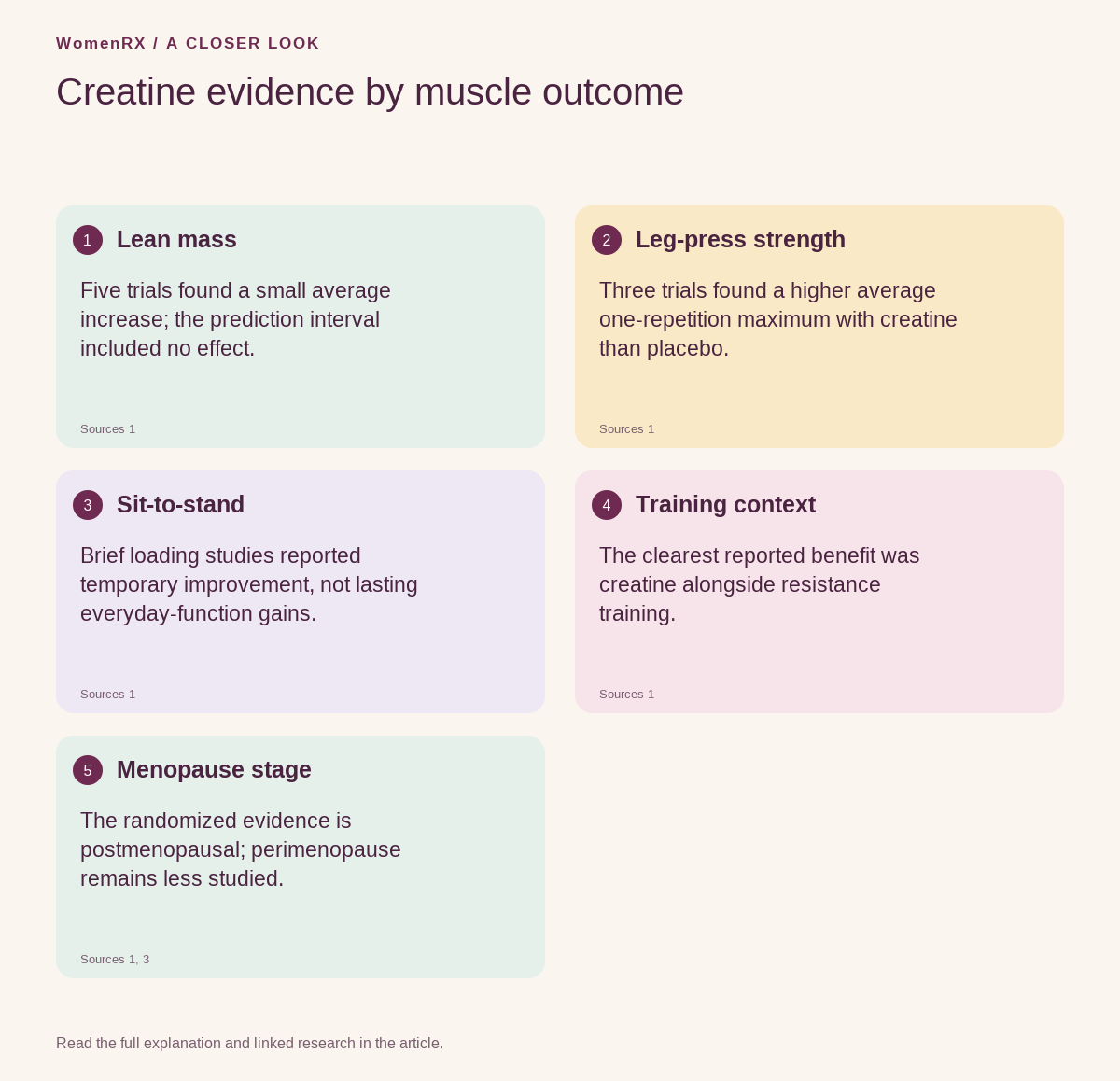
Creatine evidence by muscle outcome
Lean mass: Five trials found a small average increase; the prediction interval included no effect.1
Leg-press strength: Three trials found a higher average one-repetition maximum with creatine than placebo.1
Sit-to-stand: Brief loading studies reported temporary improvement, not lasting everyday-function gains.1
Training context: The clearest reported benefit was creatine alongside resistance training.1
Menopause stage: The randomized evidence is postmenopausal; perimenopause remains less studied.13
Read the figure as text
These findings come mainly from postmenopausal trials. The outcome measured changes what a result can tell you.- Lean mass: Five trials found a small average increase; the prediction interval included no effect.1
- Leg-press strength: Three trials found a higher average one-repetition maximum with creatine than placebo.1
- Sit-to-stand: Brief loading studies reported temporary improvement, not lasting everyday-function gains.1
- Training context: The clearest reported benefit was creatine alongside resistance training.1
- Menopause stage: The randomized evidence is postmenopausal; perimenopause remains less studied.13
Sources you can check
- Creatine monohydrate for lean mass, strength, and bone density in postmenopausal women: a systematic review and meta-analysis.Naddafha S, Antonio J, Kreider RB, Stout JR. · Journal of the International Society of Sports Nutrition · 2026Return to first citation
- Analysis of the Additive Effects of Nutritional Strategies in Strength Training Interventions on Body Composition, Muscle Strength and Bone Mineral Density in Postmenopausal Women: A Systematic Review.Walter F, Schalla J, Bloch W, Diel P, Geisler S, Isenmann E. · Sports medicine - open · 2026Return to first citation
- Creatine in women's health: bridging the gap from menstruation through pregnancy to menopause.Smith-Ryan AE, DelBiondo GM, Brown AF, Kleiner SM, Tran NT, Ellery SJ. · Journal of the International Society of Sports Nutrition · 2025Return to first citation