GLP-1 Treatment and Muscle: What to Watch
A change in lean mass isn’t the same as a loss of strength, so follow-up should look beyond the scale.
Studies of GLP-1 medicines report reductions in lean or fat-free mass, but those measures don’t tell us by themselves how much skeletal muscle changed or whether strength declined. Shorter-term studies often found strength was maintained despite lean-mass reductions; evidence in older adults is limited. Ask your care team to consider strength, everyday function, nutrition, and weight together, not lean mass alone. 3 4 5
Lean mass is a measurement, not a strength test
When a study reports “lean body mass” or “fat-free mass,” it’s reporting a body-composition measure, not a direct reading of skeletal muscle or how well your muscles work. The measure and the method used to estimate it matter. In its review of human muscle research, one group deliberately treated lean mass as a proxy and excluded studies that reported only that measure. A separate meta-analysis found lower lean or fat-free mass during GLP-1 receptor agonist treatment, while noting that it remains uncertain whether those changes cause meaningful declines in muscle function or physical performance. 3 4
That distinction matters in everyday life. A scan or body-composition estimate might show less lean mass while your ability to climb stairs, carry groceries, or rise from a chair stays steady. Conversely, a reassuring number doesn’t replace noticing a real change in what you can do.
What research says about strength
The findings don’t point to one uniform response. A 2026 narrative review found that studies measuring muscle strength generally reported no significant change, even as some found lower muscle mass. A separate review described short-to-mid-term trials in adults with obesity in which handgrip strength was preserved despite losses in lean soft tissue. These reviews also describe concern from observational or retrospective research in older adults, but they don’t establish that every person taking these medicines will lose strength. 3 5
Older adults deserve particular attention because age-related vulnerability and longer-term effects remain unclear. The narrative review included 21 studies, only four focused specifically on older adults; those studies were heterogeneous and difficult to compare. 3 The findings summarized here don’t let you determine whether muscle outcomes differ by sex or menopausal status, so they don’t establish a women-specific rate of muscle loss. 3 4 6
Make follow-up about function, too
At a treatment follow-up, you can ask what the numbers actually measure and what would count as a meaningful change for you. For example, if a body-composition test is being used, ask whether it estimates lean mass or measures skeletal muscle more directly, and how the result will be interpreted alongside your strength and daily activities. You can also ask whether a body-composition test would be useful in your situation, rather than treating one estimate as a complete picture of muscle health.
A practical conversation can cover:
- Strength and function: Have activities such as stairs, lifting, walking, or getting up from a chair become harder? If so, describe what changed and when.
- Nutrition: Is reduced appetite or another treatment effect making it difficult to eat enough? Ask whether a dietitian or another nutrition plan could help you meet your needs. General nutrition guidance emphasizes getting energy and nutrients from a varied eating pattern, rather than relying on a rigid one-size-fits-all diet. 1
- Activity: Ask what kind of movement or strengthening activity fits your health, current ability, and treatment plan.
- Monitoring: Ask which changes in function would prompt a closer look, and whether body-composition results would change what your care team recommends.
These are discussion points, not a guarantee that a particular routine will prevent lean-mass loss. Research on muscle-preserving strategies during treatment is still developing, and evidence that a nutrition product helps in real-world users does not prove it prevents muscle loss. One retrospective study of adults prescribed oral nutritional supplements found they still lost lean body mass; its observational design cannot show that supplements caused the outcomes or reliably prevented muscle loss. 6
When eating becomes difficult
If gastrointestinal symptoms are making it hard to keep food or fluids down, one question for the clinician managing your medicine is how to address eating and drinking during treatment. The US prescribing information for Saxenda (liraglutide) describes gastrointestinal reactions, sometimes severe. 2 You can also ask how your symptoms and specific medicine affect the plan, rather than interpreting a body-composition number on its own.
The useful takeaway is straightforward: a lean-mass result can raise a question, but strength and everyday function help give it meaning. Bring both into the conversation, along with how well you’re able to eat and stay active.
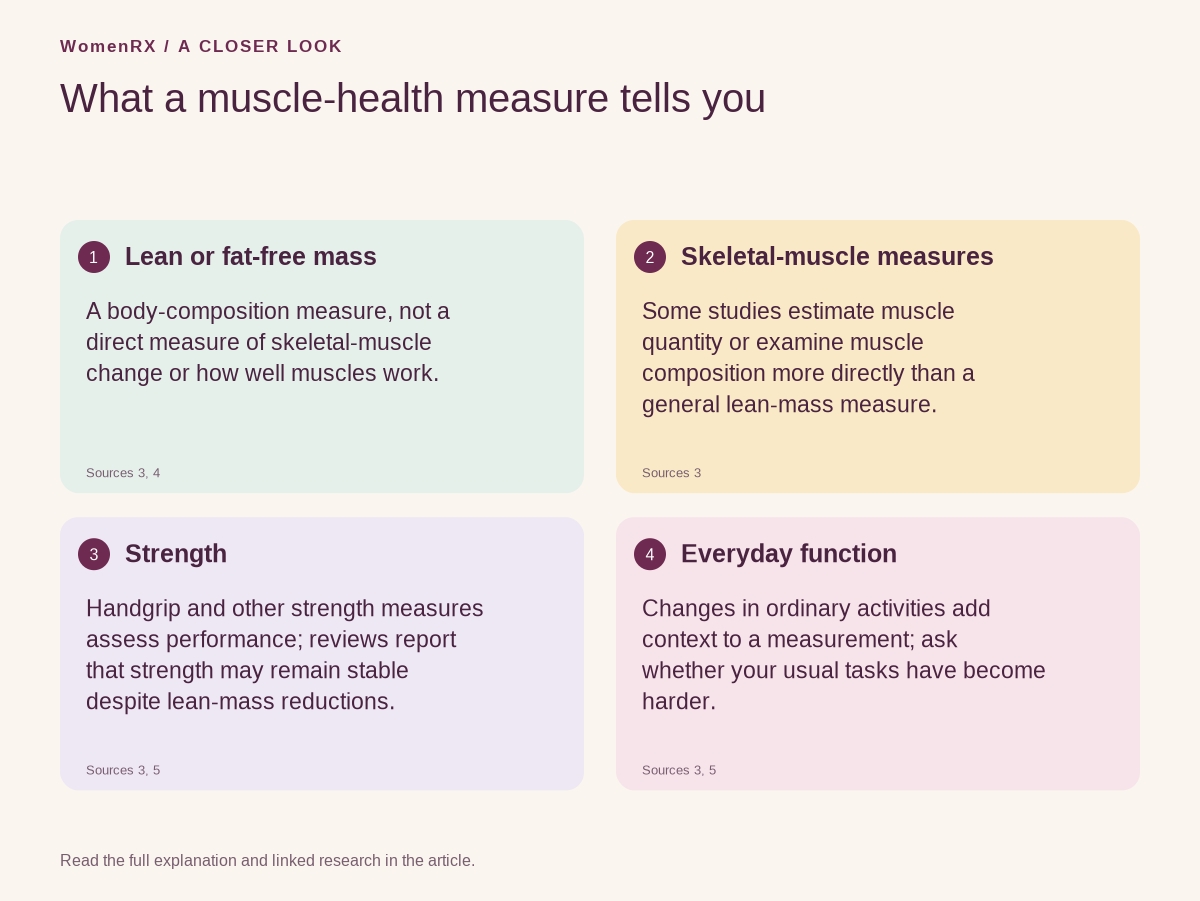
What a muscle-health measure tells you
Lean or fat-free mass: A body-composition measure, not a direct measure of skeletal-muscle change or how well muscles work.34
Skeletal-muscle measures: Some studies estimate muscle quantity or examine muscle composition more directly than a general lean-mass measure.3
Strength: Handgrip and other strength measures assess performance; reviews report that strength may remain stable despite lean-mass reductions.35
Everyday function: Changes in ordinary activities add context to a measurement; ask whether your usual tasks have become harder.35
Read the figure as text
Lean-mass estimates, strength, and daily function answer different questions. Reading them together gives a more useful picture than any one measure alone.- Lean or fat-free mass: A body-composition measure, not a direct measure of skeletal-muscle change or how well muscles work.34
- Skeletal-muscle measures: Some studies estimate muscle quantity or examine muscle composition more directly than a general lean-mass measure.3
- Strength: Handgrip and other strength measures assess performance; reviews report that strength may remain stable despite lean-mass reductions.35
- Everyday function: Changes in ordinary activities add context to a measurement; ask whether your usual tasks have become harder.35
More questions, answered
Do women lose more muscle than men on GLP-1 medicines?
The findings summarized here don’t allow a reliable comparison of muscle outcomes by sex or menopausal status. They don’t support assuming that women lose more muscle, or that menopause changes the rate. 3 4 6
Sources you can check
- Nutrition: MedlinePlusAccessed 2026-09-25Return to first citation
- SAXENDA (LIRAGLUTIDE) INJECTION, SOLUTION [NOVO NORDISK PHARMACEUTICAL INDUSTRIES, LP] | US prescribing information and patient instructionsAccessed 2026-09-25Return to first citation
- GLP-1 receptor agonist therapy and skeletal muscle: A narrative review synthesizing adult evidence with implications for older adults.Jagasia K, Pfeiffer AM, Vitale K. · JAR life · 2026Return to first citation
- GLP-1 Receptor Agonists and Musculoskeletal Outcomes: A Systematic Literature Review and Meta-Analysis.Beaudart C, Malréchauffé Y, van Heden S, Sanchez-Rodriguez D, Scheen A, Bruyère O, Mobasheri A, Duque G, Rizzoli R, Reginster JY, Thiyagarajan JA. · Drugs · 2026Return to first citation
- Glucagon-like peptide-1 receptor agonists and muscle strength changes in older adults: Risks beyond muscle mass reductions.Prokopidis K. · British journal of pharmacology · 2026Return to first citation
- Oral Nutritional Supplements and Body Composition Outcomes Among GLP-1 Receptor Agonist Users: Real-World Evidence.Hong K, Sulo S, Wang W, Kim M, Hong L, Kerr KW, Fan L, Williams DR. · Diabetes, metabolic syndrome and obesity : targets and therapy · 2026Return to first citation