Semaglutide and PCOS: What the Evidence Actually Shows
Semaglutide has early PCOS-specific evidence for weight and metabolic changes, but that doesn’t yet make it a proven treatment for fertility or pregnancy outcomes.
There is some research on semaglutide specifically in women with PCOS, mostly around weight and metabolic measures. But evidence for the medicine isn’t automatically evidence for Ozempic as a PCOS treatment, and improvement in weight or periods doesn’t prove better fertility. One small trial tested semaglutide with metformin, not semaglutide alone, and its pregnancy findings came after participants stopped semaglutide. 34
Start with the goal, not the brand
“Does Ozempic work for PCOS?” can mean several things: might semaglutide help with weight or blood-sugar-related measures, make periods more regular, support ovulation, or improve the chance of pregnancy? Those are different outcomes, and evidence for one doesn’t establish the others.
Ozempic is a semaglutide product. Some studies look at semaglutide as a medicine, rather than testing a particular brand as a PCOS treatment. So a semaglutide finding may be relevant to the molecule, but it doesn’t by itself establish a brand-specific PCOS benefit or show that all semaglutide products have the same approved use. 23
Weight and metabolic outcomes: the clearest signal
A 2025 meta-analysis reported results from eight randomized trials involving 526 people with PCOS. It found a lower average BMI with semaglutide than with placebo or conventional treatment, along with changes in some blood lipids. The authors rated the overall evidence moderate to low quality, so these results are a signal, not a definitive answer for every person with PCOS. 4
A separate randomized trial enrolled 100 overweight or obese women with PCOS. For 16 weeks, one group received metformin and the other received metformin plus semaglutide. Among the 80 participants who completed the study, average weight loss was 6.09 kg with the combination and 2.25 kg with metformin alone. That supports a possible added effect from the combination in this study population; it doesn’t tell us what semaglutide alone would do. 3
This distinction matters if your main goal is weight or metabolic health. PCOS can involve irregular or absent ovulation, and insulin resistance may play a role, but improving weight or metabolic measures doesn’t automatically resolve every PCOS feature. 14
Periods and fertility need their own evidence
The same trial reported more menstrual-cycle recovery in the semaglutide-plus-metformin group than in the metformin group. That’s encouraging, but it’s one short study of combination treatment, not proof that semaglutide alone reliably restores regular ovulation or treats infertility. A 2026 review also describes menstrual findings as preliminary, with much of the evidence coming from small studies or conference reports. 35
The pregnancy result needs an especially careful read. After the 16-week comparison, all participants received metformin alone from weeks 16 to 40. The combination group had a higher natural pregnancy rate during that later period, 35% versus 15%. Because semaglutide was no longer being taken during that period, this result does not show that taking semaglutide caused the higher pregnancy rate. It is a reason to study the question further, not a promise of improved fertility. 3
A broader review of incretin medicines reports more established PCOS-specific evidence for liraglutide than for semaglutide. Results from liraglutide or other GLP-1 medicines shouldn’t be presented as if they were semaglutide results. 67
If pregnancy is part of your plan
Weight, menstrual, and fertility goals can overlap, but they aren’t interchangeable. Semaglutide should not be used during pregnancy, and the PCOS review literature says it should be stopped before planned conception. If pregnancy is a near-term goal, that changes the treatment discussion; don’t assume that more regular periods mean it’s safe to keep taking the medicine or that conception will be easier. 57
A useful conversation is to name the outcome you want first: metabolic improvement, weight change, more regular cycles, or help with conception. Then ask whether the evidence being discussed is for semaglutide itself, a combination with metformin, or a different GLP-1 medicine, and whether the study measured your specific goal. That keeps a promising metabolic finding from being mistaken for a fertility result.
What semaglutide evidence covers in PCOS
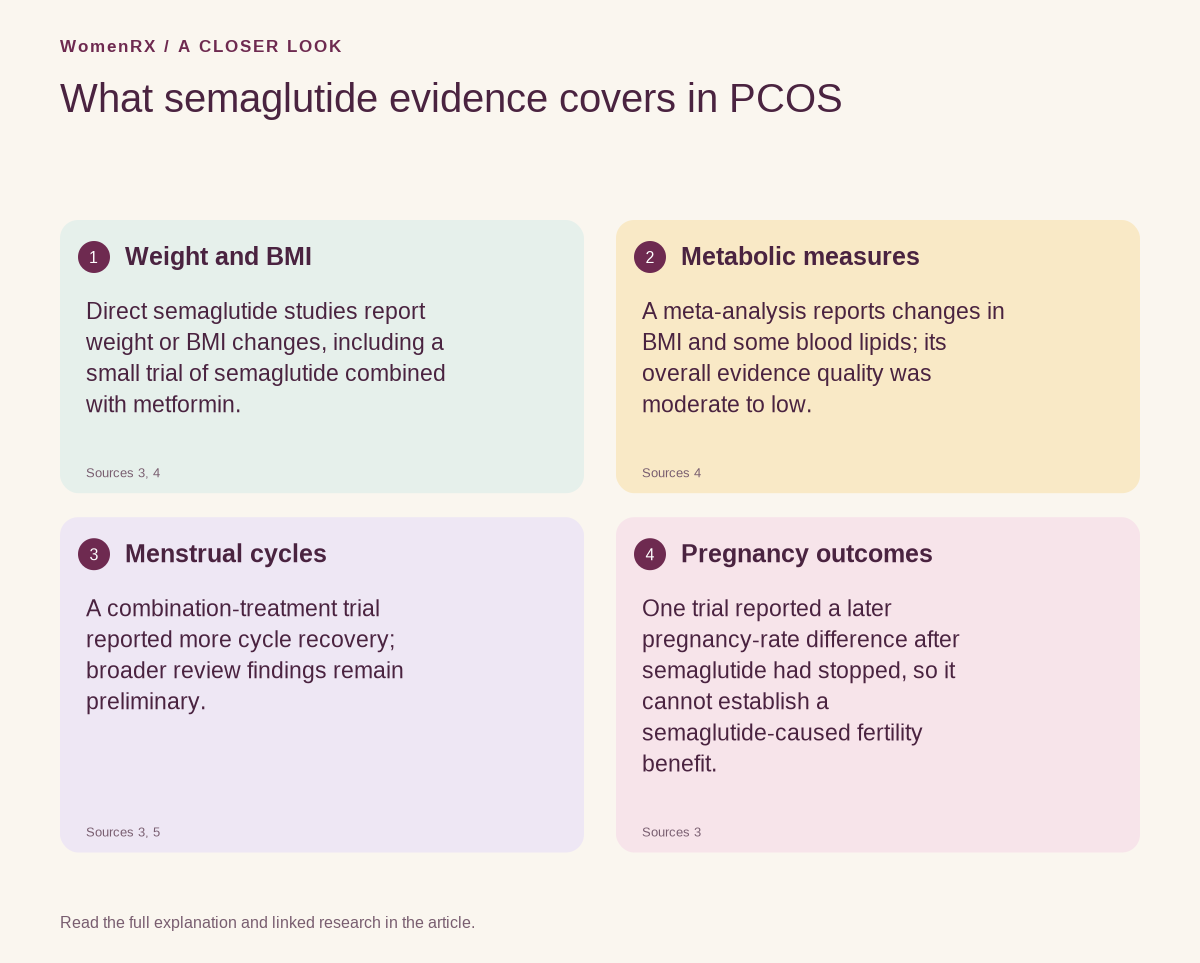
Weight and BMI: Direct semaglutide studies report weight or BMI changes, including a small trial of semaglutide combined with metformin.34
Metabolic measures: A meta-analysis reports changes in BMI and some blood lipids; its overall evidence quality was moderate to low.4
Menstrual cycles: A combination-treatment trial reported more cycle recovery; broader review findings remain preliminary.35
Pregnancy outcomes: One trial reported a later pregnancy-rate difference after semaglutide had stopped, so it cannot establish a semaglutide-caused fertility benefit.3
Read the figure as text
The outcome matters: evidence for weight or metabolic change is not proof of a fertility or pregnancy benefit.- Weight and BMI: Direct semaglutide studies report weight or BMI changes, including a small trial of semaglutide combined with metformin.34
- Metabolic measures: A meta-analysis reports changes in BMI and some blood lipids; its overall evidence quality was moderate to low.4
- Menstrual cycles: A combination-treatment trial reported more cycle recovery; broader review findings remain preliminary.35
- Pregnancy outcomes: One trial reported a later pregnancy-rate difference after semaglutide had stopped, so it cannot establish a semaglutide-caused fertility benefit.3
More questions, answered
Does evidence about liraglutide or exenatide apply to semaglutide?
Not automatically. These medicines are in the same broad GLP-1 class, but PCOS-specific evidence is not equally developed for each one. A review describes liraglutide as having a denser PCOS evidence base, while semaglutide findings remain more limited. 67
Does a more regular period mean semaglutide improved fertility?
Not necessarily. Menstrual changes are not the same outcome as confirmed ovulation, conception, or a healthy pregnancy. The semaglutide-plus-metformin trial reported both menstrual changes and a later pregnancy difference, but semaglutide had already been stopped before that pregnancy-outcome period. 35
Sources you can check
- PCOS | Polycystic Ovary Syndrome | MedlinePlusAccessed 2026-09-25Return to first citation
- OZEMPIC (SEMAGLUTIDE) INJECTION, SOLUTION [A-S MEDICATION SOLUTIONS] | US prescribing information and patient instructionsAccessed 2026-09-25Return to first citation
- Effects of combined metformin and semaglutide therapy on body weight, metabolic parameters, and reproductive outcomes in overweight/obese women with polycystic ovary syndrome: a prospective, randomized, controlled, open-label clinical trial.Chen H, Lei X, Yang Z, Xu Y, Liu D, Wang C, Du H. · Reproductive biology and endocrinology : RB&E · 2025Return to first citation
- Meta-analysis of the effects of semaglutide on body mass index (BMI) and blood lipid levels in polycystic ovary syndrome patients.Chen W, Xu D, Shao X, Song Q, Chen R. · Gynecological endocrinology : the official journal of the International Society of Gynecological Endocrinology · 2025Return to first citation
- Efficacy and Safety of Semaglutide in Patients with Polycystic Ovary Syndrome: A Scoping Review.La Vignera S, Condorelli RA. · Biomedicines · 2026Return to first citation
- Incretin-Based Anti-obesity Medications in Polycystic Ovary Syndrome: The Evidence Map.Jensterle M, Janez A. · Drugs · 2026Return to first citation
- GLP-1 Receptor Agonists and Fertility: What Is Known So Far?Becker AS, Castilhos JP, Shugair SAS, Colombo T, Hentschke M-. · JBRA assisted reproduction · 2026Return to first citation