Semaglutide for PCOS: What the Evidence Shows
A small trial found greater short-term weight loss with semaglutide plus metformin, but it can’t show that semaglutide alone improves fertility or PCOS symptoms.
The clearest PCOS-specific semaglutide evidence is one small randomized trial in overweight or obese women: semaglutide added to metformin led to more weight loss over 16 weeks than metformin alone. Menstrual and pregnancy findings are encouraging but less conclusive: the pregnancy comparison came after both groups had switched to metformin, so it doesn’t establish semaglutide’s direct effect on fertility. 2
What the PCOS-specific trial tested
A 2025 randomized trial assigned 100 women with PCOS who were overweight or obese to metformin alone or metformin plus semaglutide. The participants were 18 to 40 years old, had not responded to lifestyle changes for three months, and did not have diabetes. The semaglutide group received 1 mg weekly alongside metformin for 16 weeks. This was a study regimen, not a dosing recommendation. 2
At 16 weeks, the combination group lost an average of 6.09 kg, compared with 2.25 kg in the metformin-only group. The study also reported greater improvements in waist-to-hip ratio and some metabolic and hormone measures, including testosterone, in the combination group. These results suggest a short-term weight and marker benefit from adding semaglutide to metformin in this particular population. They don’t tell us how semaglutide compares with metformin when used alone, or how the combination compares with other PCOS treatments. 2
The distinction matters because semaglutide’s broader use for weight management is not the same as evidence that it treats PCOS-related menstrual or fertility problems. A review describes weight and metabolic findings across a range of GLP-1 medicines, but findings for drugs such as liraglutide or exenatide should not be counted as semaglutide results. 3 4
Menstrual and pregnancy results need more context
The trial reported more menstrual-cycle recovery in the combination group, but the available results don’t provide enough detail to judge how large or lasting that difference was. It’s a promising signal, not proof that semaglutide reliably restores regular cycles for women with PCOS. 2
Pregnancy results need an especially careful reading. After the initial 16 weeks, everyone in the study received metformin alone through week 40. The authors reported natural pregnancy rates of 35% in the group initially assigned semaglutide plus metformin and 15% in the group initially assigned metformin alone. Because no one continued semaglutide during that later comparison, the result doesn’t show that taking semaglutide directly increased the chance of pregnancy. It could reflect differences associated with the earlier treatment period, but this one study can’t settle that question. 2
The trial also excluded people who were pregnant or planning pregnancy during the first 16 weeks. It therefore cannot answer whether semaglutide should be used during pregnancy, or how best to time treatment around conception. If pregnancy is a current goal, that gap is a reason to make the treatment plan with the prescriber managing your PCOS and fertility care, rather than treating weight-loss results as fertility guidance. 2
Who these results may not represent
PCOS can involve different combinations of irregular or absent ovulation, higher androgen levels, and ovarian features. The trial enrolled women with overweight or obesity under the study’s criteria; it doesn’t establish the same results for women with PCOS who aren’t overweight, or for every pattern of PCOS symptoms. It also excluded women with diabetes, so its findings don’t answer how the combination performs in that group. 1 2
The study was conducted at one center, and 80 of the 100 participants completed it. Gastrointestinal symptoms such as nausea, vomiting, diarrhea, and bloating were the most commonly reported adverse events; they were more frequent in the combination group, though no participant withdrew because of an adverse event. A larger, longer trial with semaglutide-only and appropriate comparison groups would help clarify which benefits are due to semaglutide and whether reproductive outcomes persist. 2
A useful way to weigh the claims
If you’re reviewing a claim about semaglutide and PCOS, ask what outcome was actually measured. Short-term weight change has a direct comparison in one PCOS trial. Metabolic and menstrual findings are early signals from that same study. Fertility claims are more uncertain because the reported pregnancy comparison followed a switch to metformin alone. Evidence about other GLP-1 medicines may be relevant background, but it cannot fill in the missing semaglutide-specific answers. 2 4
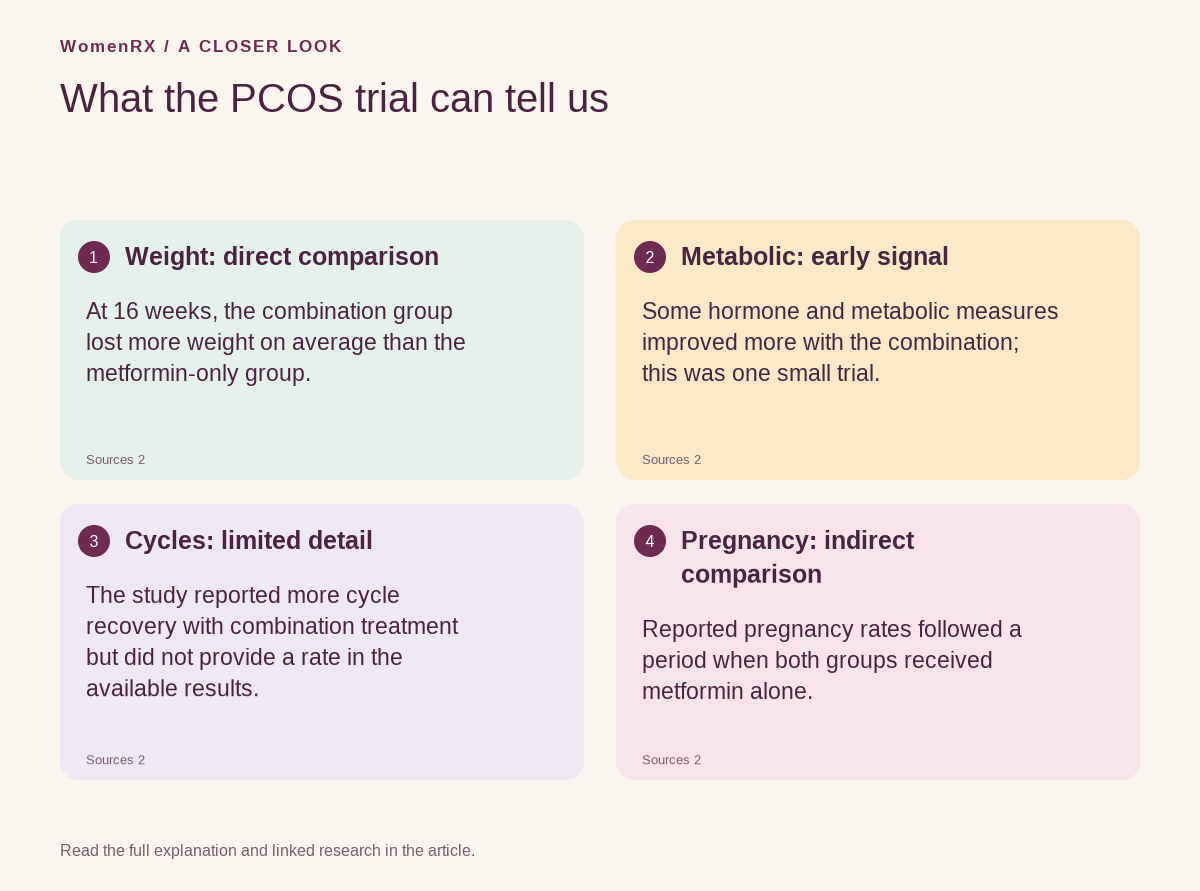
What the PCOS trial can tell us
Weight: direct comparison: At 16 weeks, the combination group lost more weight on average than the metformin-only group.2
Metabolic: early signal: Some hormone and metabolic measures improved more with the combination; this was one small trial.2
Cycles: limited detail: The study reported more cycle recovery with combination treatment but did not provide a rate in the available results.2
Pregnancy: indirect comparison: Reported pregnancy rates followed a period when both groups received metformin alone.2
Read the figure as text
The strongest direct comparison is for short-term weight change. Other outcomes are signals with more limits, and the pregnancy comparison followed a change to metformin alone.- Weight: direct comparison: At 16 weeks, the combination group lost more weight on average than the metformin-only group.2
- Metabolic: early signal: Some hormone and metabolic measures improved more with the combination; this was one small trial.2
- Cycles: limited detail: The study reported more cycle recovery with combination treatment but did not provide a rate in the available results.2
- Pregnancy: indirect comparison: Reported pregnancy rates followed a period when both groups received metformin alone.2
More questions, answered
Has semaglutide been shown to improve PCOS on its own?
The PCOS-specific randomized trial described here tested semaglutide added to metformin, not semaglutide alone. Its results therefore can’t show whether semaglutide by itself produces the same weight, menstrual, or metabolic changes. 2
Does the pregnancy result prove semaglutide improves fertility?
No. The study reported higher natural pregnancy rates in the group initially assigned semaglutide plus metformin, but all participants received metformin alone during the later pregnancy-outcome period. The result is a signal worth studying, not proof of a direct semaglutide fertility effect. 2
Sources you can check
- PCOS | Polycystic Ovary Syndrome | MedlinePlusAccessed 2026-09-25Return to first citation
- Effects of combined metformin and semaglutide therapy on body weight, metabolic parameters, and reproductive outcomes in overweight/obese women with polycystic ovary syndrome: a prospective, randomized, controlled, open-label clinical trial.Chen H, Lei X, Yang Z, Xu Y, Liu D, Wang C, Du H. · Reproductive biology and endocrinology : RB&E · 2025Return to first citation
- The expanding role of semaglutide: beyond glycemic control.Zarei M, Sabetkasaei M, Mozafari M, Zaeri S. · Journal of diabetes and metabolic disorders · 2025Return to first citation
- GLP-1 Receptor Agonists and Fertility: What Is Known So Far?Becker AS, Castilhos JP, Shugair SAS, Colombo T, Hentschke M-. · JBRA assisted reproduction · 2026Return to first citation