Tirzepatide and PCOS: What the Evidence Actually Shows
Tirzepatide has been linked to substantial weight loss in women with PCOS, but its effects on cycles, metabolic health, and fertility remain much less clear.
Tirzepatide may help with weight management if you have PCOS and overweight or obesity. In a large observational study, women who reported PCOS lost weight while using it, but the study couldn’t establish how much weight loss tirzepatide caused or whether it improved ovulation, fertility, or other PCOS outcomes.4 If pregnancy is possible, contraception and your plans for conception belong in the decision from the start.236
Weight loss is the clearest PCOS-specific finding
PCOS can affect ovulation and periods, but it also involves health concerns beyond the ovaries. Not everyone with PCOS has the same symptoms or needs the same treatment.1 That distinction matters here: a medicine that helps with weight isn’t automatically a treatment for irregular cycles, excess hair growth, or difficulty getting pregnant.
The most directly relevant tirzepatide research followed women prescribed the medicine through a UK digital weight-management service. It was a retrospective observational study, not a trial that assigned women to tirzepatide or a comparison treatment. Of 54,114 women in the cohort, 4,241 reported having PCOS. Among those with a recorded weight at 10 months, the 40 women with PCOS had lost an average of 19.40% of their starting body weight. The corresponding average was 18.74% among 397 women without PCOS, a difference that was not statistically significant.4
That’s an encouraging weight-management signal, with a major limit: only 40 women with PCOS contributed to the 10-month average, even though thousands were in the PCOS group initially. PCOS status was self-reported, and there was no untreated PCOS comparison group. The result can’t tell you what an individual woman will lose, how much of the change was caused by the medicine rather than other parts of care, or what happens over longer periods.4
Weight, cycles, and fertility are different outcomes
If your main goal is weight management, that study speaks to your question more directly than it does if your goal is predictable periods or pregnancy. It did not establish whether tirzepatide restored ovulation, made cycles regular, lowered androgen-related symptoms, improved insulin resistance in the PCOS group, or increased pregnancies.4 Weight change alone can’t stand in for any of those outcomes.
You may also see promising PCOS findings attributed to “GLP-1 medicines.” Reviews discuss improvements in outcomes such as insulin resistance and menstrual frequency with other medicines in this family. But tirzepatide is a dual GIP/GLP-1 agonist, and a review of PCOS trials discussed in the direct tirzepatide study included no tirzepatide data. Results for liraglutide or semaglutide shouldn’t be presented as proven tirzepatide results.45
This gives you a practical way to frame the choice. If weight is your priority, ask what benefit is realistic for you and how it fits with the rest of your PCOS care. If you’re trying to conceive, a weight-loss result is not the same as a fertility-treatment result. PCOS-specific fertility treatments are a separate part of care.14
If you take the pill, account for a specific interaction
Both US tirzepatide products, Mounjaro and Zepbound, warn that the medicine may reduce the effectiveness of oral hormonal contraceptives. Tirzepatide delays stomach emptying, which can affect how an oral contraceptive is absorbed; the effect is greatest after the first dose and lessens over time. Their prescribing information advises switching to a non-oral contraceptive method or adding a barrier method for four weeks after starting tirzepatide and for four weeks after each dose increase.23
For example, if you use a birth control pill to prevent pregnancy, starting tirzepatide is a reason to settle your contraception plan before treatment begins, then revisit it if the dose changes. This warning specifically concerns oral hormonal contraception. Don’t assume that having irregular periods means pregnancy can’t happen: many women with PCOS can still get pregnant.123
Pregnancy plans change the timing of the conversation
If you hope to conceive soon, say so before starting tirzepatide. Pregnancy safety data for this group of medicines remain limited, and a reproductive-health review recommends planning discontinuation before conception rather than treating weight management and pregnancy planning as unrelated decisions.6 Whether tirzepatide improves fertility in PCOS remains unproven.46 A reproductive-health review recommends stopping tirzepatide 8 weeks before attempting conception.6 That interval is a review recommendation, separate from the US prescribing information’s advice about oral contraception.23
Finally, the usual medication safety discussion still applies. US prescribing information lists a personal or family history of medullary thyroid carcinoma, multiple endocrine neoplasia syndrome type 2, and a known serious hypersensitivity to tirzepatide or product ingredients among reasons not to use it.23 Those checks matter whether the reason you’re considering tirzepatide is weight, diabetes, or both.
The useful question is not simply, “Will tirzepatide treat my PCOS?” It’s, “Which outcome am I seeking, what evidence applies to that outcome, and how will this choice fit my contraception or pregnancy plans?” For weight, there is a PCOS-specific observational signal. For cycles, fertility, and other PCOS outcomes, the answer is still uncertain.4
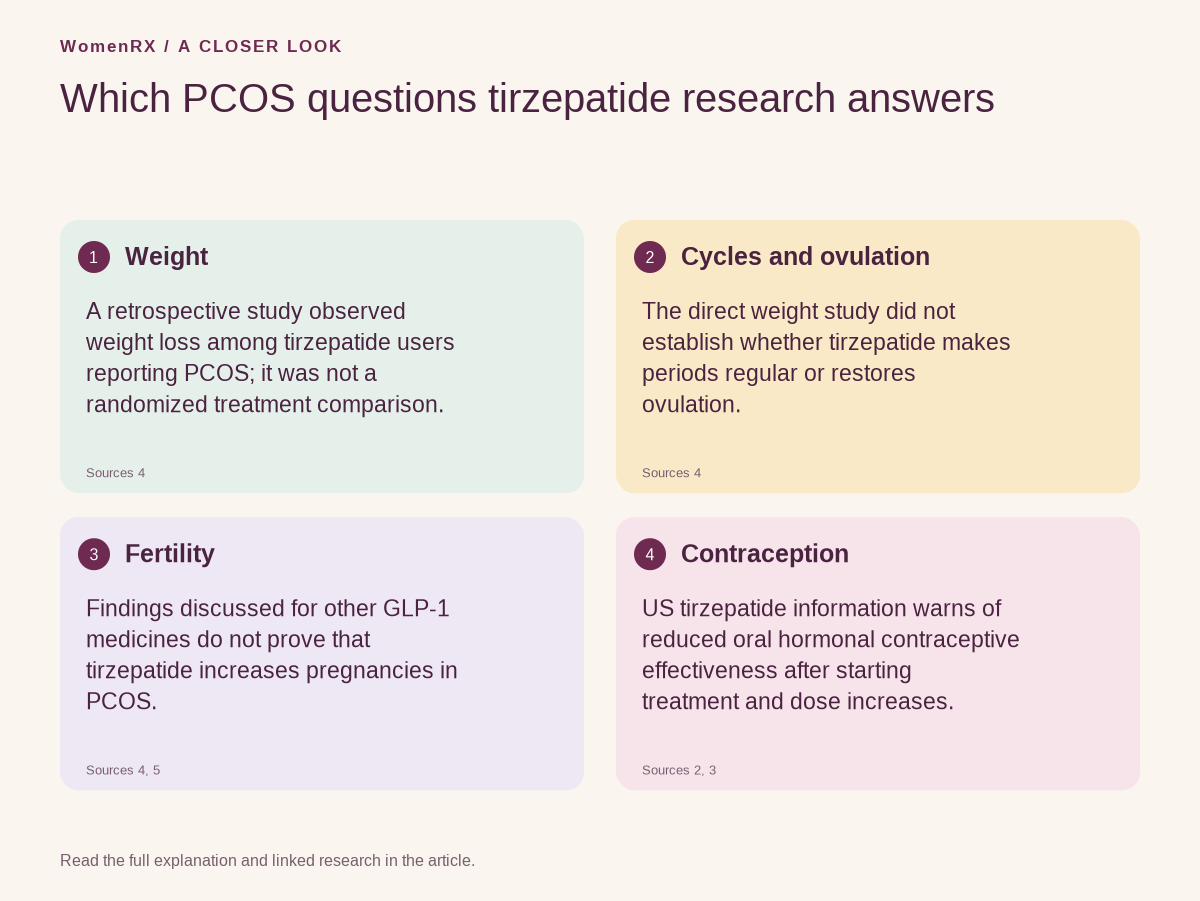
Which PCOS questions tirzepatide research answers
Weight: A retrospective study observed weight loss among tirzepatide users reporting PCOS; it was not a randomized treatment comparison.4
Cycles and ovulation: The direct weight study did not establish whether tirzepatide makes periods regular or restores ovulation.4
Fertility: Findings discussed for other GLP-1 medicines do not prove that tirzepatide increases pregnancies in PCOS.45
Contraception: US tirzepatide information warns of reduced oral hormonal contraceptive effectiveness after starting treatment and dose increases.23
Read the figure as text
The distinction is between weight outcomes directly observed in women reporting PCOS and other outcomes that cannot be inferred from weight loss.- Weight: A retrospective study observed weight loss among tirzepatide users reporting PCOS; it was not a randomized treatment comparison.4
- Cycles and ovulation: The direct weight study did not establish whether tirzepatide makes periods regular or restores ovulation.4
- Fertility: Findings discussed for other GLP-1 medicines do not prove that tirzepatide increases pregnancies in PCOS.45
- Contraception: US tirzepatide information warns of reduced oral hormonal contraceptive effectiveness after starting treatment and dose increases.23
More questions, answered
Does weight loss on tirzepatide mean I’m ovulating?
No. A change in weight doesn’t tell you whether ovulation has resumed. The direct PCOS tirzepatide study reported weight outcomes, not evidence that an individual’s ovulation or cycle pattern changed.4
Is the oral-contraceptive warning specific to tirzepatide?
The Mounjaro and Zepbound US prescribing information specifically warns that tirzepatide may reduce oral hormonal contraceptive effectiveness and gives precautions for starting treatment and dose increases. Don’t assume every medicine described as a GLP-1 drug has the same interaction.237
Sources you can check
- PCOS | Polycystic Ovary Syndrome | MedlinePlusAccessed 2026-09-25Return to first citation
- ZEPBOUND (TIRZEPATIDE) INJECTION, SOLUTION ZEPBOUND (TIRZEPATIDE) INJECTION, SOLUTION ZEPBOUND KWIKPEN (TIRZEPATIDE) INJECTION, SOLUTION [ELI LILLY AND COMPANY] | US prescribing information and patient instructionsAccessed 2026-09-25Return to first citation
- MOUNJARO (TIRZEPATIDE) INJECTION, SOLUTION MOUNJARO KWIKPEN (TIRZEPATIDE) INJECTION, SOLUTION [ELI LILLY AND COMPANY] | US prescribing information and patient instructionsAccessed 2026-09-25Return to first citation
- Weight loss outcomes with tirzepatide in women with and without self-reported polycystic ovary syndrome.Clift AK, Reisel D, Johnson H, Sattar N, Huang DR. · Journal of the Endocrine Society · 2026Return to first citation
- What obgyns need to know about GLP-1 receptor agonists.Chauhan I. · Current opinion in obstetrics & gynecology · 2026Return to first citation
- The effects of glucagon-like peptide-1 receptor agonists on fertility, contraception, and pregnancy: clinical perspectives.Dilbaz B, Ateş Ç. · The European journal of contraception & reproductive health care : the official journal of the European Society of Contraception · 2026Return to first citation
- Glucagon-like Peptide-1 Receptor Agonists and Reproductive Health: Current Evidence and Clinical Implications.Kettner J, Donnelly E, Maes ML. · Journal of pharmacy practice · 2026Return to first citation