Zepbound and PCOS: What You Can and Can’t Expect
PCOS alone isn’t listed as a reason you can’t take Zepbound, but evidence for treating PCOS symptoms with tirzepatide is still early.
Having PCOS does not by itself appear to rule out Zepbound: PCOS is not among the contraindications listed in its U.S. prescribing information. That’s different from saying Zepbound is an established PCOS treatment. Early studies offer weight-loss findings, but don’t establish reliable effects on cycles or fertility, or safety around pregnancy. 2 4 5

First, separate eligibility from the treatment goal
Zepbound contains tirzepatide. Having PCOS isn’t listed among the contraindications in its U.S. prescribing information. The listed contraindications include a personal or family history of medullary thyroid carcinoma (MTC), multiple endocrine neoplasia syndrome type 2 (MEN 2), and a serious allergy to tirzepatide or its ingredients. Whether Zepbound is appropriate for you depends on the reason it’s being considered and your individual health, not on PCOS alone. 2
The more specific question is what you hope treatment will change. PCOS can involve irregular or absent ovulation, higher androgen levels, and insulin resistance. A weight-management medicine shouldn’t be assumed to address all of those concerns just because weight and metabolism may be relevant to PCOS. 1
What the tirzepatide studies actually show
One randomized trial studied 60 overweight or obese Chinese women with PCOS. Over 16 weeks, participants taking metformin plus tirzepatide had an average weight reduction of 10.4 kg, compared with 1.7 kg among those taking metformin alone. This is a result for the combination treatment in a small, specific group. It doesn’t tell us what tirzepatide alone would do for someone with PCOS. 4
The trial also reported differences between groups in menstrual-cycle recovery and total pregnancy rate. Those findings are early signals, not proof that tirzepatide improves fertility or reliably restores cycles. The study was short, and its pregnancy findings do not establish that tirzepatide is safe during pregnancy. 4
A separate retrospective study looked at women prescribed tirzepatide through a UK digital weight-management service. At 10 months, average weight change among the 40 women with self-reported PCOS who had reached that follow-up was a 19.40% reduction. The wider cohort included 4,241 women with PCOS, but the 10-month estimate came from those 40 women. This observational weight study did not establish changes in cycles, fertility, or other PCOS symptoms. 5
Together, the studies offer direct but limited evidence about tirzepatide in women with PCOS, especially for weight change. Results from other medicines, such as liraglutide or exenatide, are not proof that tirzepatide has the same effects. 4 5
Match the option to the concern
If weight management is your main goal, consider that separately from PCOS symptoms. A change on the scale does not show by itself whether ovulation, androgen-related symptoms, or insulin resistance have improved. It can be useful to decide which health outcome matters to you, rather than treating weight loss as a stand-in for every PCOS goal. 1 3
If irregular periods or acne and excess facial or body hair are the main concern, other treatment approaches may fit that goal better. MedlinePlus describes hormonal birth control as an option that can help make periods more regular and improve acne or excess hair symptoms when you’re not trying to become pregnant. It also describes insulin-sensitizing medicines as an option for insulin resistance and blood-glucose goals. These approaches address different concerns; they aren’t interchangeable with weight management. 1
Make reproductive plans part of the decision
If you’re trying to conceive, might become pregnant, or are planning a pregnancy, discuss the medication plan before starting or continuing tirzepatide. The PCOS studies described here don’t establish safety around conception or during pregnancy. A higher pregnancy rate in one small trial should not be read as proof that the medicine improves fertility or is safe to use while pregnant. 4 5
A focused conversation can start with three questions: Is the goal weight management or a specific PCOS symptom? What change would count as a meaningful benefit for that goal? How should the plan account for your reproductive plans? Those questions keep the promising early weight findings in view without assuming that PCOS outcomes are settled.
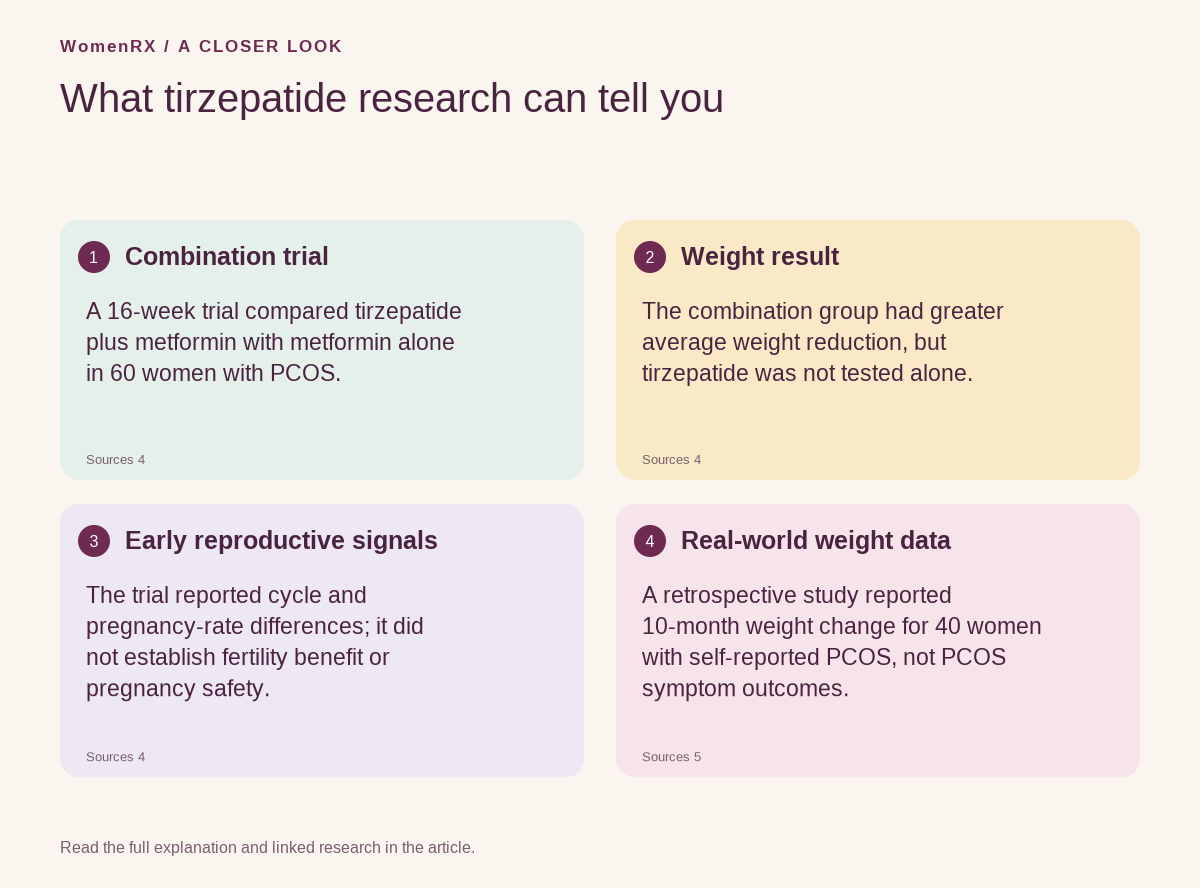
What tirzepatide research can tell you
Combination trial: A 16-week trial compared tirzepatide plus metformin with metformin alone in 60 women with PCOS.4
Weight result: The combination group had greater average weight reduction, but tirzepatide was not tested alone.4
Early reproductive signals: The trial reported cycle and pregnancy-rate differences; it did not establish fertility benefit or pregnancy safety.4
Real-world weight data: A retrospective study reported 10-month weight change for 40 women with self-reported PCOS, not PCOS symptom outcomes.5
Read the figure as text
These studies answer different questions. Weight change is not the same as proof of lasting PCOS or reproductive benefit.- Combination trial: A 16-week trial compared tirzepatide plus metformin with metformin alone in 60 women with PCOS.4
- Weight result: The combination group had greater average weight reduction, but tirzepatide was not tested alone.4
- Early reproductive signals: The trial reported cycle and pregnancy-rate differences; it did not establish fertility benefit or pregnancy safety.4
- Real-world weight data: A retrospective study reported 10-month weight change for 40 women with self-reported PCOS, not PCOS symptom outcomes.5
More questions, answered
Does the PCOS trial show that tirzepatide improves fertility?
No. The small trial reported a higher total pregnancy rate in the group taking tirzepatide plus metformin, but that finding does not prove a fertility benefit or establish pregnancy safety. 4
Do results for other GLP-1 medicines apply to Zepbound?
Not automatically. Findings for medicines such as liraglutide or exenatide are separate from the limited direct research on tirzepatide in PCOS. 4 5
Sources you can check
- PCOS | Polycystic Ovary Syndrome | MedlinePlusAccessed 2026-09-25Return to first citation
- ZEPBOUND (TIRZEPATIDE) INJECTION, SOLUTION ZEPBOUND (TIRZEPATIDE) INJECTION, SOLUTION ZEPBOUND KWIKPEN (TIRZEPATIDE) INJECTION, SOLUTION [ELI LILLY AND COMPANY] | US prescribing information and patient instructionsAccessed 2026-09-25Return to first citation
- Body Weight: MedlinePlusAccessed 2026-09-25Return to first citation
- Short-Term Combined Treatment With Tirzepatide and Metformin for Overweight/Obese Chinese Women With Polycystic Ovary Syndrome: A Prospective, Open-Label, Randomised Controlled Trial.Yang Z, Xu Y, Du H, Liu W, Chen H, Liu D, Zhang L, Wang C. · Diabetes, obesity & metabolism · 2026Return to first citation
- Weight loss outcomes with tirzepatide in women with and without self-reported polycystic ovary syndrome.Clift AK, Reisel D, Johnson H, Sattar N, Huang DR. · Journal of the Endocrine Society · 2026Return to first citation