Tirzepatide for PCOS: What the Early Evidence Shows
There are early weight and reproductive findings, but they come from studies that don’t answer what tirzepatide alone does for PCOS.
You can discuss tirzepatide with your clinician if weight management is one of your goals, but current research doesn’t establish it as a treatment for PCOS itself. Direct PCOS research includes a small trial of tirzepatide combined with metformin and an observational study of weight outcomes. Neither establishes what tirzepatide alone does for cycles or fertility, or answers pregnancy-safety questions. 2 3 4
Weight change and PCOS treatment are different questions
PCOS can involve irregular or absent ovulation, higher androgen levels, and metabolic concerns such as insulin resistance. The mix of symptoms and health concerns varies from person to person. So a change in weight, by itself, doesn’t show that all parts of PCOS have improved. 1
The strongest direct evidence here is a small, 16-week randomized trial in 60 overweight or obese Chinese women with PCOS. It compared metformin alone with metformin plus tirzepatide. The combination group had a greater average weight reduction over 16 weeks: 10.4 kg, compared with 1.7 kg in the metformin-only group. The researchers also reported greater menstrual-cycle recovery and a higher total pregnancy rate in the combination group. 2
That’s a useful early signal, but it has clear boundaries: the trial was short, small, and open-label, and it tested tirzepatide with metformin, not tirzepatide alone. Its pregnancy finding was a higher total pregnancy rate, not proof of a reliable fertility benefit or improved pregnancy outcomes more broadly. The study can’t tell us whether the results last or apply to everyone with PCOS. 2
What the larger weight study can and can’t tell you
A UK retrospective study looked at women using a digital weight-management service. Among women with self-reported PCOS who had a 10-month weight assessment, average weight change was −19.40% (40 women). For women without PCOS, it was −18.74% (397 women). The study found no significant difference between those groups. 3
This offers a real-world weight signal, not evidence that tirzepatide improves PCOS symptoms, ovulation, or fertility. It wasn’t a randomized trial, PCOS was self-reported, and only 40 women with PCOS were included in the 10-month weight result. The figures describe those who reached that follow-up, not every woman with PCOS who started treatment. 3
Match the treatment conversation to your goal
Before weighing options, name the outcome you care about most. It might be weight management, a metabolic concern, more regular periods, or trying to become pregnant. These are related but distinct goals. Ask what improvement would look like for that particular goal and how it would be assessed separately from weight change.
For example, if irregular cycles are your main concern, ask how cycle patterns would be followed and what other PCOS care might be relevant. If weight or metabolic health is the priority, ask how those outcomes would be reviewed. PCOS can be linked to other health concerns, so monitoring should reflect your health picture rather than assume weight is the only measure that matters. 1
Put pregnancy plans on the table early
Tell your prescriber if you’re trying to conceive, might want to become pregnant, or want to avoid pregnancy. Pregnancy and the period around conception remain evidence gaps for incretin medicines in PCOS. That means these studies don’t establish a safe treatment timeline or a contraception plan for you. 4
In the small trial, participants were required to use barrier contraception for eight weeks, and pregnancy outcomes were assessed later. That was the research protocol; it isn’t a general instruction for people taking tirzepatide. Ask your prescriber what applies to your medication and plans, rather than treating the trial schedule as personal guidance. 2
The practical takeaway: early studies suggest weight loss is possible, and one small combination-treatment trial reported menstrual and pregnancy-rate findings. But neither type of study proves tirzepatide alone treats PCOS or reliably improves fertility. A clear treatment goal, a pregnancy conversation, and follow-up focused on the outcome you care about can help you decide whether it belongs in your plan.
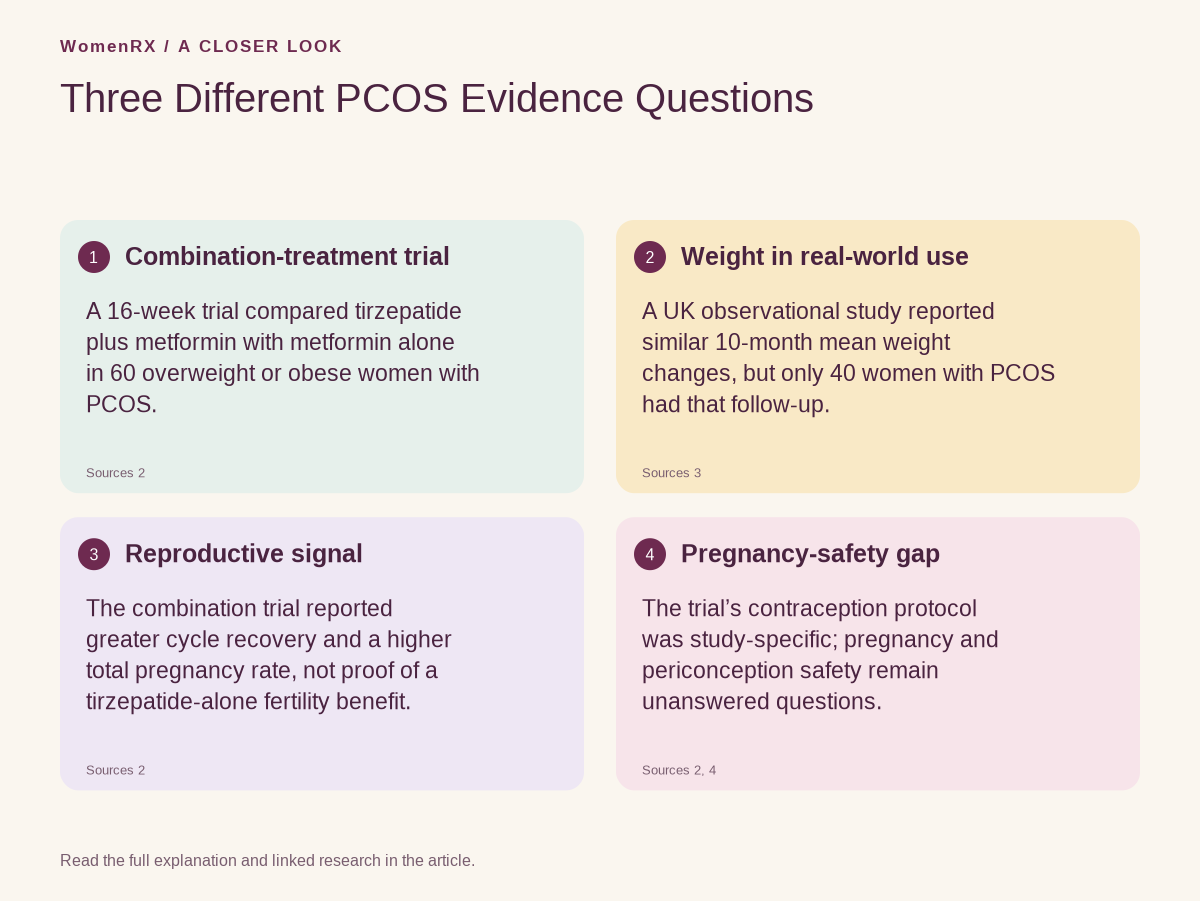
Three Different PCOS Evidence Questions
Combination-treatment trial: A 16-week trial compared tirzepatide plus metformin with metformin alone in 60 overweight or obese women with PCOS.2
Weight in real-world use: A UK observational study reported similar 10-month mean weight changes, but only 40 women with PCOS had that follow-up.3
Reproductive signal: The combination trial reported greater cycle recovery and a higher total pregnancy rate, not proof of a tirzepatide-alone fertility benefit.2
Pregnancy-safety gap: The trial’s contraception protocol was study-specific; pregnancy and periconception safety remain unanswered questions.24
Read the figure as text
Weight results, reproductive findings, and pregnancy safety come from different kinds of evidence and should not be treated as the same outcome.- Combination-treatment trial: A 16-week trial compared tirzepatide plus metformin with metformin alone in 60 overweight or obese women with PCOS.2
- Weight in real-world use: A UK observational study reported similar 10-month mean weight changes, but only 40 women with PCOS had that follow-up.3
- Reproductive signal: The combination trial reported greater cycle recovery and a higher total pregnancy rate, not proof of a tirzepatide-alone fertility benefit.2
- Pregnancy-safety gap: The trial’s contraception protocol was study-specific; pregnancy and periconception safety remain unanswered questions.24
More questions, answered
Did the PCOS trial show a fertility benefit from tirzepatide alone?
No. The 16-week randomized trial tested tirzepatide combined with metformin, not tirzepatide alone. It reported a higher total pregnancy rate for the combination group than for the metformin-only group, but that finding doesn’t establish a fertility benefit from tirzepatide by itself. 2
What should I ask if I may want to become pregnant?
Tell your prescriber about your pregnancy intentions and ask how they affect your treatment and contraception plan. The trial’s eight-week barrier-contraception requirement was part of its research protocol, not general guidance; pregnancy and periconception safety remain evidence gaps. 2 4
Sources you can check
- PCOS | Polycystic Ovary Syndrome | MedlinePlusAccessed 2026-09-25Return to first citation
- Short-Term Combined Treatment With Tirzepatide and Metformin for Overweight/Obese Chinese Women With Polycystic Ovary Syndrome: A Prospective, Open-Label, Randomised Controlled Trial.Yang Z, Xu Y, Du H, Liu W, Chen H, Liu D, Zhang L, Wang C. · Diabetes, obesity & metabolism · 2026Return to first citation
- Weight loss outcomes with tirzepatide in women with and without self-reported polycystic ovary syndrome.Clift AK, Reisel D, Johnson H, Sattar N, Huang DR. · Journal of the Endocrine Society · 2026Return to first citation
- Incretin-Based Anti-obesity Medications in Polycystic Ovary Syndrome: The Evidence Map.Jensterle M, Janez A. · Drugs · 2026Return to first citation