What to Track Early on Zepbound
Early visits are a chance to track weight, tolerability, and dose changes without expecting a fixed week-by-week result.
Track your starting weight, later weights, current dose and dose-change dates, and how you’re tolerating treatment. Those details help put a slow or uneven early change in context. Available real-world studies report weight outcomes at six months or one year, not a guaranteed result by a particular early week. If you’re wondering whether your dose should change, discuss it with your prescriber. 2 3
Early progress isn’t a pass-or-fail test
Zepbound doesn’t come with a reliable week when everyone should see a particular change on the scale. The real-world studies here report outcomes over six months or a year, so those results can give longer-term context, but they can’t promise what you’ll see in your first few weeks. 2 3
That’s why early check-ins can be useful even if your weight hasn’t changed much. They give you and your prescriber a chance to look at the whole picture: the weight trend, how treatment feels, what dose you’re taking, and whether any dose changes or interruptions affect the comparison. If you’re concerned about progress or wondering whether your dose should change, bring that question to your prescriber.
Keep a simple record between visits
You don’t need a complicated tracker. A note on your phone or a few lines in a notebook can capture:
- Starting weight and later weights: Record the date with each measurement so you can compare the trend rather than treating one reading as the verdict.
- Dose and change dates: Write down your current dose and when it changes. Zepbound’s prescribing information refers to dose escalations, and recording them helps distinguish a weight trend during one dose period from a trend after a change. 1
- Tolerability: Note symptoms or other changes that affect eating, drinking, daily activities, or whether you can continue treatment as planned. Bring the details and any dose questions to your follow-up.
- Treatment gaps: If you miss doses or have a gap in treatment, note when it happened. The real-world studies’ results came from defined groups of people who remained on treatment by each study’s criteria, so their averages may not describe someone with a different treatment pattern. 2 3
For weight, consistency makes comparisons more useful: use the same scale when practical and measure under similar conditions. If frequent weighing feels distressing, ask your prescriber what tracking approach makes sense for you.
What six months and one year can tell you
A Massachusetts Medicaid study followed 7,493 adults who started semaglutide or tirzepatide, with or without diabetes. At six months, 86.5% of a selected subgroup with high treatment persistence and adherence had at least a 5% reduction in weight documented at prior-authorization recertification. The subgroup included people taking tirzepatide, semaglutide, or with exposure to both. That figure combines medications, reflects a selected group, and isn’t a Zepbound-only estimate or a personal forecast. 3
A separate US claims study looked at adults with overweight or obesity without type 2 diabetes who stayed on treatment under the study’s persistence definition. Among 3,122 people taking tirzepatide, mean weight change at one year was a loss of 16.5% from baseline. This is an average in a selected real-world group, not a target everyone reaches or a timetable for early loss. 2
The practical takeaway is to use early visits to review your own trend and experience, then keep the longer-term study results in perspective. Ask what the next review point is for you and what would prompt a change in the plan. The studies’ follow-up windows don’t establish a universal early-week benchmark.
Make pregnancy plans part of the conversation
If you’re pregnant or planning a pregnancy, bring that up before starting or continuing treatment. The US prescribing information says weight loss isn’t recommended during pregnancy and advises discontinuing Zepbound when pregnancy is recognized. It also warns that Zepbound may reduce the effectiveness of oral hormonal contraceptives: the label advises using a non-oral method or adding a barrier method for four weeks after starting and for four weeks after each dose escalation. 1
A useful question for your next visit
Instead of asking only, “Should I have lost more by now?” try: “Given my weight trend, dose changes, and how I’m tolerating treatment, what are we reviewing at this visit, and when should we reassess?” That keeps the discussion focused on your actual treatment course rather than a deadline that the longer-term studies don’t establish.
Tracking from start to longer-term review
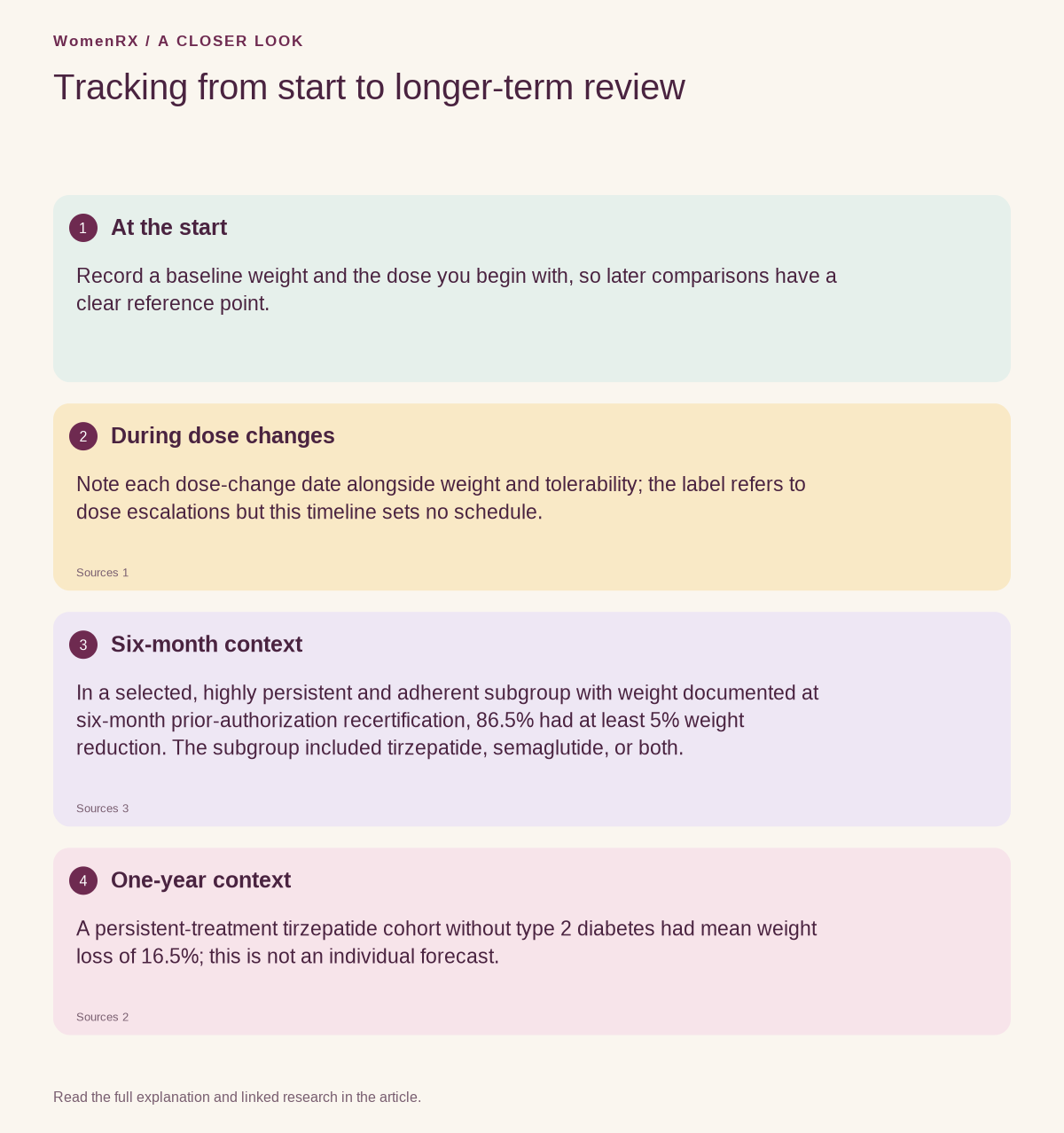
At the start: Record a baseline weight and the dose you begin with, so later comparisons have a clear reference point.
During dose changes: Note each dose-change date alongside weight and tolerability; the label refers to dose escalations but this timeline sets no schedule.1
Six-month context: In a selected, highly persistent and adherent subgroup with weight documented at six-month prior-authorization recertification, 86.5% had at least 5% weight reduction. The subgroup included tirzepatide, semaglutide, or both.3
One-year context: A persistent-treatment tirzepatide cohort without type 2 diabetes had mean weight loss of 16.5%; this is not an individual forecast.2
Read the figure as text
Separate your personal treatment milestones from study follow-up windows; the longer-term results are context, not an early deadline.- At the start: Record a baseline weight and the dose you begin with, so later comparisons have a clear reference point.
- During dose changes: Note each dose-change date alongside weight and tolerability; the label refers to dose escalations but this timeline sets no schedule.1
- Six-month context: In a selected, highly persistent and adherent subgroup with weight documented at six-month prior-authorization recertification, 86.5% had at least 5% weight reduction. The subgroup included tirzepatide, semaglutide, or both.3
- One-year context: A persistent-treatment tirzepatide cohort without type 2 diabetes had mean weight loss of 16.5%; this is not an individual forecast.2
More questions, answered
Did studies show different weight-loss timing for women?
The one-year US claims study included a predominantly female tirzepatide group, but it did not report a separate women’s weight-loss timeline. Its overall average shouldn’t be read as a women-specific estimate. 2
What if the scale is moving slowly?
Record your weight trend and dose-change dates, then discuss your progress and any dose questions with your prescriber. The study results reported at six months and one year don’t establish a dose-adjustment rule for early progress. 2 3
Sources you can check
- ZEPBOUND (TIRZEPATIDE) INJECTION, SOLUTION ZEPBOUND (TIRZEPATIDE) INJECTION, SOLUTION ZEPBOUND KWIKPEN (TIRZEPATIDE) INJECTION, SOLUTION [ELI LILLY AND COMPANY] | US prescribing information and patient instructionsAccessed 2026-09-25Return to first citation
- Real-World Weight Loss Observed With Semaglutide and Tirzepatide in Patients with Overweight or Obesity and Without Type 2 Diabetes (SHAPE).Ng CD, Divino V, Wang J, Toliver JC, Buss M. · Advances in therapy · 2025Return to first citation
- Real-world 6-month persistence, adherence, and effectiveness of GLP-1 medications for overweight and obesity in a Medicaid population.Meyer KB, McVeigh M, Chiara AN, Boss KC, Pomfret TC, Semmel K, Bacon R, Nicolas D, Clements K, Alper CJ, Lenz K. · Journal of managed care & specialty pharmacy · 2026Return to first citation