Tirzepatide and Your Period: What to Track
A changed cycle after starting tirzepatide deserves context, not an automatic assumption that the medicine caused it.
Human evidence doesn’t establish that tirzepatide routinely disrupts periods. The direct human study involved women with PCOS taking tirzepatide with metformin, and found more menstrual cycle recovery than with metformin alone over 16 weeks. That result can’t tell us what happens for most tirzepatide users. Track your usual cycle, changes, treatment timing, weight change, and pregnancy possibility. 3
What the research can, and can’t, tell you
A period that changes after you start Zepbound (tirzepatide) may feel connected to the medication, especially if the timing lines up. But timing alone doesn’t establish cause. The direct tirzepatide study focused on a specific group: 60 Chinese women with overweight or obesity and polycystic ovary syndrome (PCOS), all of whom had irregular periods at the start. In a 16-week open-label randomized trial, menstrual cycle recovery was higher among those taking tirzepatide with metformin than among those taking metformin alone. Because the combination included metformin, and everyone in the study had PCOS, the result doesn’t show that tirzepatide by itself changes periods in people without PCOS. 3
A review of GLP-1 medicines describes some research on menstrual regularity in women with PCOS, but notes that evidence about reproductive outcomes remains limited. Findings in PCOS don’t establish what to expect if your cycles were regular before treatment, or whether changes are caused directly by tirzepatide, weight change, or another factor. 4
Make the change easier to interpret
For a few cycles, note the first day of bleeding, how long it lasts, whether the flow or symptoms differ from your usual pattern, and whether you missed or had a period between bleeds. Add when you started tirzepatide and when the dose changed, along with any notable weight change. These notes aren’t a diagnostic test; they help you and your prescriber see what changed and when.
Also note whether your cycles were already irregular, including if you have PCOS. A period that arrives unexpectedly may be part of an existing irregular pattern rather than a new medication effect. The tirzepatide trial doesn’t answer whether its findings apply to perimenopause, adolescence, or people who have reached menopause. Your life stage and your usual pattern matter when interpreting a new change, but the available study doesn’t give stage-specific guidance. 3
Consider whether your eating or exercise changed substantially, too. Inadequate energy intake is a recognized contributor to menstrual disruption in adolescents; that doesn’t establish why an adult’s period changed after starting tirzepatide. It does make a major shift in eating or activity worth mentioning rather than assuming the medication itself is responsible. 5
Keep pregnancy in the picture
If pregnancy is possible, don’t assume a late or missed period is just a medication or weight-change effect. Tirzepatide’s Mounjaro medication guide says pregnancy risks are not known and warns that birth control pills may not work as well while taking tirzepatide. It says a prescriber may recommend another contraceptive method for four weeks after starting Mounjaro and for four weeks after each dose increase. Because this is the Mounjaro guide, ask your Zepbound prescriber what guidance applies to your treatment. 1
If you become pregnant or think you may be pregnant, contact your prescriber promptly to discuss the medication. Don’t start or stop a medicine on your own; decisions about medicines during pregnancy should be made with a clinician. 12
When to bring it up
Share a cycle change with your prescriber if it keeps happening, differs substantially from your usual pattern, or is worrying you. Get in touch sooner if pregnancy is possible. Bring your notes and mention any history of PCOS or irregular cycles, along with substantial changes in eating or exercise. The goal isn’t to prove that tirzepatide caused the change; it’s to consider the timing alongside your baseline and pregnancy possibility.
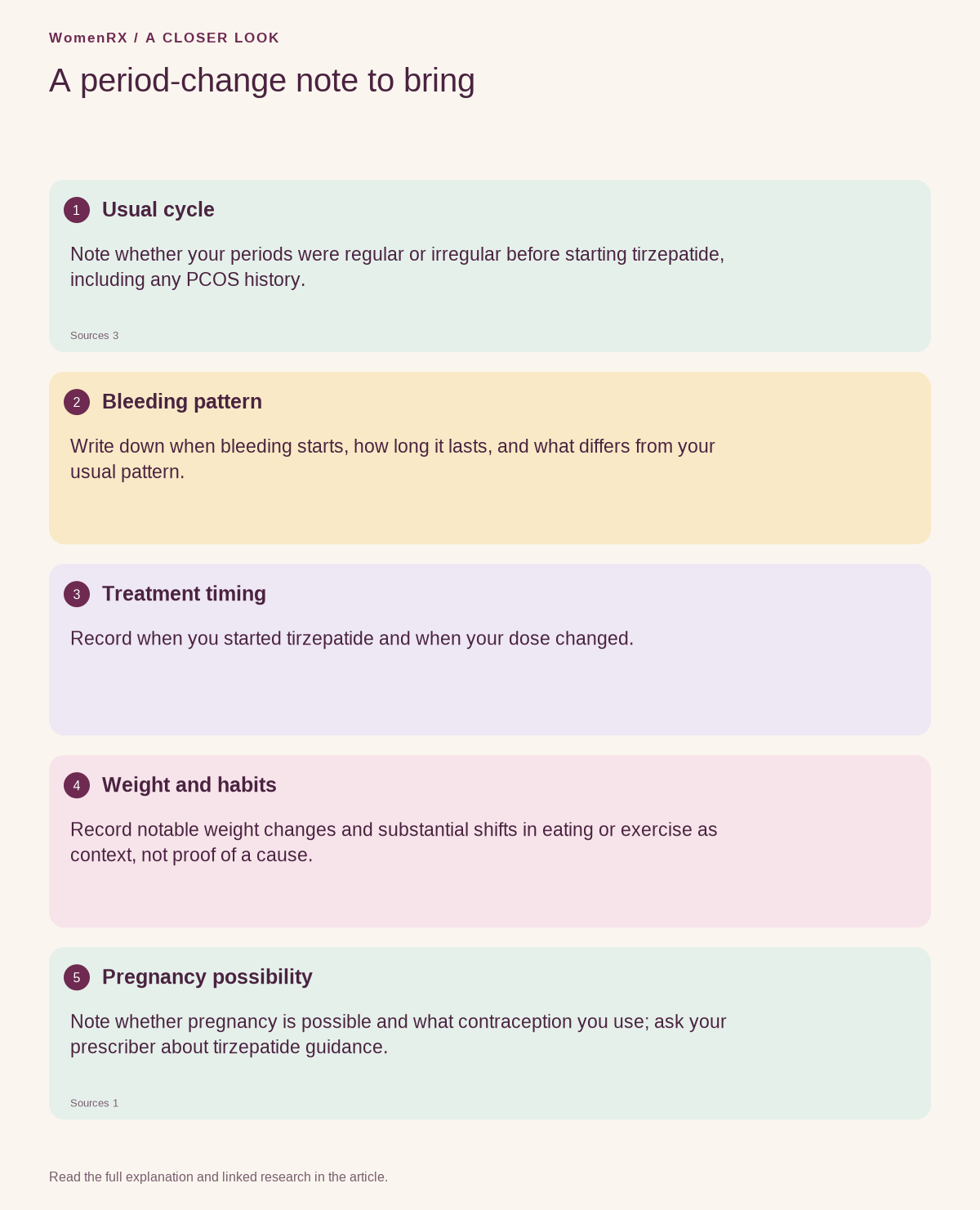
A period-change note to bring
Usual cycle: Note whether your periods were regular or irregular before starting tirzepatide, including any PCOS history.3
Bleeding pattern: Write down when bleeding starts, how long it lasts, and what differs from your usual pattern.
Treatment timing: Record when you started tirzepatide and when your dose changed.
Weight and habits: Record notable weight changes and substantial shifts in eating or exercise as context, not proof of a cause.
Pregnancy possibility: Note whether pregnancy is possible and what contraception you use; ask your prescriber about tirzepatide guidance.1
Read the figure as text
Record these details to make the timing and context of a cycle change easier to discuss.- Usual cycle: Note whether your periods were regular or irregular before starting tirzepatide, including any PCOS history.3
- Bleeding pattern: Write down when bleeding starts, how long it lasts, and what differs from your usual pattern.
- Treatment timing: Record when you started tirzepatide and when your dose changed.
- Weight and habits: Record notable weight changes and substantial shifts in eating or exercise as context, not proof of a cause.
- Pregnancy possibility: Note whether pregnancy is possible and what contraception you use; ask your prescriber about tirzepatide guidance.1
More questions, answered
Can tirzepatide make periods more regular if I have PCOS?
One 16-week trial in women with PCOS found greater menstrual cycle recovery with tirzepatide plus metformin than with metformin alone. It cannot show whether tirzepatide alone caused the difference or whether the finding applies to people without PCOS. 3
Does tirzepatide affect birth control pills?
The Mounjaro medication guide for tirzepatide warns that birth control pills may not work as well while taking it and says a prescriber may recommend another method for four weeks after starting and after each dose increase. Ask your Zepbound prescriber what applies to you. 1
Sources you can check
- MOUNJARO (TIRZEPATIDE) INJECTION, SOLUTION MOUNJARO KWIKPEN (TIRZEPATIDE) INJECTION, SOLUTION [ELI LILLY AND COMPANY] | US prescribing information and patient instructionsAccessed 2026-09-25Return to first citation
- Pregnancy and Medicines | MedlinePlusAccessed 2026-09-25Return to first citation
- Short-Term Combined Treatment With Tirzepatide and Metformin for Overweight/Obese Chinese Women With Polycystic Ovary Syndrome: A Prospective, Open-Label, Randomised Controlled Trial.Yang Z, Xu Y, Du H, Liu W, Chen H, Liu D, Zhang L, Wang C. · Diabetes, obesity & metabolism · 2026Return to first citation
- A Systematic Review on GLP-1 Receptor Agonists in Reproductive Health: Integrating IVF Data, Ovarian Physiology and Molecular Mechanisms.Voros C, Chatzinikolaou F, Papapanagiotou I, Polykalas S, Mavrogianni D, Koulakmanidis AM, Athanasiou D, Kanaka V, Bananis K, Athanasiou A, Athanasiou A, Papadimas G, Tsimpoukelis ... · International journal of molecular sciences · 2026Return to first citation
- The impact of nutrition, exercise, and pharmacotherapy on menstrual health in adolescents with overweight and obesity.Wu J, Jacobson-Dickman E. · Nutrition (Burbank, Los Angeles County, Calif.) · 2026Return to first citation