Hair Shedding on Tirzepatide: What to Track
Hair-loss events have been reported during tirzepatide treatment, but their timing and other changes can help put those reports in context.
Tirzepatide weight-loss trials recorded alopecia, but that broad event label doesn’t confirm a diagnosis or show whether people had diffuse shedding or another hair-loss pattern. A review found the trials didn’t report when the events began. Track treatment dates, weight and eating changes, stress, and life-stage changes to discuss with your prescriber. 5 6
Hair changes can feel alarming when they start during treatment with Zepbound (tirzepatide). In weight-loss trials, a 2026 systematic review reported alopecia in 119 of 2,183 people receiving tirzepatide (5.4%), compared with 22 of 2,221 receiving placebo (0.9%). The trials recorded alopecia as an event; that label doesn’t confirm a particular diagnosis or tell us whether each person experienced diffuse shedding, patterned thinning, or another hair-loss pattern. The trials also didn’t report when the events began. 5 6
That leaves a useful question: what else was happening before you noticed the change? Weight, eating, health, stress, and hormones may all offer relevant context. A timeline can help organize those clues without assuming one is the cause.
Start with the pattern, not just the medicine date
Some forms of hair loss involve diffuse shedding, while others cause gradual, patterned thinning. A 2026 review found that telogen effluvium, a form of diffuse shedding, and androgenetic alopecia, or pattern hair loss, were among the most frequently reported types in GLP-1-related research. The review describes telogen effluvium as temporary shedding associated with stressors, and notes that it can make underlying pattern hair loss more noticeable. 6
Write down whether you’re seeing more loose hairs overall, thinning in a particular area, a widening part, or changes at the hairline. Note when you first noticed it and whether it has changed. These observations don’t diagnose the cause, but they give your clinician more to work with than “my hair started falling out on the medication.”
Build a timeline of possible triggers
For the months around the start of shedding, jot down:
- Treatment: when you started tirzepatide and any dose changes.
- Weight and eating changes: when weight loss became noticeable, whether it was rapid, and whether your eating changed. Rapid weight loss and related metabolic or nutritional changes are discussed as possible triggers for telogen effluvium, but that doesn’t prove they explain any one person’s shedding. 5
- Other stressors and health changes: major physical or emotional stress and health conditions can provide context when considering hair loss. 2 5
- Life-stage changes: recent childbirth, perimenopause or menopause, and any relevant menstrual changes, including unusually heavy periods. Postpartum shedding often appears a few months after delivery as estrogen falls. Menopause is also associated with some forms of alopecia, though the available research describes varied conditions and does not establish a single explanation for hair changes. 1 3
- Scalp and hair changes: whether the shedding is diffuse or patterned and whether the hairline or part looks different.
There isn’t a medication-specific onset window in the trial findings to compare your experience against. The date the hair-loss change began is still useful, especially when considered alongside weight and life events on your timeline. 6
Include women’s health clues without assuming the cause
A systematic review and meta-analysis found lower ferritin levels, on average, among women with nonscarring hair loss than among women without it. That association doesn’t establish that low iron caused an individual’s hair loss, or that iron treatment will help without a deficiency. 4 If your periods have been unusually heavy, mention that as a separate menstrual-history detail, not as an explanation for the shedding.
Thyroid conditions are another possible explanation to raise if relevant: thyroid problems are among the conditions associated with hair loss. 2 If you’re postpartum, the timing matters too: the American Academy of Dermatology says postpartum shedding often appears a few months after delivery and usually peaks around four months. 1
Menopause can bring changes in scalp hair, but the research doesn’t make every change a menopause effect. A systematic review found associations with certain types of alopecia, while also describing limitations and variation in the evidence. Share the timing of your menstrual changes and any hormone therapy with your clinician if they apply. 3
Bring a focused summary to your prescriber
You might say: “I started tirzepatide on this date, noticed the hair change around this date, and my weight and eating changed in these ways. I’ve also had these recent health or life-stage changes.” Then ask whether the pattern and timeline suggest reviewing other causes, including iron status or thyroid problems where appropriate.
Don’t treat a report of hair loss during treatment as proof that tirzepatide is the sole cause. At the same time, it’s reasonable to raise the concern with the prescriber managing your treatment. The goal is to look at the medication, weight change, and other plausible explanations together.
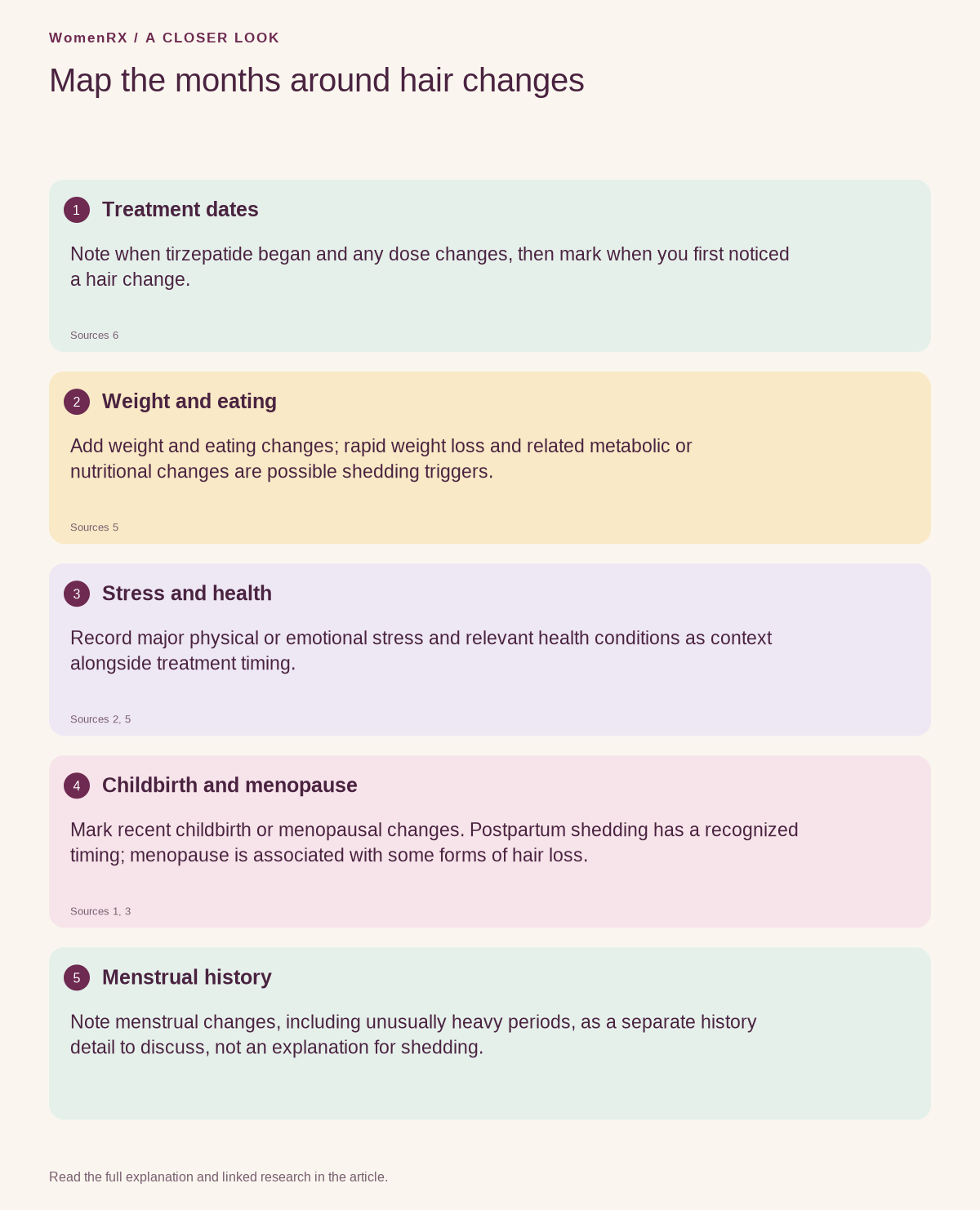
Map the months around hair changes
Treatment dates: Note when tirzepatide began and any dose changes, then mark when you first noticed a hair change.6
Weight and eating: Add weight and eating changes; rapid weight loss and related metabolic or nutritional changes are possible shedding triggers.5
Stress and health: Record major physical or emotional stress and relevant health conditions as context alongside treatment timing.25
Childbirth and menopause: Mark recent childbirth or menopausal changes. Postpartum shedding has a recognized timing; menopause is associated with some forms of hair loss.13
Menstrual history: Note menstrual changes, including unusually heavy periods, as a separate history detail to discuss, not an explanation for shedding.
Read the figure as text
Place treatment dates beside weight, health, stress, and life-stage changes. The map helps organize a clinical discussion; it does not identify a cause by itself.- Treatment dates: Note when tirzepatide began and any dose changes, then mark when you first noticed a hair change.6
- Weight and eating: Add weight and eating changes; rapid weight loss and related metabolic or nutritional changes are possible shedding triggers.5
- Stress and health: Record major physical or emotional stress and relevant health conditions as context alongside treatment timing.25
- Childbirth and menopause: Mark recent childbirth or menopausal changes. Postpartum shedding has a recognized timing; menopause is associated with some forms of hair loss.13
- Menstrual history: Note menstrual changes, including unusually heavy periods, as a separate history detail to discuss, not an explanation for shedding.
More questions, answered
Does the trial evidence show when hair-loss events start?
No. The systematic review reported alopecia in tirzepatide and placebo groups, but said the trials did not report time to onset. The event label doesn’t establish a specific hair-loss pattern or diagnosis. 5 6
Could menopause or thyroid problems be relevant?
They may be worth mentioning, but neither should be assumed to explain the hair change. Thyroid problems are among conditions associated with hair loss, and research links menopause with some forms of alopecia while noting limitations in the evidence. 2 3
Sources you can check
- Hair loss in new moms: Dermatologist tipsAccessed 2026-09-25Return to first citation
- Hair Loss | Alopecia | Alopecia Areata | MedlinePlusAccessed 2026-09-25Return to first citation
- Menopause and Common Dermatoses: A Systematic Review.Roster K, Fleshner L, Karatas TB, Ecanow A, Sayegh A, Farabi B, Marmon S. · American journal of clinical dermatology · 2026Return to first citation
- Iron Deficiency and Nonscarring Alopecia in Women: Systematic Review and Meta-Analysis.Treister-Goltzman Y, Yarza S, Peleg R. · Skin appendage disorders · 2022Return to first citation
- Alopecia as an Emerging Adverse Effect Associated With Glucagon-Like Peptide-1 (GLP-1) Receptor Agonists for Weight Loss: A Scoping Review.Rojas Lopez RF, Lynett Barrera D, Amaya Muñoz MC, Saavedra Diaz MP. · Cureus · 2025Return to first citation
- GLP-1 therapies and hair loss: A systematic review of current evidence and implications for counseling.Gupta AK, Teasell EM, Economopoulos V, Mirmirani P. · Science progress · 2026Return to first citation