Hair Shedding on Zepbound: What to Check First
Hair loss was reported in Zepbound weight-loss trials, but the timing and cause of your shedding can’t be read from that finding alone.
In Zepbound weight-loss trials, hair loss was reported more often by participants taking tirzepatide than by those taking placebo, but those figures don’t show what caused any one person’s shedding or when it began. Compare when you noticed shedding with dose changes, your weight trajectory, eating changes, and other health events. The prescribing-information table doesn’t break results down by sex. 2
What the Zepbound evidence can tell you
Hair loss appears in the US prescribing information for Zepbound. In the pooled weight-reduction trials listed there, it was reported by 5% of participants taking 5 mg, 4% taking 10 mg, and 5% taking 15 mg, compared with 1% taking placebo. The table doesn’t report a sex breakdown, when shedding started, or which type of hair loss participants had. These group results are a reason to take the concern seriously, not proof that tirzepatide caused your hair loss. 2
Newer reviews describe a possible association between GLP-1 medicines, including tirzepatide, and hair loss. But the evidence includes observational studies and reports that often didn’t confirm the diagnosis; it can’t establish the cause for an individual. 3 4
Look at weight change as well as dose
A useful investigation compares several things on one timeline: when shedding became noticeable, when treatment or dose changed, and how your weight and food intake were changing. Also include other major events, illnesses, stress, and medication changes. Thyroid problems, illness, stress, low-protein intake, poor nutrition, and some medicines can also contribute to hair loss, so the injection date alone may leave out important context. 1
Weight loss is one possible link worth considering. Telogen effluvium, a form of shedding, has been reported in GLP-1 medicine research, and reviews suggest that the physical and nutritional changes that can accompany weight loss may contribute. A retrospective cohort study found that GLP-1 medicine users who had hair-loss outcomes had lower follow-up BMI than users without those outcomes; it did not report that comparison specifically for tirzepatide users. That association doesn’t prove weight loss caused the hair loss, and it doesn’t rule out a medication effect or another explanation. 3 5
There isn’t a well-established onset interval in the cited trial information: the prescribing table doesn’t give one, and a review of tirzepatide trials noted that time to onset wasn’t reported. So don’t assume shedding must start immediately after a dose change, or that a delay proves the medicine isn’t involved. 2 4
Notice the pattern, not just the amount
Try to describe what you see. Is the change mostly extra hair coming out, or is thinning becoming more noticeable in a particular area? Reviews most often discuss telogen effluvium and androgenetic, or pattern, hair loss, but many reported cases weren’t clinically characterized. A clinician’s assessment can help distinguish these possibilities and consider other causes. 3 4
The Zepbound trial table doesn’t break hair-loss results down by sex. Your own history can still help make sense of the timeline. If you’ve recently given birth, postpartum shedding is another possibility: it often becomes noticeable a few months after delivery as estrogen levels fall. If your part is gradually widening rather than hair suddenly coming out all over, female-pattern hair loss may fit better; it can also occur alongside shedding. Consider whether you’d noticed thinning before starting Zepbound, including around perimenopause or after menopause, without assuming that life stage or the medicine explains it. 2 7 8 9
Food intake and health history matter here, too. Too little iron or protein can contribute to hair loss. If eating has become difficult or you have reason to suspect an iron deficiency, mention it when the shedding is assessed rather than starting an iron supplement on a guess. A dermatologist may recommend blood tests when a deficiency or another underlying cause is suspected. 8 9
Make the timeline useful
A simple note can help connect the dots without treating the timeline as a diagnosis. Record:
- When shedding first became noticeable, and whether it’s changing.
- Treatment and dose-change dates, alongside your weight trend.
- Changes in appetite, food intake, or protein intake.
- Recent illness, stress, childbirth, or other medication changes.
- Whether the change looks like widespread shedding or a widening part or other localized thinning.
Bring that summary to the clinician managing your Zepbound or to a dermatologist if you’re concerned. Ask what other explanations fit your pattern and whether any health or nutrition factors should be assessed. Low-protein intake and thyroid problems are among the possible causes listed in general hair-loss guidance. 1
Don’t treat the trial percentages as a personal prediction. Reviews haven’t established a single cause or mechanism for hair loss reported with GLP-1 medicines. The most useful next step is to assess the pattern and the full timeline together. 3 6
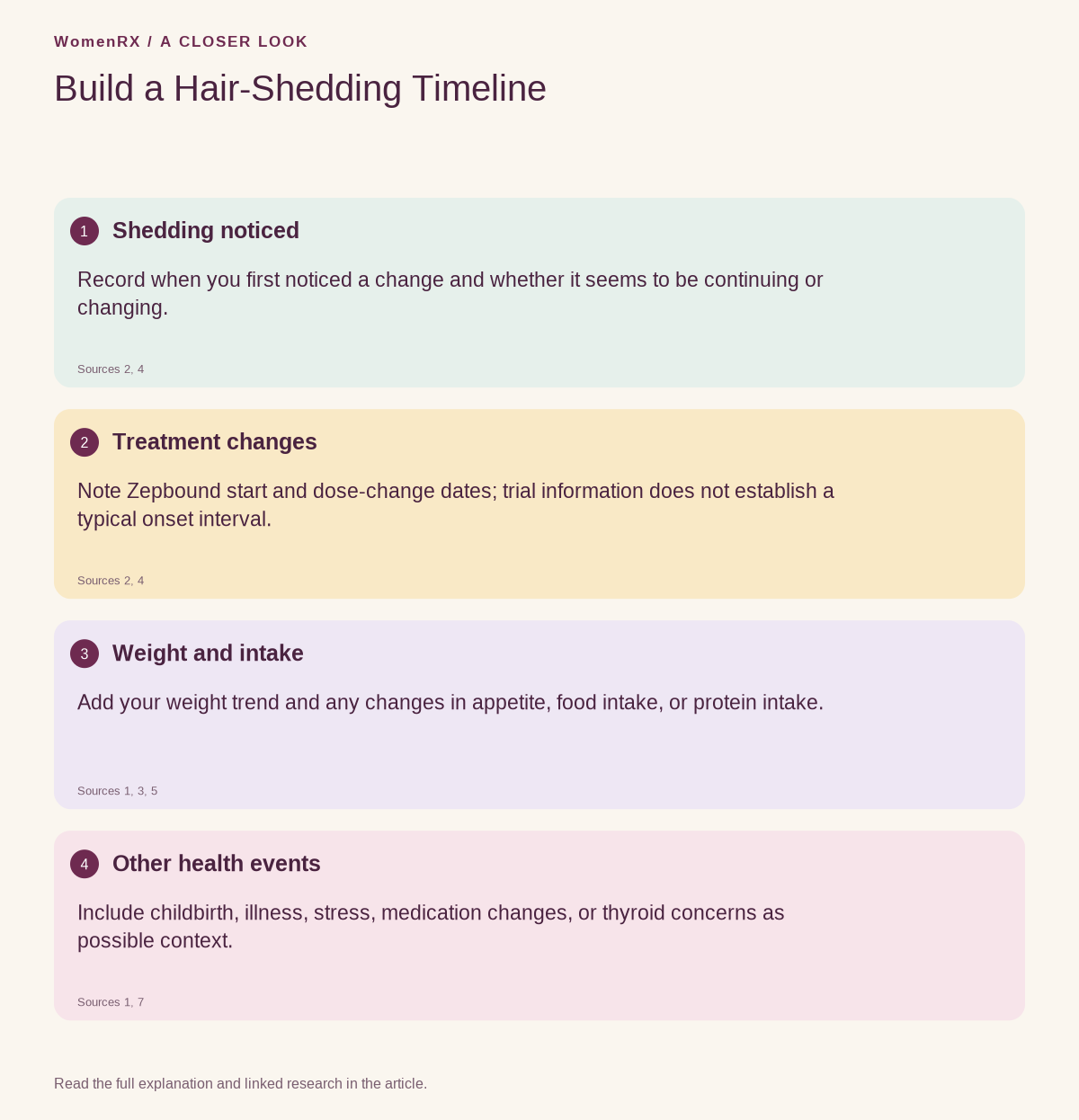
Build a Hair-Shedding Timeline
Shedding noticed: Record when you first noticed a change and whether it seems to be continuing or changing.24
Treatment changes: Note Zepbound start and dose-change dates; trial information does not establish a typical onset interval.24
Weight and intake: Add your weight trend and any changes in appetite, food intake, or protein intake.135
Other health events: Include childbirth, illness, stress, medication changes, or thyroid concerns as possible context.17
Read the figure as text
Compare when shedding appeared with treatment, weight, intake, and other health changes. The timeline is a review aid, not a test for cause.- Shedding noticed: Record when you first noticed a change and whether it seems to be continuing or changing.24
- Treatment changes: Note Zepbound start and dose-change dates; trial information does not establish a typical onset interval.24
- Weight and intake: Add your weight trend and any changes in appetite, food intake, or protein intake.135
- Other health events: Include childbirth, illness, stress, medication changes, or thyroid concerns as possible context.17
More questions, answered
Does hair shedding mean Zepbound is definitely the cause?
No. Hair loss was reported more often in the Zepbound weight-loss trial table than with placebo, but those group figures can’t identify the cause in an individual. Weight change, nutrition, illness, stress, thyroid problems, and some medicines are other possibilities to consider. 1 2
Do the trial results show whether women are more affected?
The Zepbound prescribing-information table reports hair-loss percentages but doesn’t break them down by sex. A review describes a possible signal in women across GLP-1 medicines, but it also says the evidence needs stronger studies before risk and causality are clear. 2 4
Sources you can check
- Hair Loss | Alopecia | Alopecia Areata | MedlinePlusAccessed 2026-09-25Return to first citation
- ZEPBOUND (TIRZEPATIDE) INJECTION, SOLUTION ZEPBOUND (TIRZEPATIDE) INJECTION, SOLUTION ZEPBOUND KWIKPEN (TIRZEPATIDE) INJECTION, SOLUTION [ELI LILLY AND COMPANY] | US prescribing information and patient instructionsAccessed 2026-09-25Return to first citation
- Alopecia as an Emerging Adverse Effect Associated With Glucagon-Like Peptide-1 (GLP-1) Receptor Agonists for Weight Loss: A Scoping Review.Rojas Lopez RF, Lynett Barrera D, Amaya Muñoz MC, Saavedra Diaz MP. · Cureus · 2025Return to first citation
- GLP-1 therapies and hair loss: A systematic review of current evidence and implications for counseling.Gupta AK, Teasell EM, Economopoulos V, Mirmirani P. · Science progress · 2026Return to first citation
- Nonscarring Alopecia in Adults Treated With GLP-1s: A Propensity Score Matched TriNetX Cohort Study.Katragadda R, Hayden J, Saltagi AK, Welschmeyer AF, Quereshy HA, Karasik D, Rabbani CC, Gourishetti SC, Goslawski AM. · The Laryngoscope · 2026Return to first citation
- The Role of Glucagon-Like Peptide-1 Receptor Agonists in Hair Loss: Clinical Evidence and Proposed Mechanisms.Zarabian N, Farah M, Stines A, Friedman A. · Dermatologic surgery : official publication for American Society for Dermatologic Surgery [et al.] · 2026Return to first citation
- Hair loss in new moms: Dermatologist tipsAccessed 2026-09-25Return to first citation
- Hair loss: Diagnosis and treatmentAccessed 2026-09-25Return to first citation
- Hair loss: Who gets and causesAccessed 2026-09-25Return to first citation