Hair Shedding on Mounjaro: What Should You Review?
Hair loss has been reported during tirzepatide treatment, but current studies can’t tell whether the medicine itself, weight change, or another factor is responsible.
If you notice shedding while taking Mounjaro for type 2 diabetes, compare when it began with dose changes, weight loss, illness, and other health or treatment changes. A retrospective cohort study found an association between tirzepatide and hair-loss diagnoses, especially telogen effluvium, but it can’t show that tirzepatide directly caused them. The study abstract doesn’t report sex-specific results. 2
Hair shedding can be upsetting, especially when it starts after a medication change. With Mounjaro (tirzepatide), the evidence supports taking the concern seriously, but not assuming a single cause: hair-loss diagnoses have been associated with tirzepatide use, while weight change and other health factors may also be involved. The available research does not establish which explanation applies to you. 2
Start with what you noticed and when
Write down when you first noticed a change in your hair, how you would describe it, and whether it is getting better, worse, or staying about the same. Then compare those dates with your Mounjaro start date, dose changes, weight trend, recent illness, and other medication or health changes. A timeline helps you see what came before and after the shedding began; it can’t prove what caused it.
Weight change is worth including because it can happen during diabetes treatment with Mounjaro. In one 40-week monotherapy trial in adults with type 2 diabetes, average weight change ranged from a loss of 6.3 to 7.8 kg across Mounjaro dose groups, compared with a 1.0 kg loss with placebo. Those are trial averages, not a prediction of what will happen to you, and the trial results don’t show that weight loss caused hair shedding. 1
What the tirzepatide research can, and can’t, say
A 2026 retrospective cohort study compared adults with type 2 diabetes or obesity who used GLP-1 medicines with matched nonusers. Tirzepatide use was associated with higher odds of telogen effluvium diagnoses at the study’s follow-up points, and follow-up BMI was lower among GLP-1 users with hair-loss outcomes than among users without them. The authors suggested weight-loss-related physiological stress might contribute. Because this was an observational study, it can show an association, not prove that tirzepatide caused shedding or that weight loss explains it. The abstract does not report sex-specific results, and the follow-up periods are not a timetable for when shedding should start. 2
A separate review found mixed results across a small set of studies: some reported hair loss as an adverse event, while others described hair improvement or regrowth. The review included different hair-loss diagnoses, including androgenic alopecia and telogen effluvium. That mix doesn’t establish that tirzepatide protects hair, causes loss, or has no effect. 3
A retrospective study of FDA adverse-event reports found higher reporting rates for alopecia with GLP-1 medicines used for type 2 diabetes than with those used for weight management. This is a comparison of reports by treatment indication, not proof that people with diabetes are more likely to lose hair. The reports can’t establish how often hair loss occurs among everyone taking these medicines or prove that a medicine caused it. 4
Include the health context that matters to you
Describe the change you’ve noticed rather than trying to name a hair-loss condition yourself. The research uses several different hair-loss diagnoses, so a report of “alopecia” alone doesn’t say what an individual noticed. 2 3
If relevant to you, you may also want to note heavy periods, recent pregnancy or postpartum changes, and where you are in the menopause transition. These are parts of your personal history you can share, not proof of a cause; the tirzepatide cohort abstract doesn’t report women-specific results or establish how these factors relate to shedding during treatment. Also include recent illness, major changes in eating or weight, and other medicines or treatments that changed around the same time.
Use the dates to guide the next conversation
Bring your timeline and medication list to the clinician who manages your diabetes, or to a dermatologist if you’re being evaluated for hair loss. Ask how what you’ve noticed and its timing fit together, whether weight change or another health factor could be relevant, and what further evaluation makes sense. The aim is to assess the likely contributors together, rather than conclude from timing alone that Mounjaro is the cause.
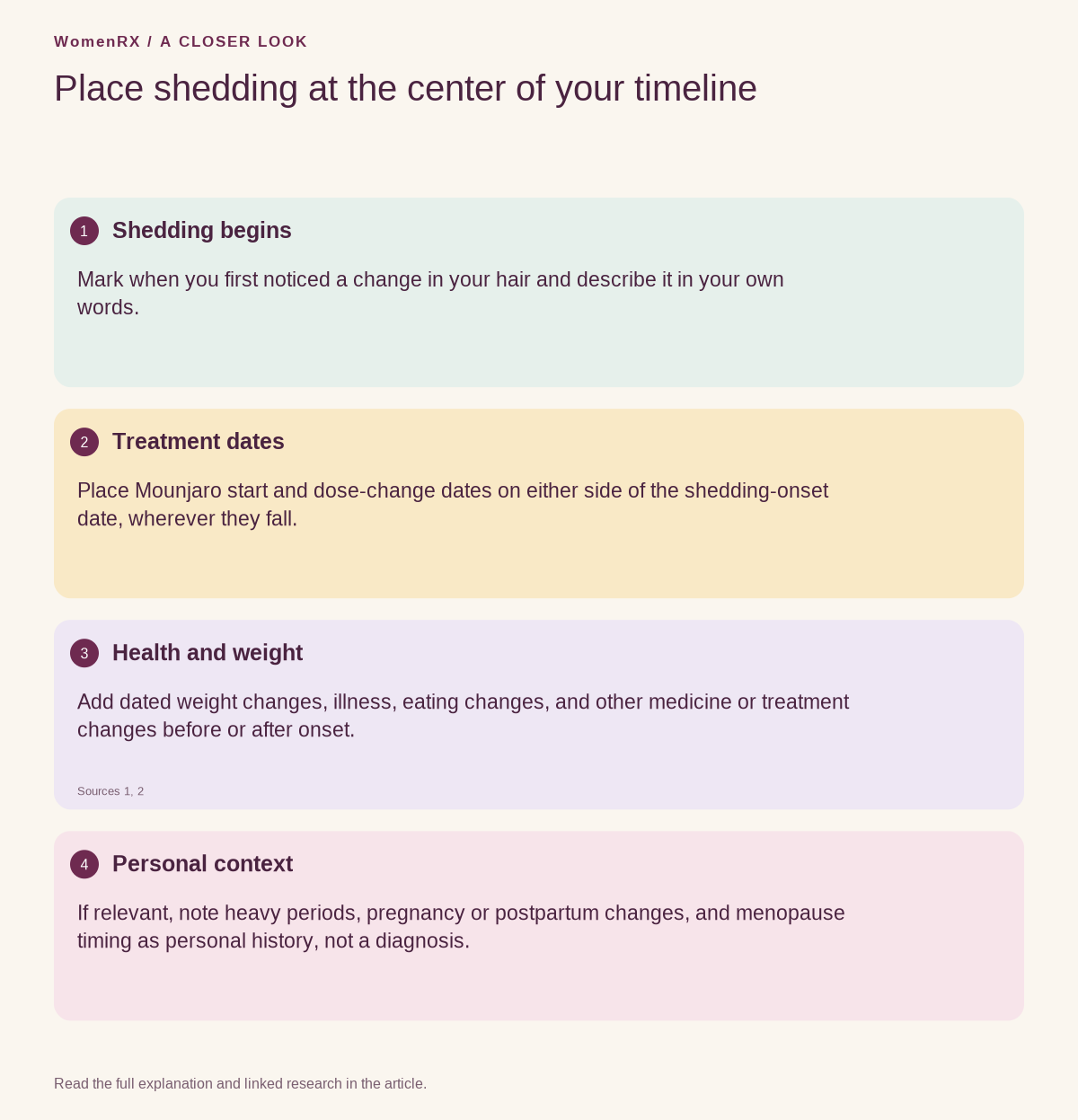
Place shedding at the center of your timeline
Shedding begins: Mark when you first noticed a change in your hair and describe it in your own words.
Treatment dates: Place Mounjaro start and dose-change dates on either side of the shedding-onset date, wherever they fall.
Health and weight: Add dated weight changes, illness, eating changes, and other medicine or treatment changes before or after onset.12
Personal context: If relevant, note heavy periods, pregnancy or postpartum changes, and menopause timing as personal history, not a diagnosis.
Read the figure as text
Use the date you first noticed shedding as the reference point, then place dated changes before or after it. The order can help organize your history, but it doesn’t prove cause.- Shedding begins: Mark when you first noticed a change in your hair and describe it in your own words.
- Treatment dates: Place Mounjaro start and dose-change dates on either side of the shedding-onset date, wherever they fall.
- Health and weight: Add dated weight changes, illness, eating changes, and other medicine or treatment changes before or after onset.12
- Personal context: If relevant, note heavy periods, pregnancy or postpartum changes, and menopause timing as personal history, not a diagnosis.
More questions, answered
Does hair loss mean Mounjaro is definitely the cause?
No. Observational research found an association between tirzepatide use and hair-loss diagnoses, but it can’t establish that the medicine caused the loss or separate its effects from weight change and other factors. 2
Do studies show whether women are more likely to shed hair on tirzepatide?
The cohort-study abstract does not report sex-stratified results, so it doesn’t show whether hair-loss outcomes differ for women. 2
Sources you can check
- MOUNJARO (TIRZEPATIDE) INJECTION, SOLUTION MOUNJARO KWIKPEN (TIRZEPATIDE) INJECTION, SOLUTION [ELI LILLY AND COMPANY] | US prescribing information and patient instructionsAccessed 2026-09-25Return to first citation
- Nonscarring Alopecia in Adults Treated With GLP-1s: A Propensity Score Matched TriNetX Cohort Study.Katragadda R, Hayden J, Saltagi AK, Welschmeyer AF, Quereshy HA, Karasik D, Rabbani CC, Gourishetti SC, Goslawski AM. · The Laryngoscope · 2026Return to first citation
- Hair Loss Associated With Glucagon-Like Peptide-1 (GLP-1) Receptor Agonist Use: A Systematic Review.Alsuwailem OA, Alanazi R, Almutairi HM, Asiree RH, Almutairi W, Almutairi TM, Zamandar A, Alkhames S. · Cureus · 2025Return to first citation
- A Retrospective Comparative Analysis of Cutaneous Adverse Reactions in GLP-1 Agonist Therapies.Daniel S, Waggett S, Lyles E, Sagut P, Shamaei Zadeh P, Marcelletti A, Stegura C, Wine Lee L. · Journal of drugs in dermatology : JDD · 2025Return to first citation