Taking Mounjaro With Metformin: What to Review
Tirzepatide has been studied alongside metformin for type 2 diabetes, but your other medicines and reason for taking metformin shape what to monitor.
Yes, tirzepatide (Mounjaro) has been studied as an add-on to metformin in adults with type 2 diabetes. In one trial of people taking metformin with or without an SGLT2 inhibitor, tirzepatide reduced A1C more than insulin degludec and had fewer reported hypoglycemia events. Those results do not determine an individual dose change or monitoring plan. 3 Review your glucose-monitoring plan, digestive symptoms, and all other glucose-lowering medicines with your prescriber. 34

What the combination evidence actually covers
For type 2 diabetes, using tirzepatide with metformin is not an unusual pairing in clinical research. In a 52-week randomized trial, adults whose diabetes was not adequately controlled on metformin, with or without an SGLT2 inhibitor, received tirzepatide or insulin degludec. At 52 weeks, A1C fell by 1.93 to 2.37 percentage points across the tirzepatide groups, compared with 1.34 points with insulin degludec. Hypoglycemia below 54 mg/dL or severe hypoglycemia was reported in 1% to 2% of tirzepatide participants, compared with 7% of those assigned insulin degludec. Participants were insulin-naive at enrollment, and the trial compared tirzepatide with insulin degludec, not tirzepatide taken alongside insulin. 3
A separate two-year trial studied adults with early type 2 diabetes that was not controlled with metformin. Tirzepatide was compared with intensified conventional care. After two years, A1C fell by an average of 1.99 percentage points with tirzepatide versus 1.32 points with conventional care; the tirzepatide group also had greater reductions in weight and waist circumference. The trial summary does not report a hypoglycemia comparison. Neither trial establishes one metformin dose adjustment that applies to every person. 34
So the useful question isn’t simply, “Can these medicines be taken together?” It’s, “What is each medicine meant to do in my plan, and how will we tell whether the plan is working or causing problems?”
Make room for digestive side effects
Gastrointestinal effects were the most common side effects reported with tirzepatide in the 52-week trial, in which participants were also taking metformin. Nausea, diarrhea, decreased appetite, and vomiting occurred more often in the tirzepatide groups than in the insulin degludec group, and the trial describes these effects as generally mild to moderate. Because both groups took metformin, the trial cannot isolate each medicine’s contribution to digestive symptoms or compare the combination with metformin alone. 3
If you already have digestive symptoms, note when they happen and whether they change after starting tirzepatide or after a planned dose change. That detail can help your prescriber consider the medicines separately rather than assuming every symptom has the same cause.
Let your full diabetes regimen guide monitoring
Glucose monitoring matters in diabetes care, but the best method and frequency depend on the person. MedlinePlus advises asking your care team how and how often to check blood glucose. 2 A practical review is to ask what readings to track while tirzepatide is being introduced or adjusted, and what changes should prompt a message or call.
Be specific about every glucose-lowering medicine you take, including insulin or other pills. The lower hypoglycemia rate reported for tirzepatide than for insulin degludec was a comparison between treatments in people previously taking metformin, sometimes with an SGLT2 inhibitor. It does not describe the hypoglycemia rate for someone taking tirzepatide alongside insulin. 3 Bring the names and current doses of your medicines to the discussion, but treat any dose change as a decision to make with the prescriber who knows your treatment goals and glucose readings.
The trial also used a planned tirzepatide dose increase: participants started at 2.5 mg and increased by 2.5 mg every four weeks until they reached their assigned trial dose. That was a study protocol, not a schedule to apply to your prescription. Ask your prescriber what changes, if any, are planned for tirzepatide, metformin, or your other diabetes medicines. 3
If metformin is part of PCOS care
Metformin is also used for PCOS, but that is a different treatment question from adding tirzepatide for type 2 diabetes. 1 The diabetes trials described above studied people with type 2 diabetes and focused on outcomes such as A1C, weight, and side effects. They do not answer whether taking tirzepatide with metformin improves PCOS-related menstrual cycles, ovulation, or fertility. 34
If you take metformin for PCOS, make sure your prescriber knows that is the reason. Ask what outcome the proposed combination is intended to address and how you’ll assess whether it is helping. Diabetes results should not be treated as proof of a reproductive benefit.
A focused medication review
You can make the conversation more useful by asking:
- What is the goal of adding tirzepatide in my case: glucose control, weight management, or both?
- Which glucose readings should I follow, and how often?
- Which digestive changes should I report, especially if I already have symptoms?
- Do my other diabetes medicines change what we should monitor?
- What dose changes are planned for each medicine, and who should I contact if side effects make that plan difficult?
- If I take metformin for PCOS, what outcome are we expecting beyond the diabetes-trial results?
The answers should fit your diagnosis and your whole medication list. Evidence for a combination in type 2 diabetes is a helpful starting point, not a substitute for a plan tailored to your situation. 234
Metformin for Diabetes or PCOS: What to Review
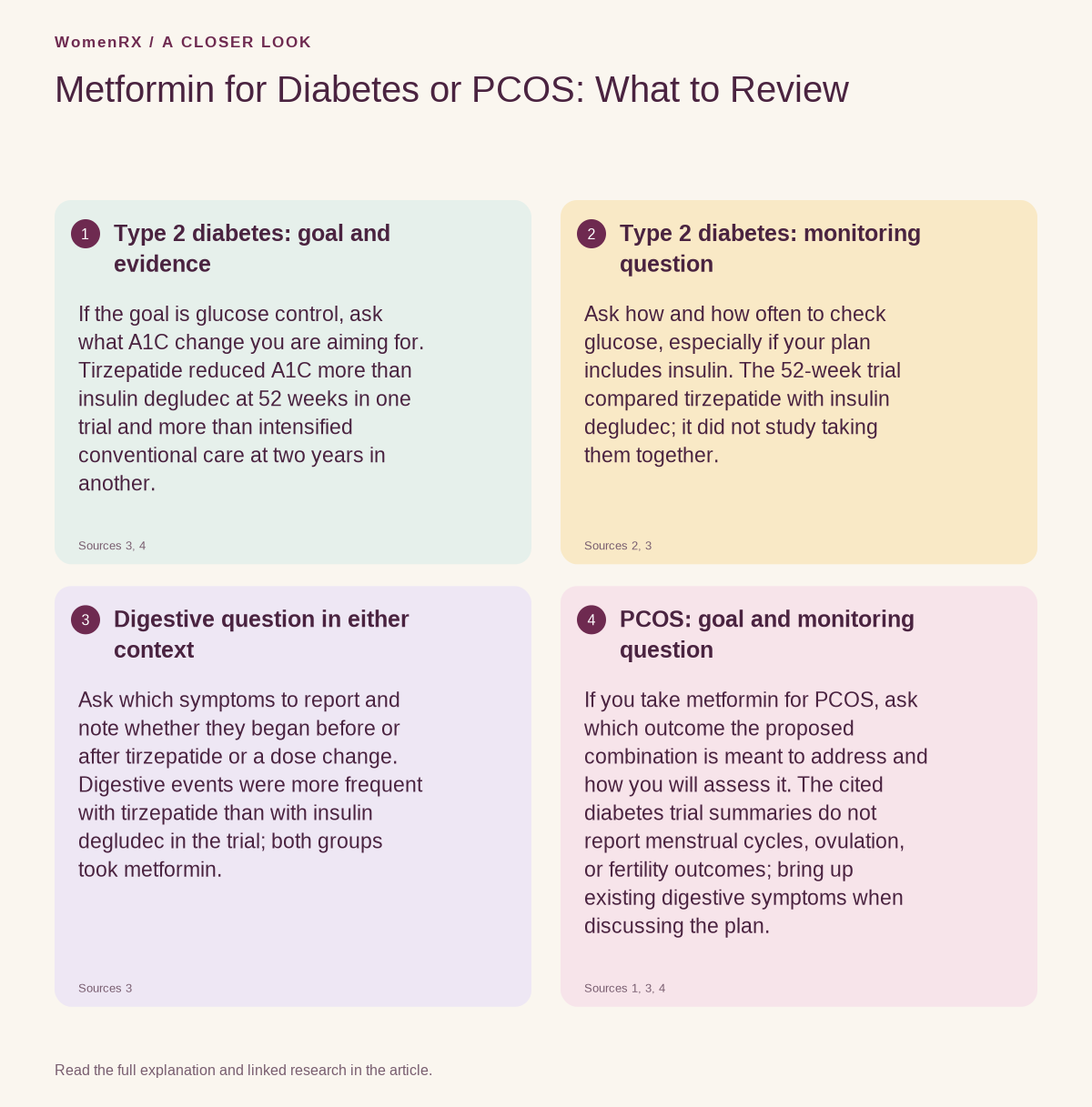
Type 2 diabetes: goal and evidence: If the goal is glucose control, ask what A1C change you are aiming for. Tirzepatide reduced A1C more than insulin degludec at 52 weeks in one trial and more than intensified conventional care at two years in another.34
Type 2 diabetes: monitoring question: Ask how and how often to check glucose, especially if your plan includes insulin. The 52-week trial compared tirzepatide with insulin degludec; it did not study taking them together.23
Digestive question in either context: Ask which symptoms to report and note whether they began before or after tirzepatide or a dose change. Digestive events were more frequent with tirzepatide than with insulin degludec in the trial; both groups took metformin.3
PCOS: goal and monitoring question: If you take metformin for PCOS, ask which outcome the proposed combination is meant to address and how you will assess it. The cited diabetes trial summaries do not report menstrual cycles, ovulation, or fertility outcomes; bring up existing digestive symptoms when discussing the plan.134
Read the figure as text
Start with why you take metformin, then ask which outcomes and symptoms to follow.- Type 2 diabetes: goal and evidence: If the goal is glucose control, ask what A1C change you are aiming for. Tirzepatide reduced A1C more than insulin degludec at 52 weeks in one trial and more than intensified conventional care at two years in another.34
- Type 2 diabetes: monitoring question: Ask how and how often to check glucose, especially if your plan includes insulin. The 52-week trial compared tirzepatide with insulin degludec; it did not study taking them together.23
- Digestive question in either context: Ask which symptoms to report and note whether they began before or after tirzepatide or a dose change. Digestive events were more frequent with tirzepatide than with insulin degludec in the trial; both groups took metformin.3
- PCOS: goal and monitoring question: If you take metformin for PCOS, ask which outcome the proposed combination is meant to address and how you will assess it. The cited diabetes trial summaries do not report menstrual cycles, ovulation, or fertility outcomes; bring up existing digestive symptoms when discussing the plan.134
More questions, answered
Does taking metformin mean I need a different dose when starting Mounjaro?
The diabetes studies found greater A1C reductions with tirzepatide than with their respective comparators, but they do not establish a single metformin dose change for everyone. 34 One trial increased tirzepatide on a set study schedule, but that protocol does not determine your doses. Ask your prescriber what, if anything, should change in your plan. 34
Do diabetes studies show that this combination improves PCOS fertility outcomes?
The cited diabetes trial summaries report outcomes such as A1C, weight, and side effects, but do not report ovulation or fertility outcomes. Those results cannot establish a reproductive benefit for people taking metformin for PCOS. 134
Sources you can check
- Metformin: a medicine to treat type 2 diabetes - NHSAccessed 2026-09-25Return to first citation
- Diabetes | Type 1 Diabetes | Type 2 Diabetes | MedlinePlusAccessed 2026-09-25Return to first citation
- Once-weekly tirzepatide versus once-daily insulin degludec as add-on to metformin with or without SGLT2 inhibitors in patients with type 2 diabetes (SURPASS-3): a randomised, open-label, parallel-group, phase 3 trial.Ludvik B, Giorgino F, Jódar E, Frias JP, Fernández Landó L, Brown K, Bray R, Rodríguez Á. · Lancet (London, England) · 2021Return to first citation
- Tirzepatide Versus Intensified Conventional Care After 2 Years of Treatment in Early Type 2 Diabetes : A Randomized Clinical Trial.Del Prato S, Heine RJ, Pérez Manghi FC, Hsia SH, Gomez-Valderas E, Zeytinoglu M, Razzoli E, Kiljanski J, Sharma P, Knights A, Thieu VT. · Annals of internal medicine · 2026Return to first citation