Mounjaro and High Blood Pressure: What to Review
Tirzepatide lowered average blood pressure in a trial, but your readings and current treatment plan should guide any changes.
Having high blood pressure doesn’t automatically rule out taking or considering Mounjaro (tirzepatide): a trial analysis included people across baseline blood-pressure categories and found lower average readings with treatment. But that result doesn’t replace your hypertension plan or tell you whether to change a medicine. Review your reading trend and full medication list with your prescriber. 4
What the trial can tell you
In a post hoc analysis of the randomized SURMOUNT-1 trial, participants with overweight or obesity who received tirzepatide had average blood-pressure readings 6.8 mm Hg lower systolic and 4.2 mm Hg lower diastolic than those who received placebo after 72 weeks. The reduction happened mainly in the first 24 weeks, then readings stabilized. Researchers found the pattern was broadly consistent across starting blood-pressure categories. These are group averages, not a forecast for your individual readings. 4
The analysis estimated that weight loss accounted for much of the blood-pressure reduction. It also found that low-blood-pressure adverse events were more frequent with tirzepatide, though described as infrequent. A separate meta-analysis of 32 trials involving 47,332 people with type 2 diabetes or obesity reported a lower relative risk of hypertension-related events and a higher relative risk of hypotension-related events with tirzepatide. Those relative risks don’t tell you your personal likelihood, and they don’t mean everyone’s blood pressure will fall. 3 4
So, high blood pressure is a reason to review your plan, not a reason to assume tirzepatide will treat it or that your blood-pressure medicines should be adjusted. Hypertension treatment can include lifestyle changes and one or more medicines. 1 2
Make the reading trend useful
High blood pressure often has no symptoms, so readings can reveal a change you might not feel. Bring a record of the numbers, dates, and times to your follow-up. If a reading seems different from your usual pattern, record it rather than relying on memory. Ask your care team how often to check and what changes in your readings should prompt a call. 1
A very high reading needs a more immediate response: MedlinePlus identifies readings higher than 180 systolic and higher than 120 diastolic as a hypertensive crisis and advises seeking medical care right away. 1
If your readings are trending lower after starting tirzepatide, ask whether your hypertension plan needs review. Don’t stop, skip, or reduce a prescribed blood-pressure medicine based on a few readings without guidance. The trial’s average result can’t determine what is right for your treatment. 1 4
Review the whole medicine list
Bring the names of all your blood-pressure medicines, how you take them, and any recent changes. Include other medicines and supplements so your prescriber can review the full picture. Different blood-pressure medicines work in different ways: diuretics help remove extra water and sodium, while ACE inhibitors and ARBs help blood vessels stay less narrowed. Some people need more than one type of medicine. 2
This research doesn’t establish whether a particular antihypertensive medicine should be adjusted for you. A review of incretin medicines also noted that trials hadn’t used blood-pressure reduction as their primary outcome when studying how these therapies interact with blood-pressure medicines. That limitation makes your own readings and medication review especially relevant; it is not proof of a specific interaction or that none exists. 5
At follow-up, ask what range is appropriate for you, what lower readings or symptoms should prompt contact, and when to review your plan again. The trial found a blood-pressure effect on average, but it doesn’t make tirzepatide a substitute for hypertension treatment. 1 4
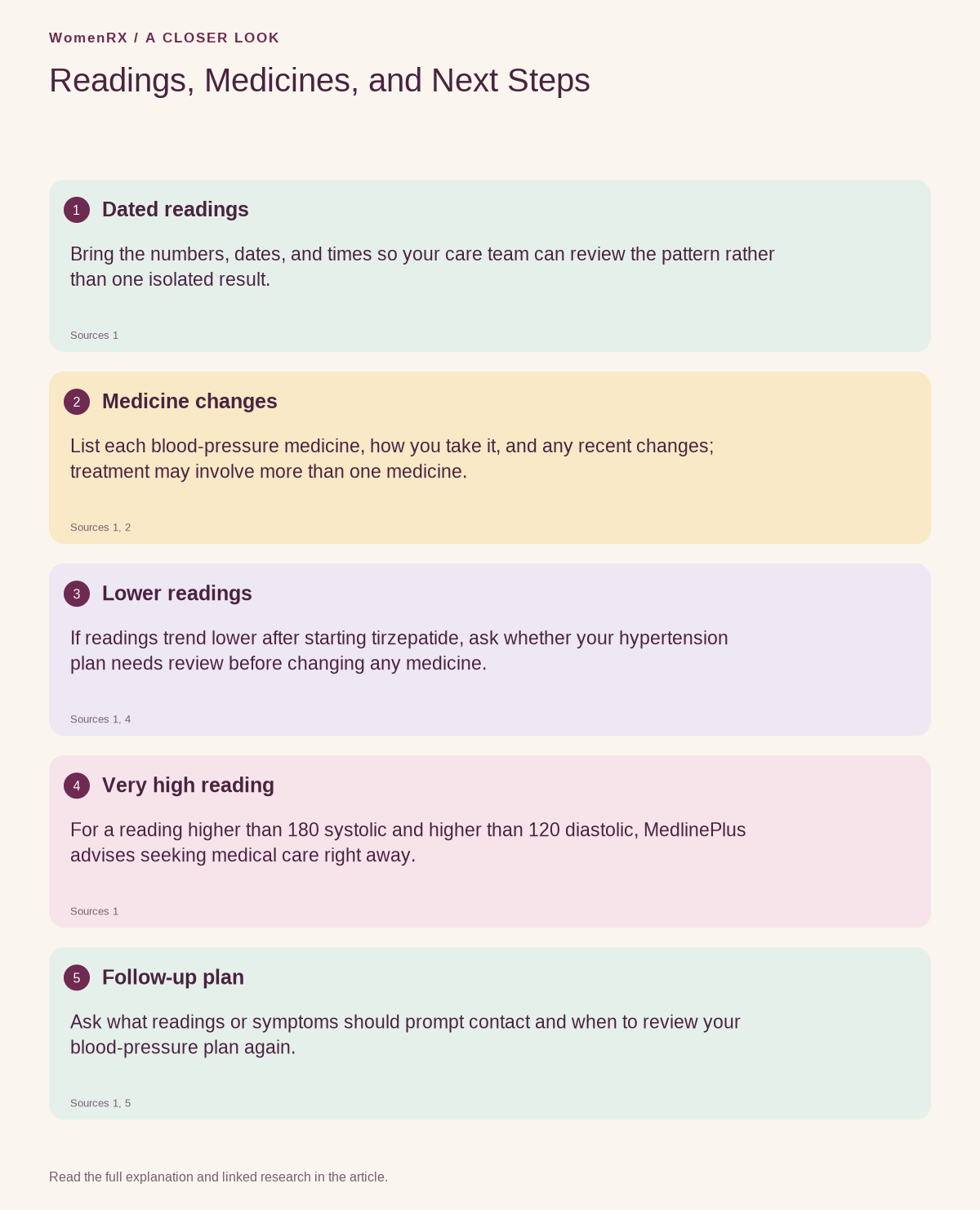
Readings, Medicines, and Next Steps
Dated readings: Bring the numbers, dates, and times so your care team can review the pattern rather than one isolated result.1
Medicine changes: List each blood-pressure medicine, how you take it, and any recent changes; treatment may involve more than one medicine.12
Lower readings: If readings trend lower after starting tirzepatide, ask whether your hypertension plan needs review before changing any medicine.14
Very high reading: For a reading higher than 180 systolic and higher than 120 diastolic, MedlinePlus advises seeking medical care right away.1
Follow-up plan: Ask what readings or symptoms should prompt contact and when to review your blood-pressure plan again.15
Read the figure as text
Use this checklist to connect your blood-pressure pattern with the medicines and changes your care team needs to review.- Dated readings: Bring the numbers, dates, and times so your care team can review the pattern rather than one isolated result.1
- Medicine changes: List each blood-pressure medicine, how you take it, and any recent changes; treatment may involve more than one medicine.12
- Lower readings: If readings trend lower after starting tirzepatide, ask whether your hypertension plan needs review before changing any medicine.14
- Very high reading: For a reading higher than 180 systolic and higher than 120 diastolic, MedlinePlus advises seeking medical care right away.1
- Follow-up plan: Ask what readings or symptoms should prompt contact and when to review your blood-pressure plan again.15
Sources you can check
- High Blood Pressure | Hypertension | MedlinePlusAccessed 2026-09-25Return to first citation
- Blood Pressure Medicines | MedlinePlusAccessed 2026-09-25Return to first citation
- Effect of tirzepatide and semaglutide on blood pressure: A systematic review and meta-analysis.Chen QX, Zhou XY, Wu Q, Xie JJ, Xu Y, Teng FY, Guo M. · Endocrine · 2026Return to first citation
- Tirzepatide and blood pressure reduction: stratified analyses of the SURMOUNT-1 randomised controlled trial.Krumholz HM, de Lemos JA, Sattar N, Linetzky B, Sharma P, Mast CJ, Ahmad NN, Bunck MC, Stefanski A. · Heart (British Cardiac Society) · 2024Return to first citation
- Incretin-Based Therapies: A Paradigm Shift in Blood Pressure Management?Dreher L, Kylies D, Danser AHJ, Wenzel UO. · Hypertension (Dallas, Tex. : 1979) · 2025Return to first citation