A High Blood Pressure Reading: What Comes Next
One high reading is a reason to check again, not a diagnosis by itself.
If a reading is high, check it again with a validated device and a cuff that fits. Keep a record of repeat readings to discuss with your clinician, who may use home or 24-hour monitoring to confirm the pattern. Pregnancy calls for a different assessment: a reading of 140/90 or higher may prompt further tests. If both numbers are above 180 and 120, seek medical care right away. 126
First, understand the two numbers
Blood pressure measures the force of blood against your arteries. The top number, called systolic pressure, is measured when your heart beats; the bottom number, diastolic pressure, is measured between beats. In the adult categories used by MedlinePlus, 130-139 or 80-89 is stage 1 high blood pressure. A top number of 140 or higher or a bottom number of 90 or higher is stage 2. Either number can put a reading in the higher category. 13
Those categories help you interpret a number, but one reading doesn't establish what your blood pressure is usually like. High blood pressure generally has no symptoms, so feeling fine doesn't confirm that a reading was harmless, and feeling unwell doesn't tell you your blood pressure without measuring it. 1
Check the reading, then look for a pattern
Measurement details can change the result. Use a validated blood pressure device with a cuff that fits your arm, and take several readings rather than relying on one. Bring the numbers and information about the device to your clinical visit. A single clinic reading is less reproducible and may be temporarily raised by anxiety in that setting. Home readings can show a different pattern, but they, too, depend on an accurate device and a consistent measurement approach. 6
For a practical way to record a pattern, take at least two readings in a morning session and at least two in an evening session, then keep all the numbers rather than only the highest one. That approach produced stable estimates within three days in a study of 812 older adults whose median age was 83. It isn't a proven schedule for every age or for pregnancy. If your care team asks you to monitor at home, have them check that you're using your particular monitor and cuff correctly and agree on how long to record readings and how to share them. 56
If a clinic reading is high, a clinician may arrange repeat visits, ask for home readings, or use a portable monitor that records blood pressure through daily activities and sleep. This helps distinguish blood pressure that's high mainly in the clinic from blood pressure that's high outside it. The reverse can happen, too: a clinic reading may look normal while readings elsewhere are high. 46
What happens after high blood pressure is confirmed?
The next conversation is about more than a cutoff. How high your readings remain, whether you have other risks for heart attack or stroke, and whether a condition or medicine may be contributing can affect the plan. For some people, the plan begins with heart-healthy changes; others also need blood pressure medicine. Regular physical activity, a DASH-style eating pattern, reducing excess sodium, and not smoking are among the changes used to support blood pressure and heart health. Your readings and broader health picture determine which next steps make sense together. 134
A change around menopause isn't a diagnosis
Blood pressure tends to rise with age, and high blood pressure is more common in women than men among older adults. Women also have greater blood-pressure variability and a higher prevalence of white-coat hypertension than men, according to a review of measurement research. Those patterns don't separate the effects of aging from the menopausal transition or show that menopause explains an individual reading. If your readings change around menopause, confirming the pattern and considering other possible contributors is more useful than assigning one cause. 36
Pregnancy and after birth need a different path
During pregnancy, a reading of 140/90 or higher may prompt further assessment, particularly after 20 weeks. High blood pressure that begins after 20 weeks can be gestational hypertension; preeclampsia involves high blood pressure along with signs that organs may be affected. High blood pressure that predates pregnancy or begins before 20 weeks is a different category. Your pregnancy care team may check urine and blood tests as well as blood pressure. 2
Preeclampsia can also begin after delivery. If you're pregnant or recently gave birth, tell your pregnancy or postpartum care team about a high reading so they can assess it in that context. 2
MedlinePlus lists a reading with a top number higher than 180 and a bottom number higher than 120 as dangerously high and calls for medical care right away. That's not a reading to set aside while you collect several days of home measurements. 1
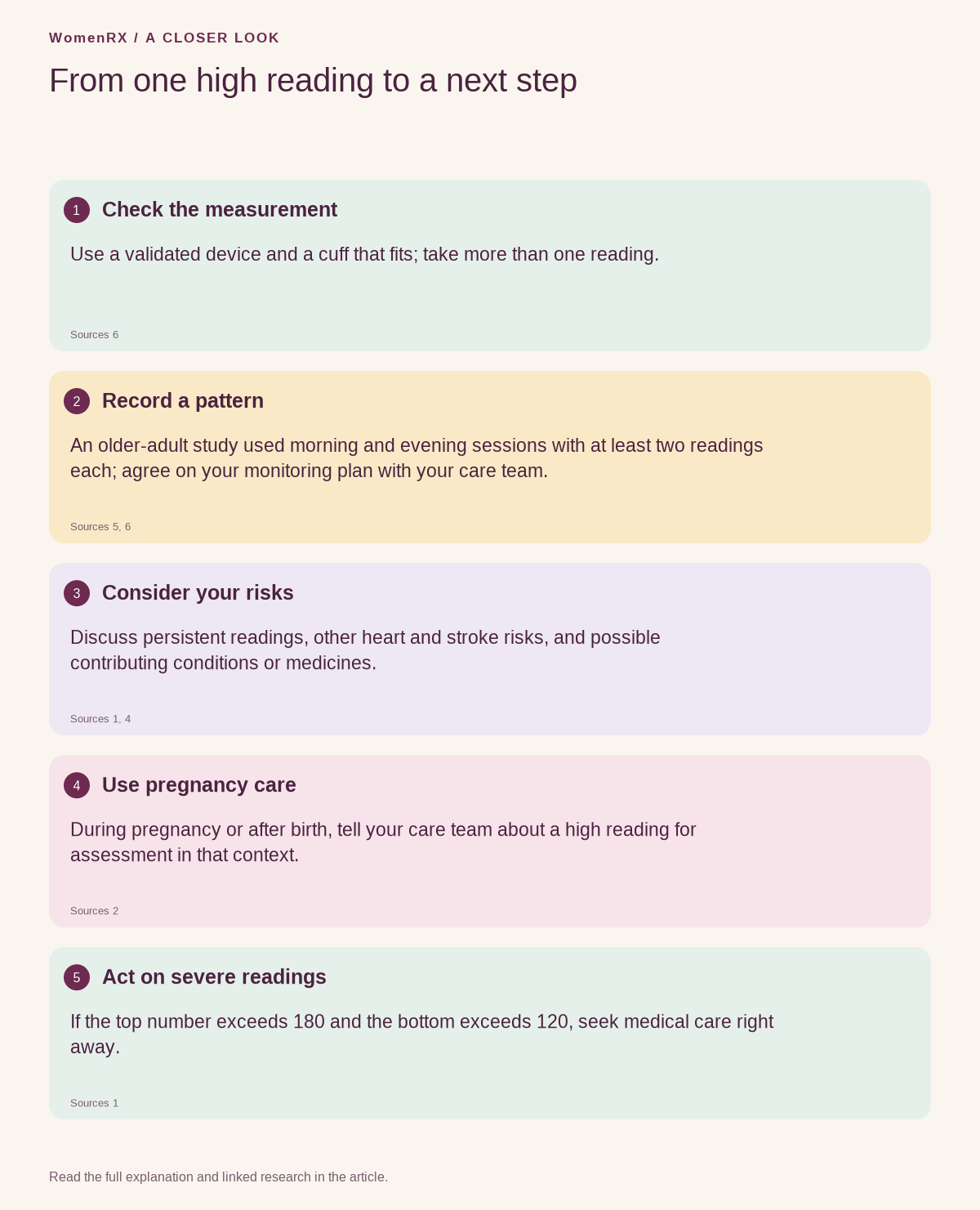
From one high reading to a next step
Check the measurement: Use a validated device and a cuff that fits; take more than one reading.6
Record a pattern: An older-adult study used morning and evening sessions with at least two readings each; agree on your monitoring plan with your care team.56
Consider your risks: Discuss persistent readings, other heart and stroke risks, and possible contributing conditions or medicines.14
Use pregnancy care: During pregnancy or after birth, tell your care team about a high reading for assessment in that context.2
Act on severe readings: If the top number exceeds 180 and the bottom exceeds 120, seek medical care right away.1
Read the figure as text
A high number needs context, but some readings and life stages change how quickly to act.- Check the measurement: Use a validated device and a cuff that fits; take more than one reading.6
- Record a pattern: An older-adult study used morning and evening sessions with at least two readings each; agree on your monitoring plan with your care team.56
- Consider your risks: Discuss persistent readings, other heart and stroke risks, and possible contributing conditions or medicines.14
- Use pregnancy care: During pregnancy or after birth, tell your care team about a high reading for assessment in that context.2
- Act on severe readings: If the top number exceeds 180 and the bottom exceeds 120, seek medical care right away.1
More questions, answered
Can my blood pressure be high only at the doctor's office?
Yes. Blood pressure can rise temporarily in a clinical setting, sometimes called a white-coat effect. Home or 24-hour monitoring can help show whether readings are also high outside the office. 6
Sources you can check
- High Blood Pressure | Hypertension | MedlinePlusAccessed 2026-09-25Return to first citation
- High Blood Pressure in Pregnancy | Preeclampsia | MedlinePlusAccessed 2026-09-25Return to first citation
- How to Prevent High Blood Pressure: MedlinePlusAccessed 2026-09-25Return to first citation
- High blood pressure - NHSAccessed 2026-09-25Return to first citation
- Optimizing Home Blood Pressure Monitoring Protocols in Older Adults: The Atherosclerosis Risk in Communities (ARIC) Study.Wang FM, Col H, Kwapong FL, Patil D, Khan MM, Ngo L, Cluett JL, Selvin E, Wagenknecht L, Hughes TM, Windham BG, Mosley T, Lutsey PL, Ring K, Valint A, Zhang M, Juraschek SP. · American journal of hypertension · 2026Return to first citation
- Measuring blood pressure accurately.Mihailidou AS. · Australian prescriber · 2026Return to first citation