Taking Zepbound With Blood Pressure Medicine: What to Monitor
A tirzepatide trial analysis included people across blood-pressure categories, but your own readings and treatment plan need review with your prescriber.
A post hoc analysis of a tirzepatide trial included participants with different blood-pressure categories, including hypertension, and found that at 72 weeks, average blood pressure was 6.8 mm Hg lower systolic and 4.2 mm Hg lower diastolic than with placebo. 3 That doesn’t determine whether Zepbound is suitable for you. Discuss your readings, current treatment, and any proposed medication changes with your prescriber. 1 Pregnancy and postpartum situations deserve separate discussion.
Can you take Zepbound if you have high blood pressure?
A post hoc analysis of the SURMOUNT-1 randomized trial found that at 72 weeks, average blood pressure with tirzepatide was 6.8 mm Hg lower systolic and 4.2 mm Hg lower diastolic than with placebo in participants with overweight or obesity. It included participants in different blood-pressure categories, including stage 1 and stage 2 hypertension. But trial inclusion doesn’t establish whether Zepbound is suitable for you. Discuss your blood pressure and current treatment with your prescriber. 3
That finding doesn’t make Zepbound a blood-pressure medicine. In the analysis, weight loss explained much of the average blood-pressure reduction. An average change across a study also can’t predict what will happen to your readings or prescribed medicines. 3
There’s a useful distinction between evidence in a broad trial population and evidence focused on people being treated for hypertension. A Cochrane review reported one tirzepatide trial with 153 participants who had stage 2 hypertension and 635 taking antihypertensive medication. Those figures describe the trial groups; they don’t establish how an individual should change treatment. 4
Why your readings and medicines matter together
Blood pressure can shift as weight changes. In the SURMOUNT-1 analysis, the reduction happened mainly alongside weight loss, and low-blood-pressure adverse events were uncommon but more frequent in the tirzepatide groups than with placebo. That’s a reason to notice a trend and share it with your prescriber, rather than decide from a few lower numbers whether your treatment should change. 1 3
The available evidence also leaves a practical question unresolved: a 2025 review reported that no trial had used blood-pressure reduction as its primary endpoint while investigating how incretin medicines interact with antihypertensive medicines. That finding describes a research gap; it does not show that there is no clinical approach to reviewing your treatment. 5
Before starting Zepbound, or if your readings change during treatment, give your prescriber a current list of your blood-pressure medicines and how you take them. Bring a short record of readings, with dates and times, and note any medication changes. Follow the measurement plan your care team recommends. Ask which changing or low readings to report and when, and whether your pattern of readings calls for a review of your blood-pressure treatment plan. High blood pressure often has no symptoms, so readings, not how you feel, are central to tracking it. 1 3
Zepbound can cause nausea, vomiting, or diarrhea. The prescribing information warns that fluid loss from these symptoms can lead to kidney problems; tell your care team right away if these symptoms don’t go away. Ask what to do if ongoing vomiting or diarrhea affects your treatment plan. 2
When a reading needs prompt attention
MedlinePlus lists a reading higher than 180 systolic and higher than 120 diastolic as a hypertensive crisis requiring medical care right away. Don’t wait for a routine medication review if your reading reaches that level. 1
Pregnancy and postpartum hypertension are different situations
The weight-management drug trials summarized in the Cochrane review enrolled non-pregnant adults, so they don’t answer how to manage high blood pressure during pregnancy. The review summary doesn’t report a postpartum-specific analysis, so it can’t answer that situation either. The Zepbound prescribing information includes a pregnancy exposure registry, but that doesn’t replace individualized pregnancy care. If you’re pregnant or recently postpartum, make sure the clinician advising on your blood pressure knows; the situations call for separate discussion. 2 4
The practical takeaway is to consider Zepbound and blood-pressure treatment together. Discuss any proposed changes to your prescribed hypertension medicines with your prescriber, and share a pattern of readings rather than making a medication decision from one measurement. 1
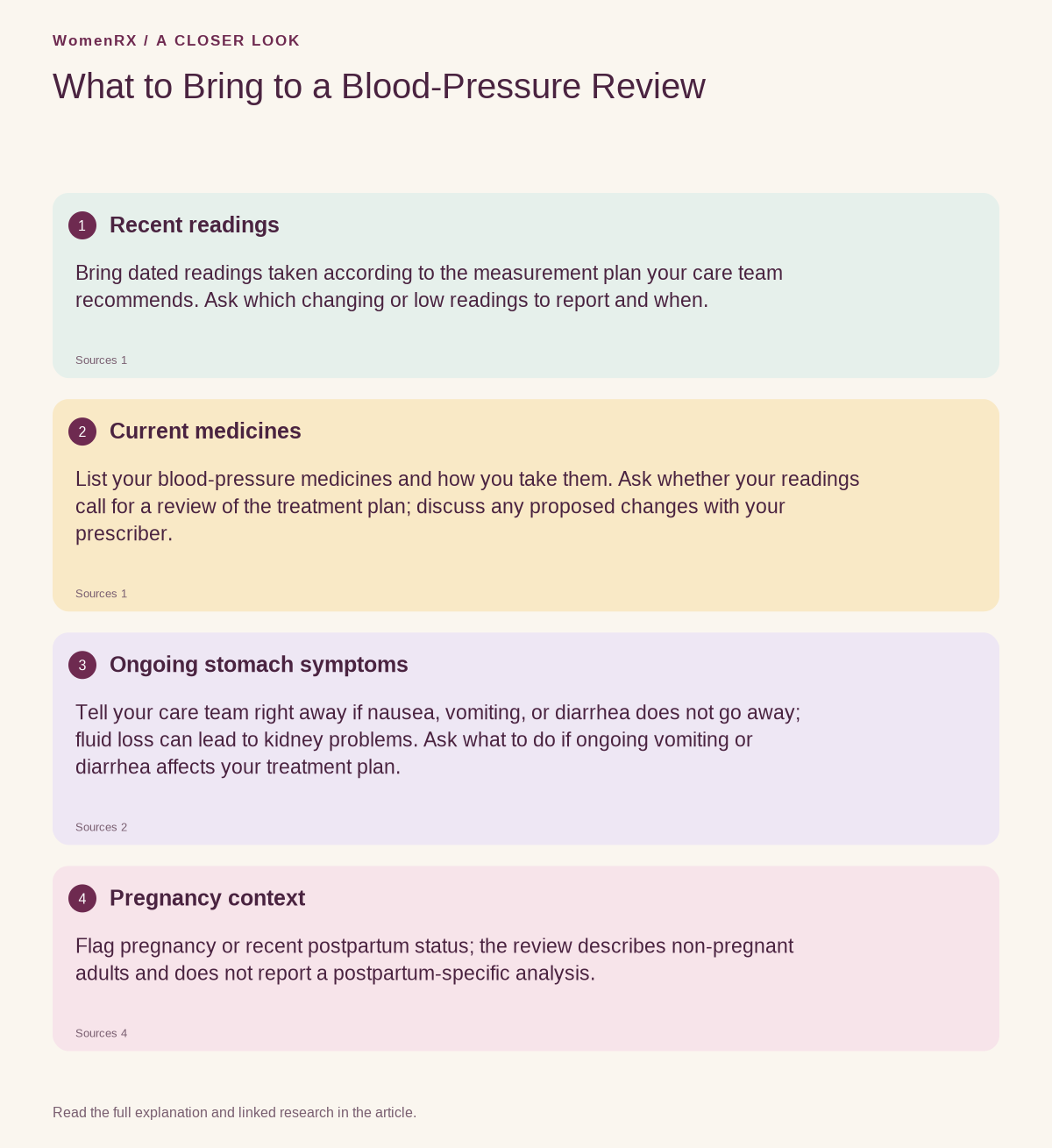
What to Bring to a Blood-Pressure Review
Recent readings: Bring dated readings taken according to the measurement plan your care team recommends. Ask which changing or low readings to report and when.1
Current medicines: List your blood-pressure medicines and how you take them. Ask whether your readings call for a review of the treatment plan; discuss any proposed changes with your prescriber.1
Ongoing stomach symptoms: Tell your care team right away if nausea, vomiting, or diarrhea does not go away; fluid loss can lead to kidney problems. Ask what to do if ongoing vomiting or diarrhea affects your treatment plan.2
Pregnancy context: Flag pregnancy or recent postpartum status; the review describes non-pregnant adults and does not report a postpartum-specific analysis.4
Read the figure as text
A short, practical checklist for discussing Zepbound alongside hypertension treatment. It is not a diagnostic tool or a medication-adjustment protocol.- Recent readings: Bring dated readings taken according to the measurement plan your care team recommends. Ask which changing or low readings to report and when.1
- Current medicines: List your blood-pressure medicines and how you take them. Ask whether your readings call for a review of the treatment plan; discuss any proposed changes with your prescriber.1
- Ongoing stomach symptoms: Tell your care team right away if nausea, vomiting, or diarrhea does not go away; fluid loss can lead to kidney problems. Ask what to do if ongoing vomiting or diarrhea affects your treatment plan.2
- Pregnancy context: Flag pregnancy or recent postpartum status; the review describes non-pregnant adults and does not report a postpartum-specific analysis.4
More questions, answered
Can Zepbound replace my blood-pressure medicine?
Don’t treat Zepbound as a replacement for prescribed hypertension treatment. Lower average blood pressure in a tirzepatide trial doesn’t establish whether your own medicine should change. Discuss any proposed changes with your prescriber. 1 3
What should I bring to a follow-up?
Bring your recent blood-pressure readings, the names and directions for your current medicines, and notes about any changes or ongoing nausea, vomiting, or diarrhea. Ask which changing or low readings to report and when, whether your blood-pressure treatment plan needs review, and what to do if vomiting or diarrhea does not go away. Tell your care team right away about symptoms that do not go away. 1 2 3
Sources you can check
- High Blood Pressure | Hypertension | MedlinePlusAccessed 2026-09-25Return to first citation
- ZEPBOUND (TIRZEPATIDE) INJECTION, SOLUTION ZEPBOUND (TIRZEPATIDE) INJECTION, SOLUTION ZEPBOUND KWIKPEN (TIRZEPATIDE) INJECTION, SOLUTION [ELI LILLY AND COMPANY] | US prescribing information and patient instructionsAccessed 2026-09-25Return to first citation
- Tirzepatide and blood pressure reduction: stratified analyses of the SURMOUNT-1 randomised controlled trial.Krumholz HM, de Lemos JA, Sattar N, Linetzky B, Sharma P, Mast CJ, Ahmad NN, Bunck MC, Stefanski A. · Heart (British Cardiac Society) · 2024Return to first citation
- Long-term effects of weight-reducing drugs in people with hypertension.Spary-Kainz U, Posch N, Radl-Karimi C, Jeitler K, Krenn C, Siebenhofer A, Berghold A, Horvath K, Winterholer S, Semlitsch T. · The Cochrane database of systematic reviews · 2026Return to first citation
- Incretin-Based Therapies: A Paradigm Shift in Blood Pressure Management?Dreher L, Kylies D, Danser AHJ, Wenzel UO. · Hypertension (Dallas, Tex. : 1979) · 2025Return to first citation