Tirzepatide’s Blood Pressure Effects: What Human Trials Show
Tirzepatide lowered blood pressure in a large trial, so a change in your readings is a reason to review your plan, not to stop blood-pressure medicine on your own.
Having high blood pressure doesn’t automatically rule out tirzepatide. In a trial of adults with overweight or obesity, blood pressure fell with treatment across baseline blood-pressure groups, though low-blood-pressure events were more frequent. Keep taking prescribed blood-pressure medicine unless your care team changes it, and agree on how to track readings and review medicines as your blood pressure changes. 6
What the blood-pressure evidence says
Tirzepatide can lower blood pressure while it helps reduce weight. In a post hoc analysis of the randomized SURMOUNT-1 trial, adults with overweight or obesity taking tirzepatide had a net reduction at 72 weeks of 6.8 mm Hg in systolic pressure and 4.2 mm Hg in diastolic pressure compared with placebo. The pattern was broadly consistent across groups with different blood pressure at the start of the trial. These are group averages, not a prediction of what will happen to your readings. 6
The analysis also found that weight loss explained much of the blood-pressure reduction. That helps make sense of why your readings might shift during treatment, but it doesn’t mean tirzepatide is a replacement for hypertension care. Blood-pressure medicines and lifestyle changes remain part of an individualized treatment plan. 6 1
A separate meta-analysis of randomized trials in people treated for type 2 diabetes or obesity found fewer hypertension-related adverse events with tirzepatide, but more hypotension-related events than with comparison treatments. Those findings describe events reported in trials; they don’t tell you the chance that you personally will develop low blood pressure. 5
Make medication review part of follow-up
If your readings come down, your prescriber may decide whether your blood-pressure treatment still fits. Don’t reduce or stop an antihypertensive medicine on your own: some people need more than one type, and the right plan depends on their circumstances. 2
Before starting, share the names of all your blood-pressure medicines and any other regular medicines with the person prescribing tirzepatide. Ask what readings they want you to record, how often to check, and when they want to review the results. If your readings change or you notice new symptoms, share that information with the care team rather than making a medication change yourself. High blood pressure often has no symptoms, so measurements, not how you feel, are what show whether it is changing. 1
A useful record can be simple: your blood-pressure readings, when you took them, any symptoms, and the medicines you take. Bring the record to follow-up. Your clinician can interpret the pattern and decide whether your current treatment needs adjustment. 1 2
Pregnancy and postpartum need a separate plan
The blood-pressure findings above come from obesity treatment trials, not evidence establishing how tirzepatide should be managed during pregnancy or postpartum. Reviews report limited pregnancy evidence and no human data establishing tirzepatide’s effects in pregnancy. If you’re pregnant, planning pregnancy, or recently gave birth and managing high blood pressure, get a treatment plan from the clinicians caring for you in that setting. Don’t assume the trial results or your usual blood-pressure plan answer those questions. 3 4
The practical takeaway
Tirzepatide and hypertension are not automatically incompatible, and blood pressure may fall during treatment. The useful next step is a shared monitoring plan: keep taking your prescribed medicines, track readings as directed, and review the pattern with your care team before anyone changes treatment. The trial findings describe averages, not a reason to expect the same change, or to make a medication adjustment, in your own case. 6 2
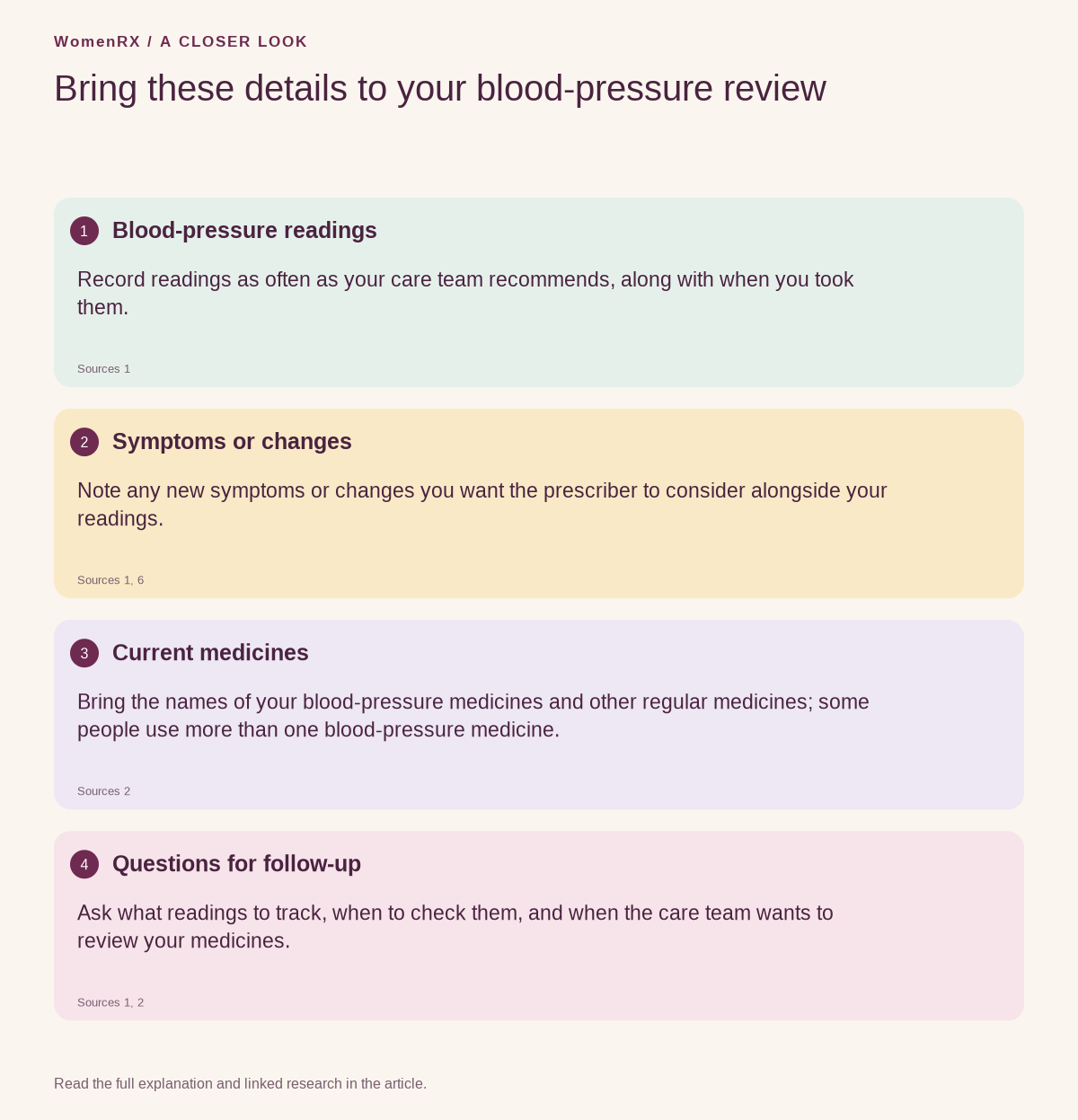
Bring these details to your blood-pressure review
Blood-pressure readings: Record readings as often as your care team recommends, along with when you took them.1
Symptoms or changes: Note any new symptoms or changes you want the prescriber to consider alongside your readings.16
Current medicines: Bring the names of your blood-pressure medicines and other regular medicines; some people use more than one blood-pressure medicine.2
Questions for follow-up: Ask what readings to track, when to check them, and when the care team wants to review your medicines.12
Read the figure as text
A short record helps connect changes in your readings with symptoms and medicines, so your care team can review the whole picture.- Blood-pressure readings: Record readings as often as your care team recommends, along with when you took them.1
- Symptoms or changes: Note any new symptoms or changes you want the prescriber to consider alongside your readings.16
- Current medicines: Bring the names of your blood-pressure medicines and other regular medicines; some people use more than one blood-pressure medicine.2
- Questions for follow-up: Ask what readings to track, when to check them, and when the care team wants to review your medicines.12
More questions, answered
Does tirzepatide replace blood-pressure medication?
No. Tirzepatide was associated with lower blood pressure in a trial, but that doesn’t establish it as a replacement for hypertension treatment. Continue your prescribed medicines unless your care team changes your plan. 6 2
Should I check my blood pressure at home?
Ask the clinician treating your hypertension what readings to take and how often. Blood pressure can change without noticeable symptoms, so recorded measurements can help your care team assess the pattern. 1
Sources you can check
- High Blood Pressure | Hypertension | MedlinePlusAccessed 2026-09-25Return to first citation
- Blood Pressure Medicines | MedlinePlusAccessed 2026-09-25Return to first citation
- GLP-1 Receptor Agonists and Fertility: What Is Known So Far?Becker AS, Castilhos JP, Shugair SAS, Colombo T, Hentschke M-. · JBRA assisted reproduction · 2026Return to first citation
- GLP-1 receptor agonists and preconception planning: bridging the gap between obesity treatment and reproductive safety, a narrative review.Saad Alfaiz A. · Annals of medicine and surgery (2012) · 2025Return to first citation
- Effect of tirzepatide and semaglutide on blood pressure: A systematic review and meta-analysis.Chen QX, Zhou XY, Wu Q, Xie JJ, Xu Y, Teng FY, Guo M. · Endocrine · 2026Return to first citation
- Tirzepatide and blood pressure reduction: stratified analyses of the SURMOUNT-1 randomised controlled trial.Krumholz HM, de Lemos JA, Sattar N, Linetzky B, Sharma P, Mast CJ, Ahmad NN, Bunck MC, Stefanski A. · Heart (British Cardiac Society) · 2024Return to first citation