Can Magnesium Lower Blood Pressure? What the Evidence Shows
Magnesium supplements may lower average blood-pressure readings a little, but that’s not the same as preventing or treating hypertension.
In randomized trials, magnesium supplements lowered blood pressure by a small average amount compared with placebo. That doesn’t show that magnesium alone prevents hypertension or can replace prescribed treatment. The results also aren’t a women-specific estimate. Before adding a supplement, check the amount of elemental magnesium and review your medicines with a clinician or pharmacist, especially if you have kidney problems. 4 3
A small average change, not a treatment plan
Magnesium has a role in normal blood-pressure regulation, and clinical trials suggest supplements can shift readings downward. A 2025 meta-analysis of 38 randomized trials, involving 2,709 participants, found average reductions of 2.81 mm Hg in systolic pressure and 2.05 mm Hg in diastolic pressure compared with placebo. The trials varied, and the review reported substantial differences across studies. These are modest average changes, not a promise of what one person’s readings will do. 3 4
Some trial groups had larger reductions, including people with hypertension who were already taking blood-pressure medication and people with low magnesium status. Those subgroup findings are signals, not a reason to add magnesium without checking your situation. They don’t show that magnesium replaces medication, nor do they establish a supplement plan that reliably controls hypertension. 4
That distinction matters because a lower reading in a trial is not the same as preventing a future diagnosis or controlling hypertension over time. High blood pressure is usually diagnosed from repeated measurements at separate appointments, and treatment may involve lifestyle changes, medication, or both. Don’t stop or change a prescribed blood-pressure medicine because you’re taking magnesium. 1 2
What the results can, and can’t, tell women
The pooled results are not a women-specific estimate. They don’t establish whether the effect differs by sex, or whether it changes across menstrual, perimenopausal, or postmenopausal life stages. A general trial average shouldn’t be treated as a proven effect for every woman. 4
The reported pooled results also don’t give a pregnancy-specific estimate, so they can’t tell you whether magnesium supplements lower blood pressure during pregnancy. 4
Check the label and your medication list
If you’re considering magnesium for a reason other than blood pressure, look at the elemental magnesium amount on the Supplement Facts label. The weight of a magnesium compound is not the same as the amount of elemental magnesium. Also count magnesium in products such as some antacids and laxatives, not just capsules marketed as supplements. 3
For adults, the established upper limit of 350 mg per day applies to magnesium from supplements and medications, not magnesium naturally found in food. It’s a limit for routine intake, not a target or a dose for lowering blood pressure. Higher amounts can cause diarrhea, nausea, or abdominal cramping; the risk of excessive magnesium is greater when kidney function is impaired. 3
Magnesium can reduce absorption of some oral antibiotics, including tetracyclines and quinolones, and oral bisphosphonates used for osteoporosis. Diuretics can also affect magnesium levels: some increase magnesium loss in urine, while potassium-sparing diuretics reduce it. These aren’t all the same kind of interaction, so show a clinician or pharmacist your full medication and supplement list rather than assuming magnesium is compatible with every prescription. 3
A practical next step is to write down the magnesium amount per serving, how many servings you would take, and any magnesium-containing antacid or laxative you use. Ask whether it makes sense with your current medicines and health history. If the goal is blood-pressure control, keep following your existing treatment plan and use repeat readings, not a supplement trial, to judge whether your pressure is being managed. 1 2 3
A reading change versus blood-pressure control
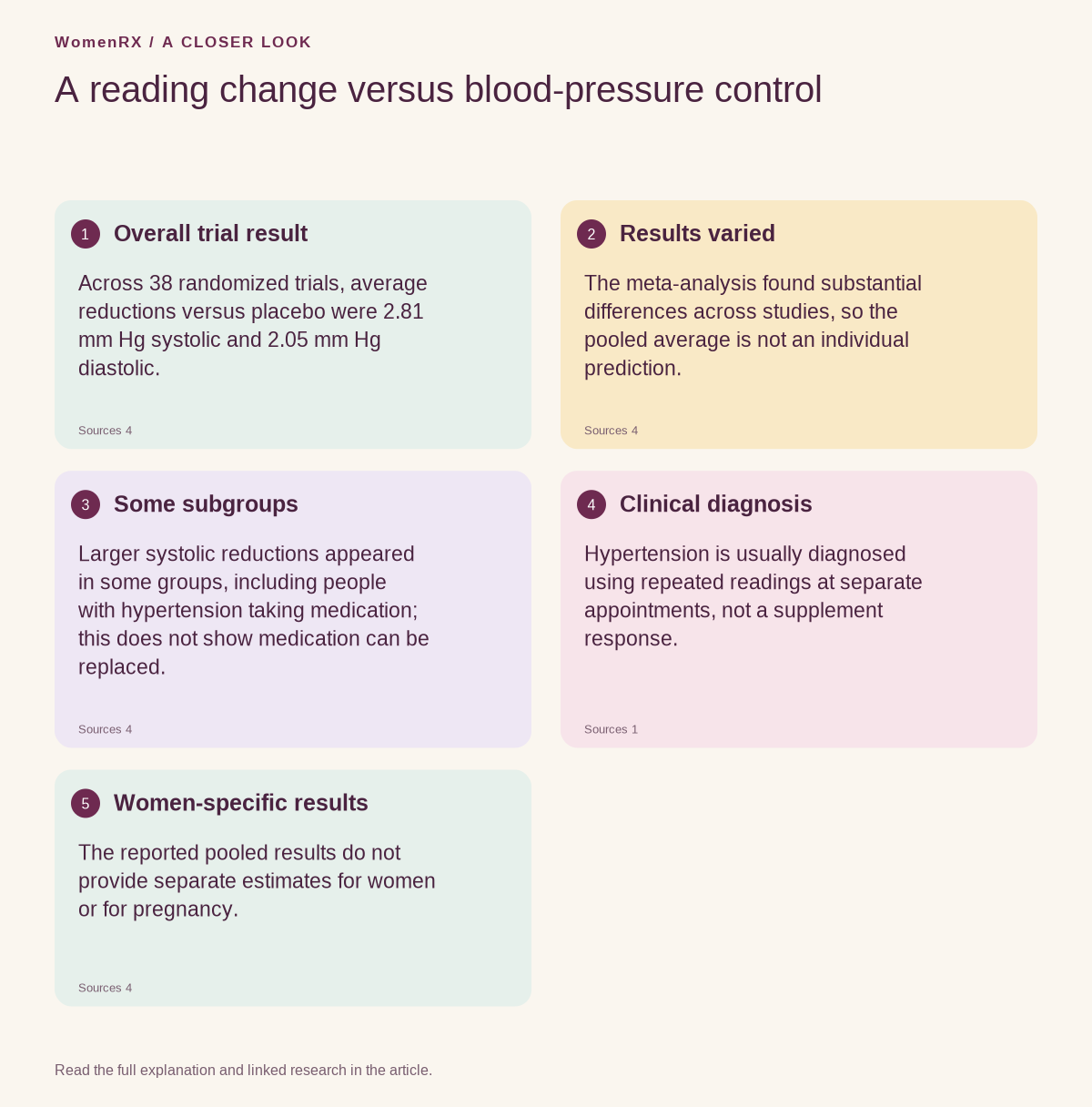
Overall trial result: Across 38 randomized trials, average reductions versus placebo were 2.81 mm Hg systolic and 2.05 mm Hg diastolic.4
Results varied: The meta-analysis found substantial differences across studies, so the pooled average is not an individual prediction.4
Some subgroups: Larger systolic reductions appeared in some groups, including people with hypertension taking medication; this does not show medication can be replaced.4
Clinical diagnosis: Hypertension is usually diagnosed using repeated readings at separate appointments, not a supplement response.1
Women-specific results: The reported pooled results do not provide separate estimates for women or for pregnancy.4
Read the figure as text
The trial average is a modest shift in readings. It does not by itself establish prevention or treatment of hypertension.- Overall trial result: Across 38 randomized trials, average reductions versus placebo were 2.81 mm Hg systolic and 2.05 mm Hg diastolic.4
- Results varied: The meta-analysis found substantial differences across studies, so the pooled average is not an individual prediction.4
- Some subgroups: Larger systolic reductions appeared in some groups, including people with hypertension taking medication; this does not show medication can be replaced.4
- Clinical diagnosis: Hypertension is usually diagnosed using repeated readings at separate appointments, not a supplement response.1
- Women-specific results: The reported pooled results do not provide separate estimates for women or for pregnancy.4
More questions, answered
Does magnesium in food have the same upper limit?
No. The adult upper limit of 350 mg per day applies to magnesium from supplements and medications, not magnesium naturally present in food. 3
Can I take magnesium with my blood-pressure medicine?
Research does not establish that every magnesium supplement is safe or useful alongside every blood-pressure medicine. Some diuretics affect magnesium levels, so have a pharmacist or clinician check the specific products and prescriptions you use. Don’t stop prescribed treatment. 2 3
Sources you can check
- High Blood Pressure | Hypertension | MedlinePlusAccessed 2026-09-25Return to first citation
- Blood Pressure Medicines | MedlinePlusAccessed 2026-09-25Return to first citation
- Magnesium - Health Professional Fact SheetAccessed 2026-09-25Return to first citation
- Magnesium Supplementation and Blood Pressure: A Systematic Review and Meta-Analysis of Randomized Controlled Trials.Argeros Z, Xu X, Bhandari B, Harris K, Touyz RM, Schutte AE. · Hypertension (Dallas, Tex. : 1979) · 2025Return to first citation