Can Magnesium Lower Cortisol? What Human Studies Show
Three small surgical trials report mixed cortisol findings, but they don’t establish that everyday oral magnesium lowers cortisol.
The three surgical trials discussed here don’t establish that taking oral magnesium lowers cortisol during everyday stress. They tested magnesium around surgery, and their cortisol findings differed. If a cortisol test prompted your interest, these trials can’t show whether magnesium would change or explain that result. 345
The short answer depends on the setting
Magnesium has a role in normal body function, but that doesn’t mean taking extra magnesium will lower cortisol. The three human trials discussed here tested magnesium around surgery, not routine oral supplements for ongoing stress. Their results differ, so they don’t establish magnesium as a cortisol-lowering treatment for everyday life. 345
That distinction matters if you’re looking at a cortisol test. These trials didn’t test whether supplements improve cortisol test results or what those results mean for a person’s health. 345
What the surgical trials found
In a randomized trial of 52 patients undergoing robotic radical prostatectomy, those given intravenous magnesium had a different cortisol pattern over time than the control group. Cortisol fell from baseline to 24 hours after surgery in the magnesium group, while it didn’t change significantly in the control group. This finding comes from a specific surgical setting, not a study of taking a pill for stress. 4
Two other randomized trials make the results less clear. In a knee-replacement trial, 150 patients received magnesium intravenously, applied during surgery, or by both routes. Cortisol levels on the first and second days after surgery didn’t differ significantly among the three groups. Because every group received magnesium, the trial also doesn’t show whether magnesium works better than no magnesium. 3
In a smaller abdominal-surgery trial, 42 patients received intravenous magnesium or saline. The groups had comparable changes in measured stress markers, including cortisol, during the first 24 hours after surgery. 5
Together, these three trials don’t show a consistent cortisol effect in the surgical settings they studied. They also don’t establish whether oral magnesium changes cortisol or stress symptoms in people who aren’t having surgery. 345
A hormone measurement isn’t a stress symptom
Stress prompts the body to release hormones that help make you alert and ready to act. 2 The trials above measured cortisol as a biological outcome around surgery; they don’t establish that a change in cortisol relieves day-to-day stress or improves how someone feels or functions. 345
These findings also offer little women-specific guidance. The findings described here don’t tell us whether effects differ by sex or apply during pregnancy or across menstrual cycles. The prostatectomy finding comes from a specific surgical population. So these trial findings don’t establish a cortisol benefit specific to women. 345
When magnesium may still be worth considering
A different question is whether you’re getting enough magnesium or have a reason to suspect deficiency. Assessing magnesium status can be difficult: serum magnesium is the most commonly used test, but it doesn’t accurately reflect total body magnesium. That’s a reason to consider the whole picture rather than assuming either that a normal result rules out low magnesium or that stress means you need a supplement. 1
If you’re considering a supplement, keep its safety limits in view. For adults, the upper limit of 350 mg per day applies to magnesium from supplements and medications, not magnesium naturally present in food. It’s a safety limit, not a target dose. High amounts from supplements or medications can cause diarrhea, nausea, and cramping; the risk of magnesium toxicity is greater when kidney function is impaired. 1
The practical takeaway is modest: magnesium may be relevant to nutrition or a deficiency evaluation, but these surgical trials don’t support choosing it specifically to lower cortisol. If a cortisol test prompted your interest, the trials don’t explain that test or establish that magnesium will change its result. 345
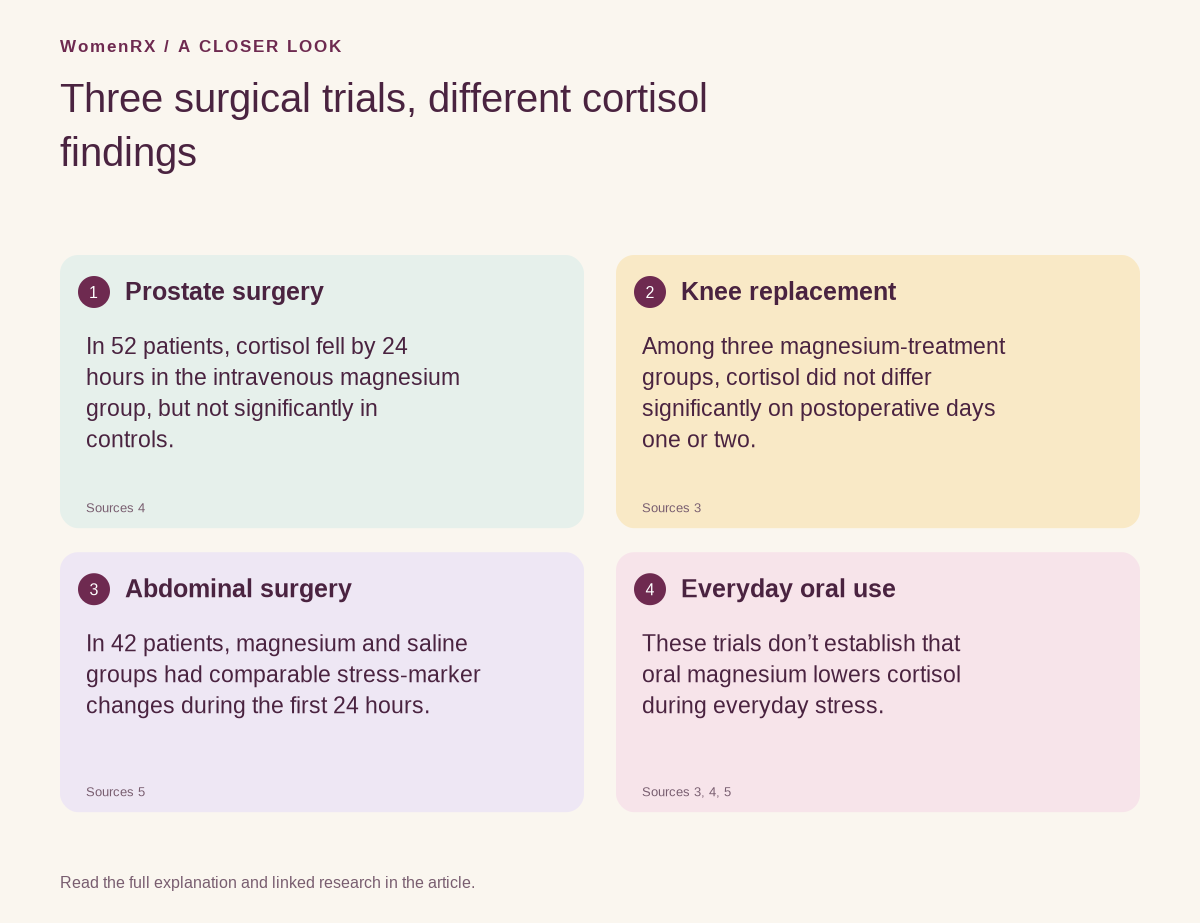
Three surgical trials, different cortisol findings
Prostate surgery: In 52 patients, cortisol fell by 24 hours in the intravenous magnesium group, but not significantly in controls.4
Knee replacement: Among three magnesium-treatment groups, cortisol did not differ significantly on postoperative days one or two.3
Abdominal surgery: In 42 patients, magnesium and saline groups had comparable stress-marker changes during the first 24 hours.5
Everyday oral use: These trials don’t establish that oral magnesium lowers cortisol during everyday stress.345
Read the figure as text
This comparison shows what the three surgical trials measured and why their results don’t establish an effect from everyday oral magnesium.- Prostate surgery: In 52 patients, cortisol fell by 24 hours in the intravenous magnesium group, but not significantly in controls.4
- Knee replacement: Among three magnesium-treatment groups, cortisol did not differ significantly on postoperative days one or two.3
- Abdominal surgery: In 42 patients, magnesium and saline groups had comparable stress-marker changes during the first 24 hours.5
- Everyday oral use: These trials don’t establish that oral magnesium lowers cortisol during everyday stress.345
Sources you can check
- Magnesium - Health Professional Fact SheetAccessed 2026-09-25Return to first citation
- Stress: MedlinePlusAccessed 2026-09-25Return to first citation
- Effects of Combined Intravenous and Topical Magnesium Sulfate Administration on Pain, Stress, and Functional Recovery After Total Knee Arthroplasty: A Prospective, Randomized, Blinded Controlled Trial.Wang Q, Wang Y, Hu J, Chen C, Yang J, Kang P. · Drug design, development and therapy · 2026Return to first citation
- Beneficial Effects of Intravenous Magnesium Administration During Robotic Radical Prostatectomy: A Randomized Controlled Trial.Kim HY, Lee SY, Lee HS, Jun BK, Choi JB, Kim JE. · Advances in therapy · 2021Return to first citation
- [Effectiveness of intravenous magnesium on postoperative pain after abdominal surgery versus placebo: double blind randomized controlled trial].Jaoua H, Zghidi SM, Wissem L, Laassili S, Ammar N, Ali J, Darmoul S, Askri A, Khelifi S, Ben Maamer A, Cherif A, Ben Fadhel K. · La Tunisie medicale · 2010Return to first citation