Should You Try to Lower Cortisol? Understanding Tests and Treatment
Cortisol testing is meant to investigate a suspected hormone disorder, not give you a general score for stress.
You don’t need to lower cortisol just because you feel stressed or have a single unusual result. Testing is worth discussing when symptoms are unusual for your age, progress together, or include clues such as easy bruising, purple stretch marks, or weakness in the upper legs or arms. Clinicians choose and interpret tests in context; a one-off cortisol result can’t diagnose Cushing syndrome or measure everyday stress. 1 2 3
Cortisol naturally changes over the day, and Cushing syndrome, a condition involving prolonged excess cortisol, is rare. Tests for it are designed to look for abnormal hormone patterns in someone with a reason to suspect the condition. They aren’t a general check of how stressed you feel, and a cortisol result isn’t a target everyone needs to lower. 1 3
Which symptoms make assessment more useful?
One symptom by itself often has other explanations. Weight gain, tiredness, mood changes, high blood pressure, and irregular periods can happen for many reasons, and they don’t establish that cortisol is high. In a registry study of 377 people referred for possible Cushing syndrome, obesity was more often the main complaint among those whose evaluation ruled out the condition than among those diagnosed with it. That finding applies to this referred group, not to everyone with obesity. 2 3
A pattern that is unusual, worsening, or involves several features is more useful to discuss. Examples include easy bruising without a clear injury, reddish-purple stretch marks, weakness in the muscles near your hips or shoulders, or osteoporosis that seems unexpected for your age. The Endocrine Society guideline criteria discussed in the registry study also include multiple progressive features, unusual features for age, and an adrenal growth found on imaging. 1 2 3
If you use steroid medicines, mention every form you take, including pills, injections, inhalers, creams, or rectal medicines. Steroid exposure is a common cause of Cushing syndrome, and clinicians generally consider it before testing for excess cortisol made inside the body. Don’t stop prescribed steroids abruptly; if they may be contributing, a clinician can help decide what to do. 1 3
Menstrual changes can be part of the picture, though they have many possible causes. Some high-dose progestogens, such as megestrol acetate, have glucocorticoid activity; mention these medicines when discussing possible testing. The symptoms listed above are clues to discuss, not a way to diagnose yourself. 3 When discussing symptoms or possible testing, also mention any hormonal medicines you use and whether you’re pregnant, postpartum, or going through menopause.
What cortisol tests can show
When there’s a clinical reason to investigate, common initial tests include late-night saliva, urine collected over 24 hours, and a dexamethasone suppression test. They look at different aspects of cortisol regulation: whether cortisol is unusually high late at night, how much is produced across a day, or whether production responds as expected to dexamethasone. Which test is appropriate depends on the situation. 3
These are not interchangeable stress tests. Cortisol varies over time, and each test has limitations. For example, a single measurement cannot capture the full daily rhythm. If suspicion is low, a clinician may start with one type of test; with moderate or higher suspicion, guidance reviewed in a 2026 clinical review describes using two or more tests. Abnormal results may need repeat testing and interpretation alongside other factors that can affect cortisol, such as some psychiatric conditions, alcohol use disorder, or uncontrolled diabetes. 3
A test result is a starting point, not a diagnosis on its own. If testing confirms cortisol excess, clinicians may check ACTH and arrange further evaluation to identify its cause. That may involve an endocrinologist and, when appropriate, additional tests or imaging. 1 3
What to do with a high result
If a cortisol result is high, ask what test was done, why it was ordered, and whether it needs repeating or interpreting alongside other results. A test ordered without an initial suspicion of Cushing syndrome may not answer the question you care about. In the registry study, some people had been referred because of a lab result obtained without that initial clinical suspicion. 2 3
If symptoms are progressive or you have several of the more specific features, ask whether a structured evaluation for Cushing syndrome makes sense. If you’re taking steroids, include the medication name, form, and use history in that conversation. When cortisol excess is confirmed, treatment depends on its cause; lowering cortisol is a medical goal when there is a diagnosed disorder, not a general wellness goal. 1 3
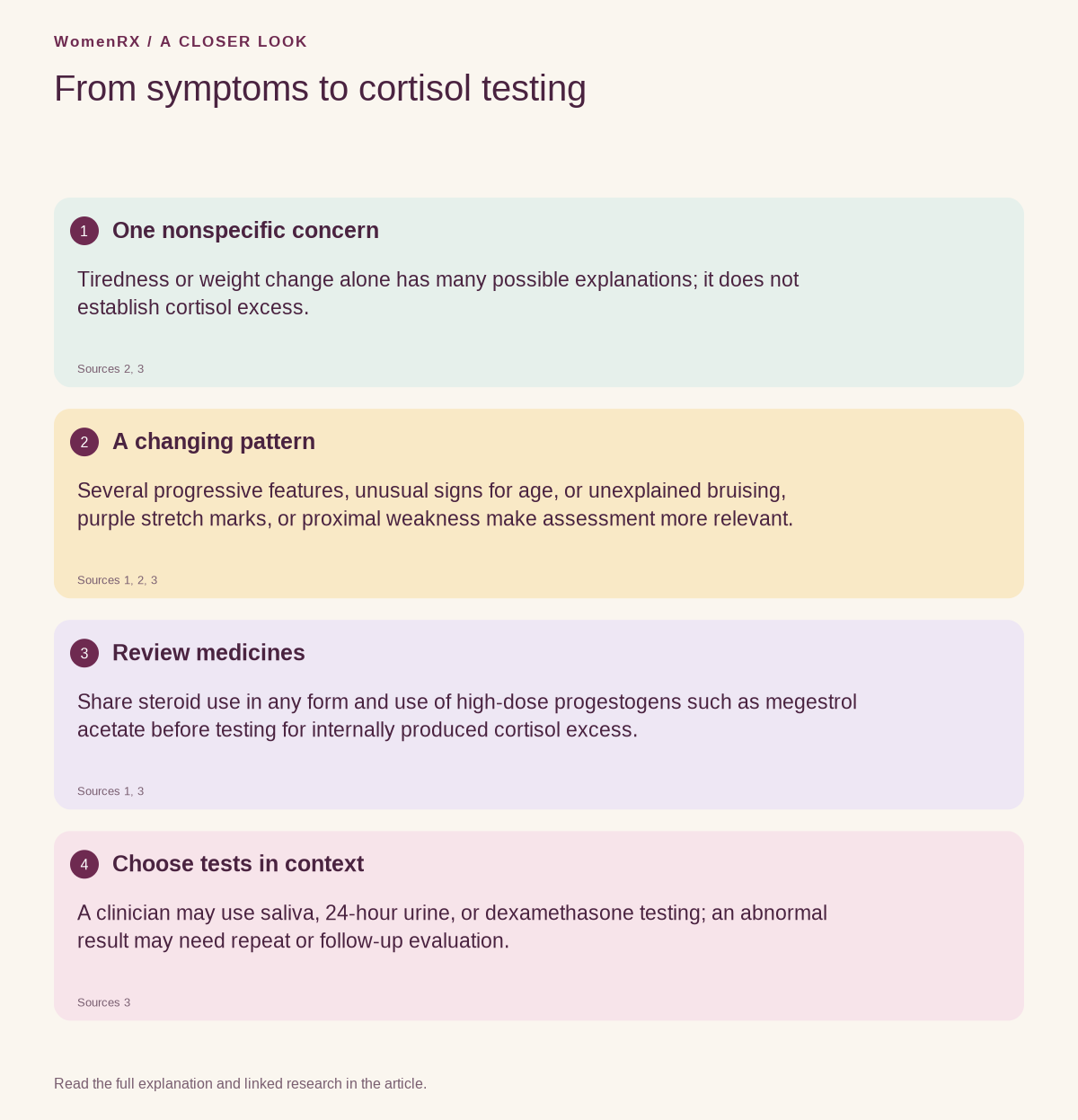
From symptoms to cortisol testing
One nonspecific concern: Tiredness or weight change alone has many possible explanations; it does not establish cortisol excess.23
A changing pattern: Several progressive features, unusual signs for age, or unexplained bruising, purple stretch marks, or proximal weakness make assessment more relevant.123
Review medicines: Share steroid use in any form and use of high-dose progestogens such as megestrol acetate before testing for internally produced cortisol excess.13
Choose tests in context: A clinician may use saliva, 24-hour urine, or dexamethasone testing; an abnormal result may need repeat or follow-up evaluation.3
Read the figure as text
A simple way to distinguish a general concern from a pattern that may warrant evaluation, and to understand what testing can do. Bring hormonal medicines, pregnancy or postpartum status, and life stage into the conversation too.- One nonspecific concern: Tiredness or weight change alone has many possible explanations; it does not establish cortisol excess.23
- A changing pattern: Several progressive features, unusual signs for age, or unexplained bruising, purple stretch marks, or proximal weakness make assessment more relevant.123
- Review medicines: Share steroid use in any form and use of high-dose progestogens such as megestrol acetate before testing for internally produced cortisol excess.13
- Choose tests in context: A clinician may use saliva, 24-hour urine, or dexamethasone testing; an abnormal result may need repeat or follow-up evaluation.3
More questions, answered
Does a high cortisol result mean I have Cushing syndrome?
No. Cortisol tests have limitations, and an abnormal result may need repeat testing and interpretation alongside symptoms, medicines, and other relevant conditions. Diagnosis may require more than one test and follow-up evaluation. 3 When asking about follow-up, mention any hormonal medicines you use and whether you’re pregnant, postpartum, or going through menopause.
Should I stop a steroid medicine if I’m worried about cortisol?
No. Steroid medicines should not be stopped abruptly. If a steroid may be contributing to symptoms, discuss it with the prescriber; reducing it may need to be done gradually. 1 3
Sources you can check
- Cushing's syndrome - NHSAccessed 2026-09-25Return to first citation
- Whom Should We Screen for Cushing Syndrome? The Endocrine Society Practice Guideline Recommendations 2008 Revisited.Braun LT, Vogel F, Zopp S, Marchant Seiter T, Rubinstein G, Berr CM, Künzel H, Beuschlein F, Reincke M. · The Journal of clinical endocrinology and metabolism · 2022Return to first citation
- Measuring cortisol in Cushing syndrome: diagnosis, monitoring, and cortisol circadian rhythm improvement.Hamidi O, St-Jean M, Lacroix A, Bancos I. · The Journal of clinical endocrinology and metabolism · 2026Return to first citation