Should You Lower Cortisol? Tests, Stress, and Supplements
A stressful week or a single cortisol result doesn’t tell you whether your cortisol is unhealthy; the reason for testing and the test itself matter.
You don’t need to lower cortisol simply because you feel stressed. Cortisol changes over the day, and a random blood measurement isn’t a reliable way to screen for Cushing syndrome. If a cortisol disorder is a concern, clinicians consider your symptoms and use tests designed for that question. Stress-management habits may help you feel better; supplement studies don’t show that supplements treat a cortisol disorder. 2 4 5
First, separate stress from a cortisol disorder
Cortisol is part of your body’s response to demands, not a toxin you need to clear. Stress hormones can make you more alert and temporarily raise your heart rate, blood pressure, and blood sugar. Ongoing stress can affect health, but feeling tense, tired, or unable to sleep doesn’t, by itself, show that your cortisol is medically abnormal. 2
There are two useful questions here: “How can I feel and function better under stress?” and “Is there a reason to investigate a cortisol disorder?” The first calls for support that fits your life. The second calls for a clinical assessment. Cushing syndrome, a condition involving prolonged excess cortisol, is uncommon, and its possible symptoms overlap with more common concerns. 3
Why the kind of test matters
Cortisol generally rises in the morning and falls to a low point late at night. It also varies between measurements. A random blood cortisol result is therefore not a reliable screening test for Cushing syndrome. If you have a result that worries you, the useful starting questions are what was measured, when the sample was collected, and why the test was ordered. 4
When Cushing syndrome is suspected, screening tests look at different features of cortisol regulation. Late-night saliva testing looks for a loss of the usual nighttime low point. A 24-hour urine collection measures free cortisol excreted over a day. A dexamethasone suppression test checks how cortisol responds to a feedback signal. An unexpected result may need further assessment rather than an immediate conclusion. Sleep disruption or shift work, for example, can make a late-night saliva result less reliable. 4
The reason for testing matters as much as the result. In a German registry of 377 people already referred for suspected Cushing syndrome, 93 had the condition confirmed. Findings such as muscle weakness, unusual bone loss, an adrenal growth, or multiple progressive symptoms helped distinguish people who warranted investigation from those with less specific complaints. Those numbers describe a referred group, not the chance that someone with everyday stress has Cushing syndrome. 3
Pregnancy and estrogen can change blood results
Pregnancy and estrogen-containing medicines can increase cortisol-binding globulin, the protein that carries much of the cortisol measured in blood. That can make a total blood cortisol result harder to interpret. Saliva and urine tests assess free cortisol and are less affected by changes in that binding protein, though the choice and interpretation of a test still depend on the clinical situation. If you’re discussing a result, mention pregnancy or hormonal medicines rather than changing a medicine to try to change the number. 4
This distinction is about test interpretation. It doesn’t mean that ordinary symptoms during pregnancy, cycling years, perimenopause, or postmenopause are evidence of abnormal cortisol.
Where supplements fit, and where they don’t
Ashwagandha has been studied for perceived stress, anxiety, sleep, and cortisol. An NIH Office of Dietary Supplements summary describes seven randomized trials involving 491 adults in India who had high self-reported stress or anxiety or a diagnosed anxiety disorder. Over six to eight weeks, the studies generally found lower stress ratings and serum cortisol with ashwagandha than with placebo. These findings concern selected adults with stress or anxiety, not treatment for Cushing syndrome or a way to correct a concerning clinical test. 1
A broader systematic review identified 52 randomized human trials of plants and phytonutrients. Because the studies differed substantially, its authors found the overall effects on stress-hormone activity unclear. The most consistent cortisol finding was a reduction in morning cortisol in ashwagandha studies. A lower measurement, however, isn’t automatically a better health outcome. 5
If what you want is relief from stress, judge an approach by whether it helps your sleep, mood, or ability to get through the day, not whether it promises a lower hormone number. If you’re being evaluated for a cortisol disorder, a supplement isn’t a substitute for the appropriate tests.
Choose a next step that matches the concern
For ongoing everyday stress, practical options include regular movement, relaxation exercises, enough sleep, less excess caffeine, and support from people you trust. For example, a walk may fit a demanding workday better than an elaborate new routine; a brief breathing or muscle-relaxation exercise may give you a pause during a tense moment. These are ways to manage stress, not treatments for Cushing syndrome. 2
If you already have a cortisol result, find out which test it was and when the sample was taken. If your concern is a cluster of symptoms that are becoming more noticeable or unusual for you, describe that pattern when you seek care. The next move is to assess the concern you actually have, rather than trying to push a number down. 3 4
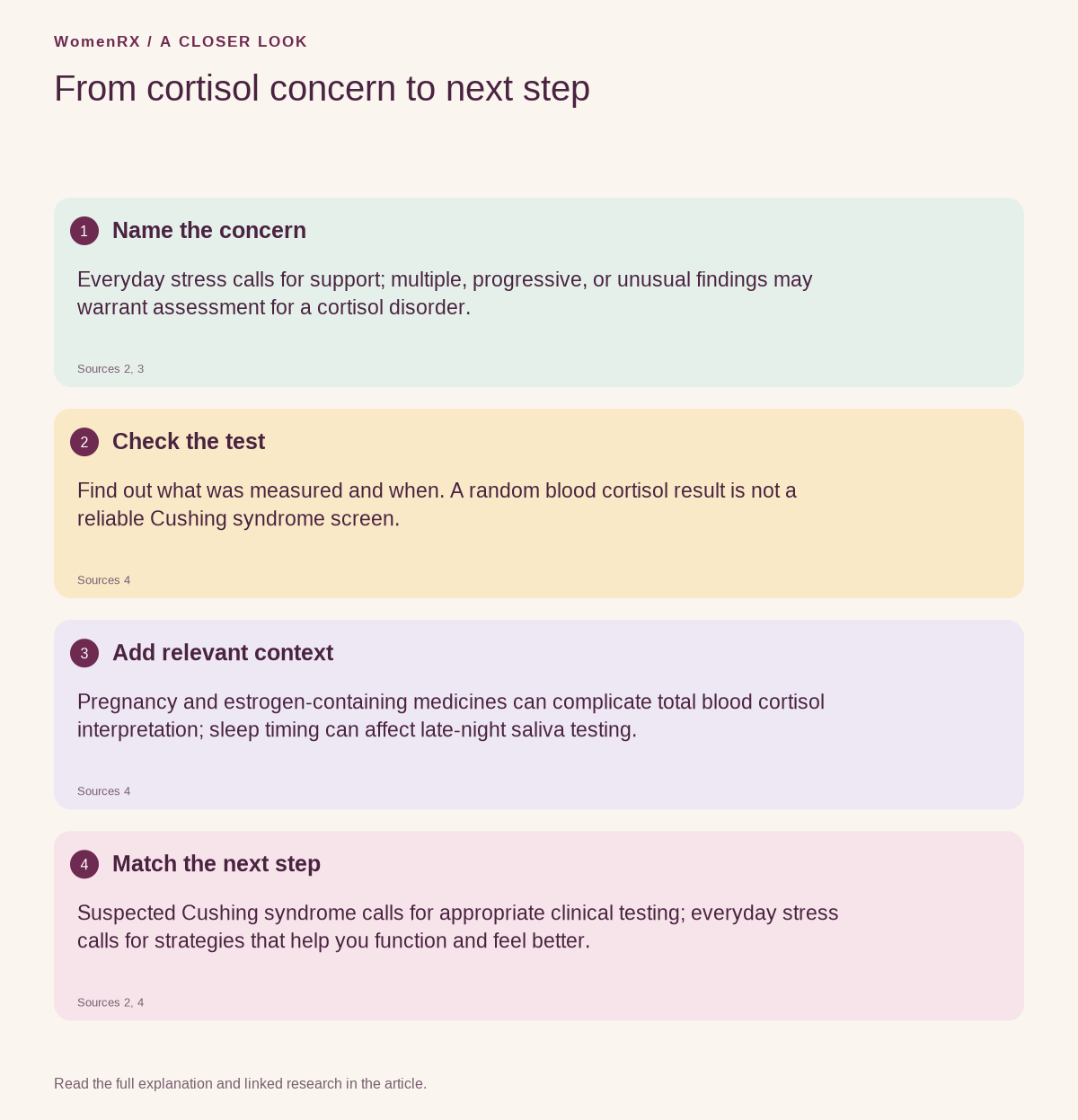
From cortisol concern to next step
Name the concern: Everyday stress calls for support; multiple, progressive, or unusual findings may warrant assessment for a cortisol disorder.23
Check the test: Find out what was measured and when. A random blood cortisol result is not a reliable Cushing syndrome screen.4
Add relevant context: Pregnancy and estrogen-containing medicines can complicate total blood cortisol interpretation; sleep timing can affect late-night saliva testing.4
Match the next step: Suspected Cushing syndrome calls for appropriate clinical testing; everyday stress calls for strategies that help you function and feel better.24
Read the figure as text
Use the reason for concern, the test details, and your clinical context to decide what question needs answering.- Name the concern: Everyday stress calls for support; multiple, progressive, or unusual findings may warrant assessment for a cortisol disorder.23
- Check the test: Find out what was measured and when. A random blood cortisol result is not a reliable Cushing syndrome screen.4
- Add relevant context: Pregnancy and estrogen-containing medicines can complicate total blood cortisol interpretation; sleep timing can affect late-night saliva testing.4
- Match the next step: Suspected Cushing syndrome calls for appropriate clinical testing; everyday stress calls for strategies that help you function and feel better.24
More questions, answered
Can a stressful day explain a high cortisol result?
Stress activates hormone responses, but you can’t interpret a cortisol result from stress alone. The type of test, its timing, and the reason it was ordered matter. A random blood result isn’t a reliable screen for Cushing syndrome. 2 4
Does lower cortisol mean a supplement is helping?
Not necessarily. Some ashwagandha trials found lower cortisol alongside lower reported stress, but they don’t establish that lowering cortisol itself improves health or treats a cortisol disorder. Findings for other plant supplements are less consistent. 1 5
Sources you can check
- Ashwagandha: Is it helpful for stress, anxiety, or sleep? - Health Professional Fact SheetAccessed 2026-09-25Return to first citation
- Stress: MedlinePlusAccessed 2026-09-25Return to first citation
- Whom Should We Screen for Cushing Syndrome? The Endocrine Society Practice Guideline Recommendations 2008 Revisited.Braun LT, Vogel F, Zopp S, Marchant Seiter T, Rubinstein G, Berr CM, Künzel H, Beuschlein F, Reincke M. · The Journal of clinical endocrinology and metabolism · 2022Return to first citation
- Screening for Cushing Syndrome at the Primary Care Level: What Every General Practitioner Must Know.Yorke E, Atiase Y, Akpalu J, Sarfo-Kantanka O. · International journal of endocrinology · 2017Return to first citation
- Modulation of the hypothalamic-pituitary-adrenal (HPA) axis by plants and phytonutrients: a systematic review of human trials.Lopresti AL, Smith SJ, Drummond PD. · Nutritional neuroscience · 2022Return to first citation