How Sleep, Stress, and Cortisol Connect
Stress can leave you feeling alert, and sleep can be disrupted alongside changes in cortisol, but one hormone result won’t tell the whole story.
Stress activates an alerting response that involves cortisol. Human studies also link sleep differences with daily cortisol patterns, but they don’t show that cortisol causes every sleep problem or that poor sleep always changes cortisol. Because cortisol varies across the day, one measurement isn’t a direct stress score. How you sleep and function during the day matters too. 1 2 3 5
The links run in different directions
When something demands your attention, your body releases hormones that help you become alert and ready to act. Cortisol is involved in that stress response. A useful burst of alertness in the moment is not the same thing as living with ongoing stress. 1 5
Stress and poor sleep can occur together, but that doesn’t tell you which came first. Nor does finding a cortisol difference prove that the hormone caused a bad night. In a study of young adult informal caregivers, caregivers reported more sleep disturbance and had more fragmented sleep than non-caregivers. Among caregivers, those who slept for shorter periods had flatter daily cortisol slopes than those who slept longer. The study observed these relationships; it couldn’t establish whether sleep changed cortisol, cortisol changed sleep, or other influences played a part. Women-specific results were not reported. 3
That’s the distinction to keep in mind: stress activates a known bodily response, while the proposed two-way sleep-and-cortisol loop is harder to pin down in people going about their lives. A restless night is real even if you don’t know what your cortisol did.
A cortisol result depends on when it was taken
Cortisol isn’t a fixed number throughout the day. In a study of 52 healthy Chinese adults who collected repeated saliva samples over two days, cortisol showed a daily pattern. Researchers can examine measurements across time to study that pattern; a single result cannot show the shape of your day. The study did not report a women-specific finding. 2
A hormone measurement and your experience also answer different questions. In one 84-day randomized supplement trial involving adults with mild to moderate stress, the study-product group reported better stress and sleep scores than the placebo group, yet serum cortisol did not differ significantly between groups. That product-specific result isn’t a reason to take the supplement. It’s a concrete example of why feeling or sleeping better need not appear as a change in one cortisol measurement. The trial did not establish a women-specific result. 5
If you already have a cortisol result, the useful context is why it was measured and when the sample was taken, rather than treating the number as a verdict on how stressed you are. The studies above don’t validate one cortisol measurement as a way to identify the cause of an individual sleep problem. 2 5
What changes during pregnancy, and what remains unclear
Pregnancy offers an example of why one pattern shouldn’t be applied to every woman. A study followed 101 women from mid-pregnancy into the early third trimester. Depression symptoms had modest associations with a lower morning cortisol level and a smaller decline across the day, independent of sleep disturbance. Associations with anxiety and trauma were generally not significant. These findings describe that study population; they don’t show that its cortisol pattern caused mood or sleep symptoms. 4
The cited human studies don’t establish a shared sleep-stress-cortisol pattern for menstrual cycles, postpartum, perimenopause, and postmenopause. Your life stage may be relevant to understanding a change in sleep, but it doesn’t supply a cortisol explanation on its own.
Start with the problem you can describe
If you’re trying to make sense of disrupted sleep, begin with what’s happening rather than guessing at a hormone level. For example, note whether the difficulty is falling asleep, waking during the night, or feeling sleepy and unable to focus the next day. You can also note whether a particular pressure in your life and worse sleep seem to coincide. These observations won’t diagnose a cause, but they describe the problem more directly than a stand-alone cortisol number.
If stress symptoms are severe for two weeks or more and you can’t manage your usual daily activities, seek help rather than waiting for a hormone result. If stress brings thoughts of suicide, get help right away. 1
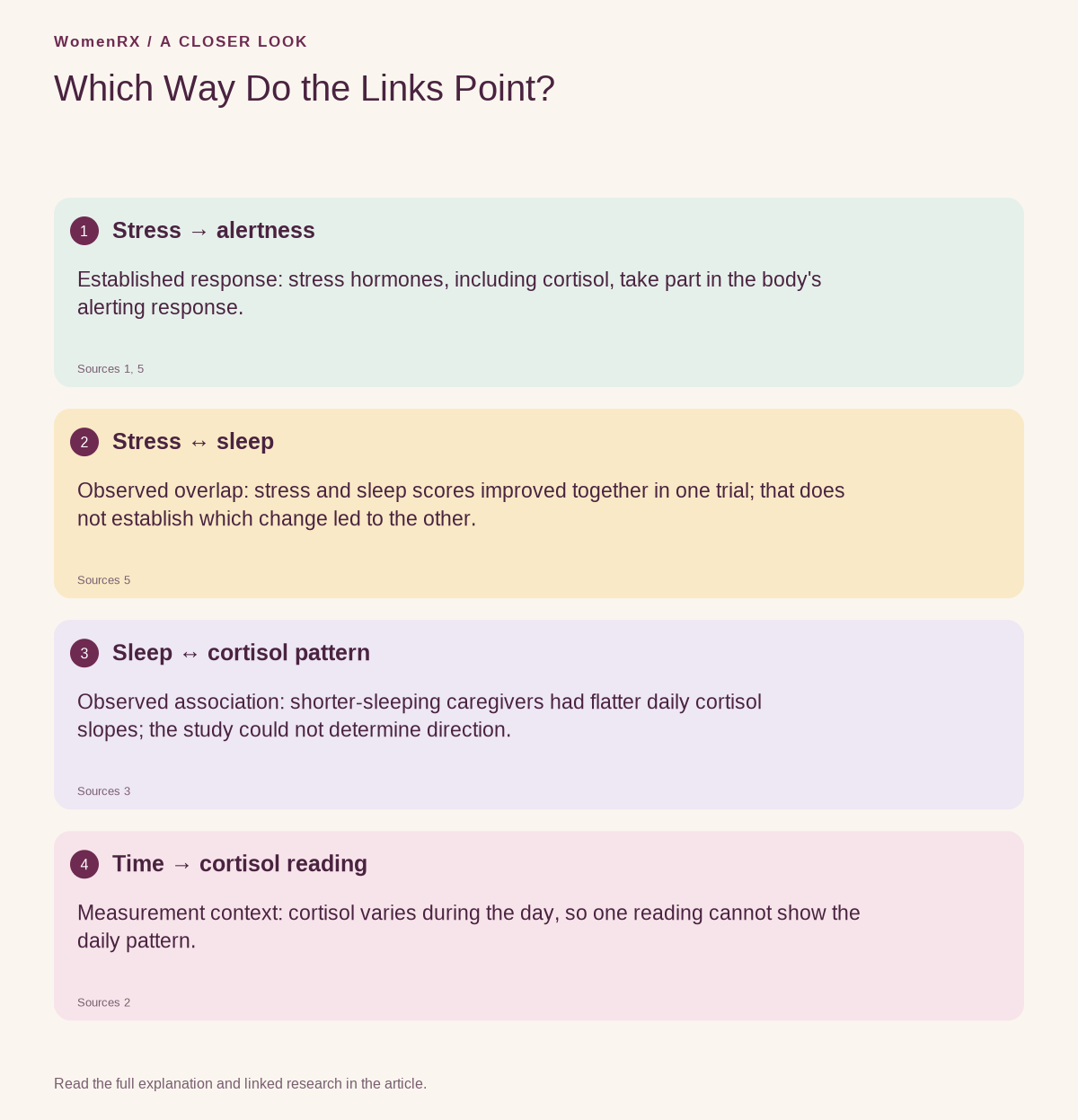
Which Way Do the Links Point?
Stress → alertness: Established response: stress hormones, including cortisol, take part in the body's alerting response.15
Stress ↔ sleep: Observed overlap: stress and sleep scores improved together in one trial; that does not establish which change led to the other.5
Sleep ↔ cortisol pattern: Observed association: shorter-sleeping caregivers had flatter daily cortisol slopes; the study could not determine direction.3
Time → cortisol reading: Measurement context: cortisol varies during the day, so one reading cannot show the daily pattern.2
Read the figure as text
Read each arrow as labeled: an established bodily response, an observed association, or a measurement issue, not one proven chain of causes.- Stress → alertness: Established response: stress hormones, including cortisol, take part in the body's alerting response.15
- Stress ↔ sleep: Observed overlap: stress and sleep scores improved together in one trial; that does not establish which change led to the other.5
- Sleep ↔ cortisol pattern: Observed association: shorter-sleeping caregivers had flatter daily cortisol slopes; the study could not determine direction.3
- Time → cortisol reading: Measurement context: cortisol varies during the day, so one reading cannot show the daily pattern.2
More questions, answered
Does a high cortisol result mean stress is causing my poor sleep?
No. Cortisol varies over the day, and a single result doesn’t show a daily pattern or identify why you’re sleeping poorly. Its timing and the reason it was measured matter. 2 3
Sources you can check
- Stress: MedlinePlusAccessed 2026-09-25Return to first citation
- Longitudinal associations between salivary cortisol to C-reactive protein ratios and psychological well-being in Chinese adults.Fong TCT, Ho RTH, Yau JCY. · Psychoneuroendocrinology · 2022Return to first citation
- Sleep Quality in Young Adult Informal Caregivers: Understanding Psychological and Biological Processes.Hoyt MA, Mazza MC, Ahmad Z, Darabos K, Applebaum AJ. · International journal of behavioral medicine · 2021Return to first citation
- Diurnal cortisol patterns and psychiatric symptoms in pregnancy: short-term longitudinal study.O'Connor TG, Tang W, Gilchrist MA, Moynihan JA, Pressman EK, Blackmore ER. · Biological psychology · 2014Return to first citation
- A New Ashwagandha Formulation (Zenroot™) Alleviates Stress and Anxiety Symptoms While Improving Mood and Sleep Quality: A Randomized, Double-Blind, Placebo-Controlled Clinical Study.Mahadevan M, Gopukumar K, Gupta R, Morde A, Patni P, Srinivas SS, Bhuvanendran A, Phanindra A. · Advances in therapy · 2025Return to first citation