Can Lifestyle Changes Lower Cortisol? What to Expect
Structured stress programs can lower measured cortisol, but feeling better and getting a lower hormone reading are different outcomes.
Yes, some structured stress programs have lowered cortisol in studies, although results vary by program and by how cortisol is measured. Lowering the number isn’t a goal everyone needs. If stress is what’s bothering you, focus on whether support helps you feel and function better. If you’re concerned about a cortisol test result, that’s a different question from everyday stress management. 4 5
Start with the problem, not the hormone
Maybe you want to feel less overwhelmed, sleep better, or cope with a difficult stretch of life. Those are useful goals in their own right. A lower cortisol reading is a separate outcome: it doesn’t, by itself, tell you whether a strategy helped with the problem that brought you here.
Cortisol isn’t measured just one way. Saliva samples taken across several days can estimate daily output. Hair cortisol reflects exposure over a longer period. A laboratory stress test measures the response to a particular challenge. A program can change one of these measures without changing another. 5
What structured programs have shown
A review of 39 mindfulness-based stress reduction (MBSR) studies, involving 2,059 participants, found lower measured cortisol with MBSR than with control conditions on average. Results varied across studies. This pooled result doesn’t establish whether effects differ for women. It supports a possibility, not a promise that any meditation or relaxation routine will lower your cortisol. 4
In a separate randomized trial, 60 participants were assigned to an eight-week group program or an active control. The program combined social and emotional skills, slow breathing with heart-rate-variability biofeedback, and ways to reframe stressful thoughts. Daily salivary cortisol output fell more in the program group, and that difference was maintained at follow-up. Yet the groups did not differ significantly in their cortisol response to a laboratory stress test. The distinction matters: even within one trial, “cortisol went down” didn’t describe every measure. 5
There’s some evidence specific to postmenopause. In a randomized trial of 64 postmenopausal women, a program combining self-care education and laughter yoga improved reported stress and menopause symptoms and lowered salivary cortisol compared with a control group. It was a small study of a combined program, so it cannot tell us which part made the difference or how well the results apply beyond that group. 3
Together, these findings show that some structured interventions can change particular cortisol measurements. They don’t establish that lowering cortisol itself prevents illness or that every helpful stress habit needs to change a hormone reading.
Choose support you can judge in daily life
You don’t need a cortisol measurement to act on everyday stress. For example, if too many demands are competing for your attention, decide what needs doing now and what can wait. If you’re carrying them alone, ask someone close to you for support. MedlinePlus also suggests avoiding too much caffeine as part of stress management. These are options to consider for managing stress, not a promise of a lower cortisol reading. 2
If you’d rather have guided practice, a structured program may appeal more than a list of tips. Judge it against your own goal: Is stress feeling more manageable? Is the symptom you hoped to address improving? A hormone number doesn’t have to be the scorecard.
Supplements are a different decision. The NIH Office of Dietary Supplements describes trials in which some ashwagandha extracts reduced reported stress and cortisol compared with placebo. The perceived-stress finding wasn’t uniform: another trial found less fatigue but no reduction in perceived stress. Products differed across studies, so those results aren’t a reason to assume any ashwagandha supplement will work for you. Ashwagandha may also interact with diabetes or blood-pressure medicines, immunosuppressants, and sedatives. 1 If you’re pregnant or breastfeeding, there’s another reason not to treat it as a casual stress remedy: the NIH fact sheet reports expert advice against use during pregnancy and cites a recommendation against use during pregnancy or breastfeeding. 1
When a cortisol result is the concern
The postmenopausal trial described above applies to that study group; it doesn’t establish a special cortisol-lowering regimen for women generally. 3
If your concern started with a cortisol test result or a possible medical condition, don’t treat a stress-management study as instructions for changing that result. The useful next move is to discuss what the test was measuring and why it was ordered. The trials above studied stress interventions, not treatment of a diagnosed cortisol disorder. 4 5
Stress-program outcomes aren’t all the same
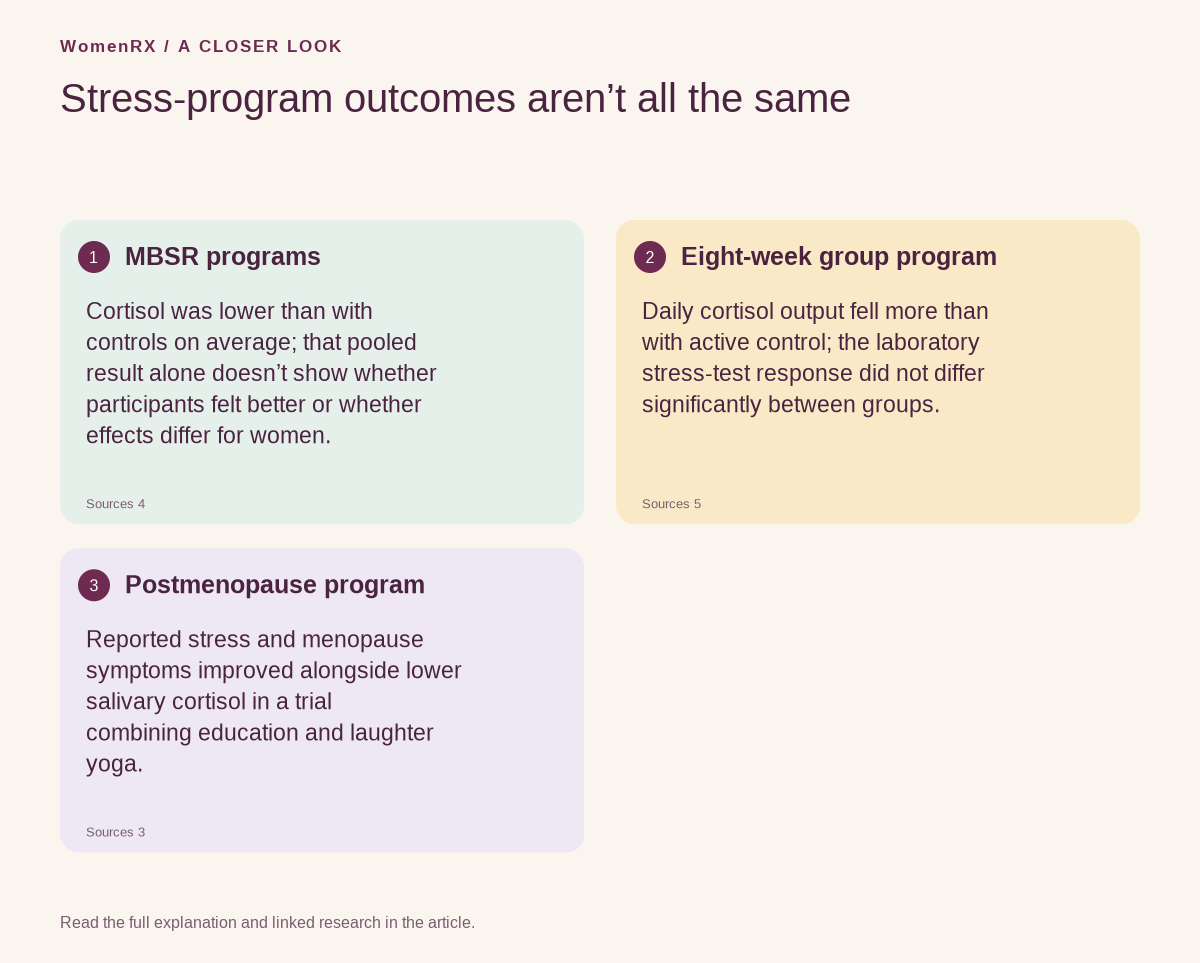
MBSR programs: Cortisol was lower than with controls on average; that pooled result alone doesn’t show whether participants felt better or whether effects differ for women.4
Eight-week group program: Daily cortisol output fell more than with active control; the laboratory stress-test response did not differ significantly between groups.5
Postmenopause program: Reported stress and menopause symptoms improved alongside lower salivary cortisol in a trial combining education and laughter yoga.3
Read the figure as text
Compare reported wellbeing outcomes with the specific cortisol measures that changed, or did not change, in these studies.- MBSR programs: Cortisol was lower than with controls on average; that pooled result alone doesn’t show whether participants felt better or whether effects differ for women.4
- Eight-week group program: Daily cortisol output fell more than with active control; the laboratory stress-test response did not differ significantly between groups.5
- Postmenopause program: Reported stress and menopause symptoms improved alongside lower salivary cortisol in a trial combining education and laughter yoga.3
More questions, answered
If I feel calmer, does that mean my cortisol went down?
Not necessarily. Feeling calmer and changing a measured cortisol outcome are different results. One group-program trial found a reduction in daily cortisol output but no significant difference in cortisol response to a laboratory stress test. 5
Sources you can check
- Ashwagandha: Is it helpful for stress, anxiety, or sleep? - Health Professional Fact SheetAccessed 2026-09-25Return to first citation
- Stress: MedlinePlusAccessed 2026-09-25Return to first citation
- Effects of a self-care-based education and laughter yoga on chronic stress, menopausal symptoms, and salivary cortisol: A randomized controlled trial.Gülevi DK, Bebiş H. · African journal of reproductive health · 2026Return to first citation
- Mindfulness-based stress reduction interventions and cortisol regulation: A systematic review and meta-analysis.Johnson BT, Simon TJ, Li C, Rokos EK, Martinez-Berman L, Jané MB, Tsai SS, Loucks EB. · Health psychology : official journal of the Division of Health Psychology, American Psychological Association · 2026Return to first citation
- Integrative group psychotherapy reduces daily cortisol output and hair cortisol: A randomized active‑controlled trial with multi‑day profiling.Pokushalov E, Terebenin E, Ponomarenko A, Sinyuk Y, Samoilov A, Gigovskaya T, Bubnovskaya M, Kudlay D, Trubicina E, Garcia C, Miller R. · PloS one · 2026Return to first citation