Can Lifestyle Changes Treat High Testosterone? Start With the Cause
Lifestyle changes may help when PCOS is involved, but they can’t explain every high testosterone result or replace evaluation of new symptoms.
Lifestyle changes can be part of PCOS care. Small trials suggest structured exercise and combined diet-and-exercise programs may improve some androgen measures in women with PCOS, but they don’t show that a routine or supplement reliably normalizes testosterone. First, find out what’s behind the result. Rapidly developing changes after menopause need timely evaluation. 231
A high result is a clue, not a diagnosis
It’s reasonable to ask what you can change yourself when a test shows high testosterone. The answer depends on why it’s high. PCOS is one possible explanation during the reproductive years, but a blood result or symptoms alone don’t establish that diagnosis. Adult PCOS diagnosis generally requires at least two of three features: irregular periods or ovulatory dysfunction, clinical or biochemical androgen excess, and polycystic ovarian appearance on ultrasound or elevated anti-Müllerian hormone. Conditions that mimic PCOS also need to be considered. 5
That’s the distinction behind any “natural” approach. A routine that supports health in someone with PCOS isn’t a treatment for every possible source of androgen excess.
What lifestyle changes have shown in PCOS
Exercise is worth discussing as part of PCOS care, but the hormone findings come from specific programs studied in specific groups. In one randomized trial, 48 women with PCOS were assigned to 12-week supervised high-intensity interval training or regular-intensity training programs. The high-intensity group had a greater reduction in free androgen index, a measure related to available testosterone, and in a measure of insulin resistance. The comparison doesn’t establish that high-intensity training is necessary or suitable for everyone. 2
Another randomized trial enrolled 120 female college students aged 18-22 with PCOS. It compared dietary adjustment alone with dietary adjustment plus Tai Chi over six months. Among the 86 participants in the complete-case analysis, measured testosterone decreased by 16.7% in the combined-program group and 6.4% in the diet-only group, with a statistically significant difference between groups. Because the study didn’t compare Tai Chi with another active exercise program, it can’t tell us whether Tai Chi itself had a unique effect. It also doesn’t establish a lasting result. 3
The practical takeaway isn’t to copy either trial’s routine. It’s that structured activity can be a useful part of a plan for diagnosed PCOS, while the best form of activity may depend on what you can do consistently and what you want the plan to address. Neither trial shows that changing an androgen measure will resolve every symptom, or that exercise treats a high result caused by something other than PCOS. 23
What about inositol and other “hormone-balancing” products?
A supplement marketed for testosterone reduction can sound more targeted than a general lifestyle change. But a trial that tested inositol alongside a diet group, a metformin group, and a combination group does not establish that inositol on its own lowers testosterone. The stronger reported outcomes for the combination also can’t be assigned to any one part of that plan. 4
That leaves a useful question before buying a product: Is there evidence it changes the outcome you care about in people with your condition? A claim to “balance hormones” doesn’t tell you whether it will change your symptoms or address the reason for your test result.
Why new symptoms after menopause deserve a different response
After menopause, new or increasing coarse hair growth or other signs of androgen excess shouldn’t automatically be treated as PCOS. The ovaries and adrenal glands can both be sources of excess androgens. Androgen-secreting tumors are relatively rare, but they are among the causes that an evaluation needs to rule out. How quickly symptoms appeared, how severe they are, and the degree of androgen excess help inform that assessment; there isn’t one agreed-upon test result or imaging approach that settles every case. 1
If you’re postmenopausal and changes develop rapidly or become pronounced, arrange timely medical assessment rather than waiting to see whether a new diet, workout, or supplement changes them. This doesn’t mean assuming the worst. It means getting an explanation before choosing a treatment. 1
Make the next decision about the cause
If you’re reviewing a high result with a clinician, these questions keep the conversation focused:
- What findings suggest PCOS, and what other explanations still need consideration?
- Does the pace of my symptoms or my menopausal status change the evaluation?
- If lifestyle changes are part of the plan, are we aiming to support metabolic health, address a symptom, or follow a hormone measurement?
- How will we tell whether the plan is helping with that goal?
For a teenager, PCOS diagnosis has different rules: the guideline calls for both irregular menstrual cycles, assessed in relation to time since the first period, and clinical or biochemical androgen excess, after excluding other causes. Ovarian appearance on ultrasound and anti-Müllerian hormone aren’t recommended for diagnosing PCOS in adolescents. 5
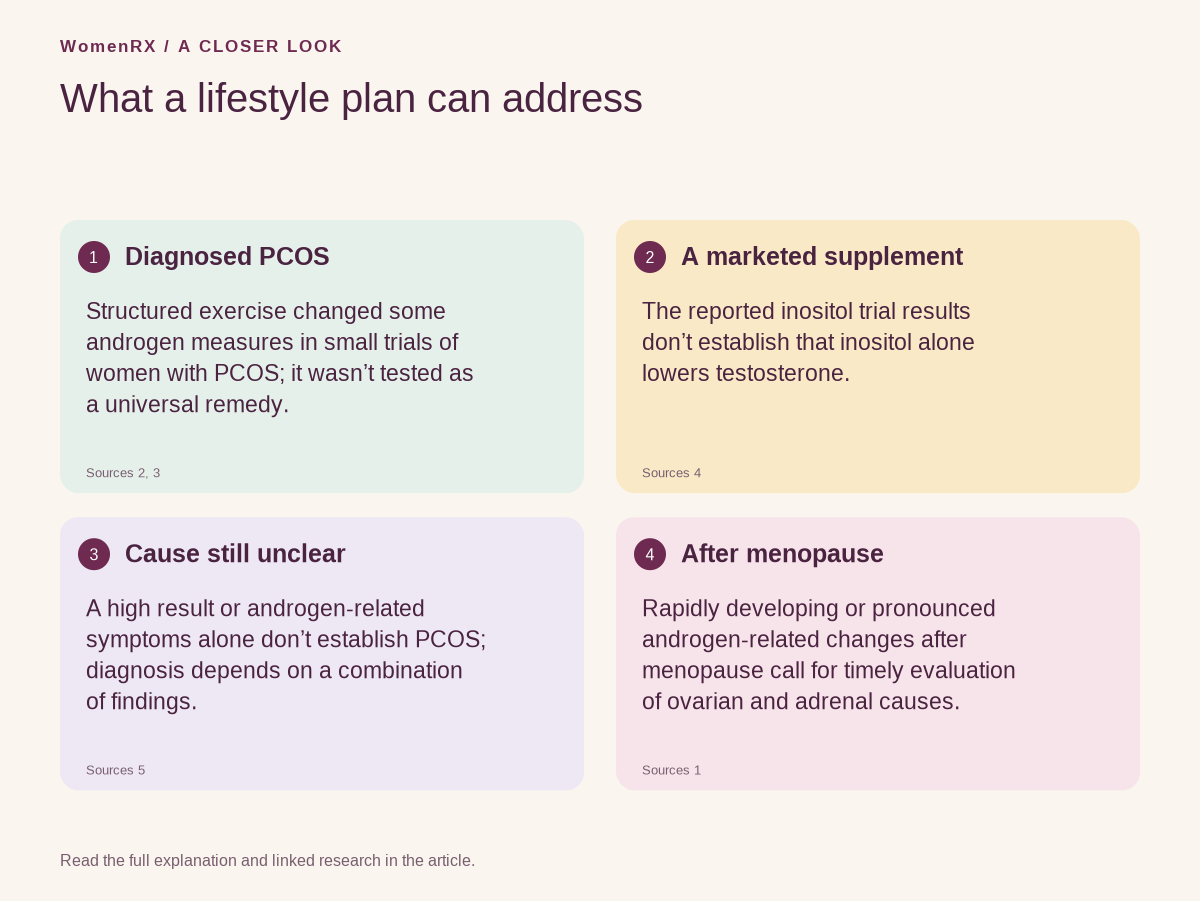
What a lifestyle plan can address
Diagnosed PCOS: Structured exercise changed some androgen measures in small trials of women with PCOS; it wasn’t tested as a universal remedy.23
A marketed supplement: The reported inositol trial results don’t establish that inositol alone lowers testosterone.4
Cause still unclear: A high result or androgen-related symptoms alone don’t establish PCOS; diagnosis depends on a combination of findings.5
After menopause: Rapidly developing or pronounced androgen-related changes after menopause call for timely evaluation of ovarian and adrenal causes.1
Read the figure as text
The same high testosterone result can lead to different next steps depending on the cause and how symptoms are changing.- Diagnosed PCOS: Structured exercise changed some androgen measures in small trials of women with PCOS; it wasn’t tested as a universal remedy.23
- A marketed supplement: The reported inositol trial results don’t establish that inositol alone lowers testosterone.4
- Cause still unclear: A high result or androgen-related symptoms alone don’t establish PCOS; diagnosis depends on a combination of findings.5
- After menopause: Rapidly developing or pronounced androgen-related changes after menopause call for timely evaluation of ovarian and adrenal causes.1
More questions, answered
Does having symptoms of high testosterone mean I have PCOS?
No. Adult PCOS diagnosis depends on a combination of features, and other conditions that can look similar need to be considered. Symptoms or one testosterone result can be a reason to investigate, not a diagnosis on their own. 5
Does a rapid change in symptoms make a difference?
After menopause, rapidly developing or severe androgen-related changes call for timely evaluation. Although androgen-secreting tumors are rare, they are among the causes that need to be ruled out. 1
Sources you can check
- Hyperandrogenism after menopause.Markopoulos MC, Kassi E, Alexandraki KI, Mastorakos G, Kaltsas G. · European journal of endocrinology · 2015Return to first citation
- The effect of high intensity interval training on free androgen index in patients with polycystic ovary syndrome.Celik GE, Ibanoglu MC, Baran GK, Baspinar Z, Pay RE, Engin-Ustun Y. · BMC endocrine disorders · 2026Return to first citation
- Effects of Tai Chi combined with dietary intervention on health-promoting lifestyle and metabolic and reproductive outcomes in female college students with polycystic ovary syndrome: a randomized controlled trial.Ren J, Chen H, Zhang L, Cui C, Wang L, He Q, Feng Y, Liang L. · Frontiers in endocrinology · 2026Return to first citation
- Multimodal Therapy With Metformin, Inositol and Dietary Restriction Improves Insulin Resistance and Endocrine Outcomes in Women With Polyendocrine Metabolic Ovarian Syndrome: A Randomized Controlled Trial.Irfan NU, Saleem S, Irfan A. · Clinical endocrinology · 2026Return to first citation
- International evidence-based recommendations for polycystic ovary syndrome in adolescents.Peña AS, Witchel SF, Boivin J, Burgert TS, Ee C, Hoeger KM, Lujan ME, Mousa A, Oberfield S, Tay CT, Teede H. · BMC medicine · 2025Return to first citation