High Testosterone in Women: When to Seek an Evaluation
A single symptom doesn’t prove testosterone is high; the combination, pace of change, and whether you’re past menopause help determine what to do next.
Acne or hair loss alone doesn’t show that your testosterone is high. New coarse facial or body hair, especially alongside other androgen-related changes, is worth discussing with a clinician. A rapidly developing cluster of changes or virilizing signs such as a deepening voice or clitoral enlargement calls for prompt assessment, particularly after menopause. These signs need evaluation, but they don’t identify the cause. 2 3 5
One symptom is different from a changing pattern
Acne, coarse hair growth on the face or body, and scalp hair thinning can be associated with androgen effects. But none of them, by itself, confirms that testosterone is high. Acne is common and can begin at any age; hormonal changes may contribute. Hair loss also has several possible causes. What matters is whether changes are appearing together, becoming more pronounced, or developing quickly. 1 2 5
For example, a few new chin hairs over a long period are a different pattern from quickly increasing coarse hair growth together with acne and scalp thinning. That comparison can help you describe what’s changed, but it cannot diagnose the cause.
When to arrange an evaluation
If you have new or increasing coarse facial or body hair, or several androgen-related changes, arrange an evaluation rather than trying to infer your testosterone level from symptoms. In reproductive-age women, hirsutism and virilization are among the patterns addressed in diagnostic evaluation of androgen levels. The symptoms alone don’t establish which condition, if any, is responsible. 3
A noticeably deepening voice or clitoral enlargement are examples of virilizing changes. These deserve clinical assessment. If changes are developing rapidly, seek prompt assessment, especially after menopause. Postmenopausal androgen excess can have ovarian or adrenal sources; while many causes are benign, virilizing features can also occur with an androgen-producing tumor. 4 5
After menopause, mild facial hair growth or hair thinning can occur with the relative shift toward androgen effects that accompanies this life stage. That context is different from pronounced, rapidly progressing changes or virilizing features, which should not be dismissed as ordinary aging. 5
In a study of 51 menopausal patients referred for androgen excess, virilization was more common among the four patients with borderline or malignant tumors than among those with benign conditions. This was a small, selected clinical group, so it cannot estimate an individual woman’s risk. It does support taking virilizing changes seriously without assuming they mean cancer. 4
What testing can clarify
An evaluation usually starts by understanding what changed and how quickly. Blood tests may include testosterone and, depending on the clinical picture, other androgens. For postmenopausal women with signs of androgen excess, one review describes testing testosterone and dehydroepiandrosterone sulfate (DHEAS), among other tests. 3 6
The way testosterone is measured matters. A diagnostic review notes limitations of some assays in women and explains that reference ranges depend on the measurement method. For postmenopausal evaluation, a review identifies testosterone measured by tandem mass spectrometry as a preferred first step. A result needs to be interpreted alongside symptoms and other findings, not used on its own to identify the source. 3 5
If the findings suggest androgen excess, imaging may help assess the ovaries or adrenal glands. The choice can include ovarian ultrasound or MRI, or adrenal CT or MRI, depending on the clinical picture. Symptoms and a blood test alone don’t tell you which source is involved. 5
A practical guide to the next step
- One mild symptom: Acne is common, and hair loss has multiple possible causes. Neither alone confirms high testosterone. If the change persists or concerns you, discuss it with a clinician. 1 2
- New or increasing coarse hair, or several changes together: Arrange an evaluation. In reproductive-age women, the symptoms are a reason to assess the pattern, not a diagnosis. 3
- Rapidly developing changes after menopause: Seek prompt assessment, especially if several androgen-related changes are appearing together. 4 5
- Deepening voice or clitoral enlargement: These are virilizing features and warrant assessment; prompt investigation is particularly relevant after menopause. 4 5
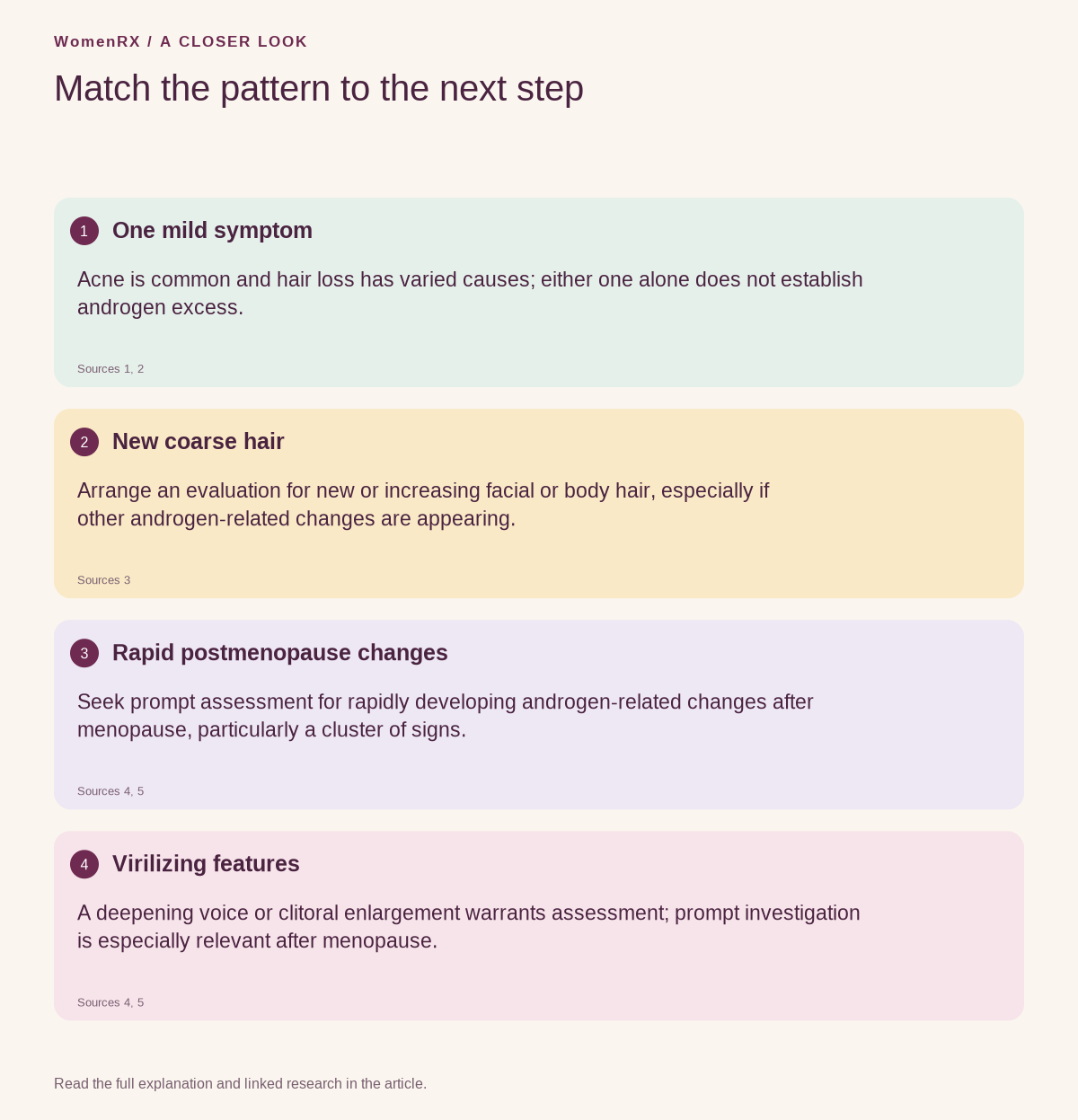
Match the pattern to the next step
One mild symptom: Acne is common and hair loss has varied causes; either one alone does not establish androgen excess.12
New coarse hair: Arrange an evaluation for new or increasing facial or body hair, especially if other androgen-related changes are appearing.3
Rapid postmenopause changes: Seek prompt assessment for rapidly developing androgen-related changes after menopause, particularly a cluster of signs.45
Virilizing features: A deepening voice or clitoral enlargement warrants assessment; prompt investigation is especially relevant after menopause.45
Read the figure as text
Use the number and pace of changes, plus life stage, to decide what to raise and how soon. Symptoms guide assessment but do not diagnose high testosterone.- One mild symptom: Acne is common and hair loss has varied causes; either one alone does not establish androgen excess.12
- New coarse hair: Arrange an evaluation for new or increasing facial or body hair, especially if other androgen-related changes are appearing.3
- Rapid postmenopause changes: Seek prompt assessment for rapidly developing androgen-related changes after menopause, particularly a cluster of signs.45
- Virilizing features: A deepening voice or clitoral enlargement warrants assessment; prompt investigation is especially relevant after menopause.45
More questions, answered
Can a testosterone blood test tell me what is causing the changes?
Not by itself. The measurement method affects how the result should be interpreted, and further hormone tests or imaging may be considered based on the overall findings. 3 5
Sources you can check
- Hair loss - NHSAccessed 2026-09-25Return to first citation
- Acne - NHSAccessed 2026-09-25Return to first citation
- Androgen Excess and Deficiency: Analytical and Diagnostic Approaches.Heijboer AC, Hannema SE. · Clinical chemistry · 2023Return to first citation
- Postmenopausal onset of androgen excess: a diagnostic and therapeutic algorithm based on extensive clinical experience.Luque-Ramírez M, Nattero-Chávez L, Rodríguez-Rubio Corona C, Ortiz-Flores AE, García-Cano AM, Rosillo Coronado M, Pérez Mies B, Ruz Caracuel I, Escobar-Morreale HF. · Journal of endocrinological investigation · 2024Return to first citation
- Approach to Investigation of Hyperandrogenism in a Postmenopausal Woman.Hirschberg AL. · The Journal of clinical endocrinology and metabolism · 2023Return to first citation
- Postmenopausal hyperandrogenism.Yoldemir T. · Climacteric : the journal of the International Menopause Society · 2022Return to first citation