When to Ask for a Fertility Evaluation
Your age and reproductive history can change how long it makes sense to keep trying before asking about an evaluation.
A useful timing guide is to ask about an evaluation after 12 months of regular, unprotected sex if you’re under 35, or after six months if you’re 35 or older. If you’re over 40, have irregular periods, a history of pelvic inflammatory disease, or previous fertility concerns, contact a clinician when you’re ready to try rather than waiting for those milestones. Both partners may need assessment. 1
Use age as a starting point, not the whole answer
If you’re under 35, a year of regular, unprotected sex without pregnancy is a reasonable point to ask about an evaluation. If you’re 35 or older, ask after six months. These timeframes are useful guides, not a reason to ignore a known health concern or to assume that a specific diagnosis or treatment is inevitable. 1
If you’re over 40 and preparing to try, MedlinePlus advises contacting a clinician when you’re ready. That’s a reason to start the conversation sooner, rather than treating the six-month mark as a requirement to wait. 1
The question isn’t only how many months you’ve been trying. Menstrual history and past reproductive health can change what’s useful to discuss now.
When it makes sense to ask sooner
If your periods are irregular, you’ve had pelvic inflammatory disease, or you’ve had fertility concerns before, contact a clinician as you begin trying. These are reasons to discuss your situation without waiting for the usual time threshold; they don’t, by themselves, tell you what the cause is. 1
Repeated miscarriage or stillbirth is also included in MedlinePlus’s description of infertility. It’s worth bringing this history up with a clinician, but the information here doesn’t set a separate waiting period for seeking an evaluation after pregnancy loss. 1
For example, if you’re 32 and have irregular periods, the calendar alone doesn’t need to determine when you make contact. If you’re 37 and have no known concerns, six months of trying is the usual point to ask. Those examples illustrate how the age and history guidance can work together, not a diagnosis of either situation. 1
Make the evaluation about both partners
Fertility difficulties can involve either partner, and sometimes both. An evaluation that focuses only on the person trying to become pregnant can miss relevant information. MedlinePlus describes testing for women and men, which may include blood tests, imaging, and a semen test. 1
That doesn’t mean both partners will need the same tests. The clinician may ask about each person’s health history and decide what assessment fits the circumstances. You can ask how both partners will be included and what the first steps would be. 1
What to do with the timing guide
If you’ve reached the age-based timeframe, contact a clinician and ask whether an evaluation makes sense. If one of the earlier-concern histories applies, raise it when you’re ready to try. You can begin by sharing how long you’ve been trying, your menstrual pattern, any relevant reproductive or pregnancy history, and information about your partner’s health. The evaluation can help look for possible causes; next steps depend on what, if anything, is found. 1
A specialist evaluation is a way to investigate, not a promise that a particular treatment will be recommended or that pregnancy will follow. Testing and treatment choices depend on the findings, among other factors. 1
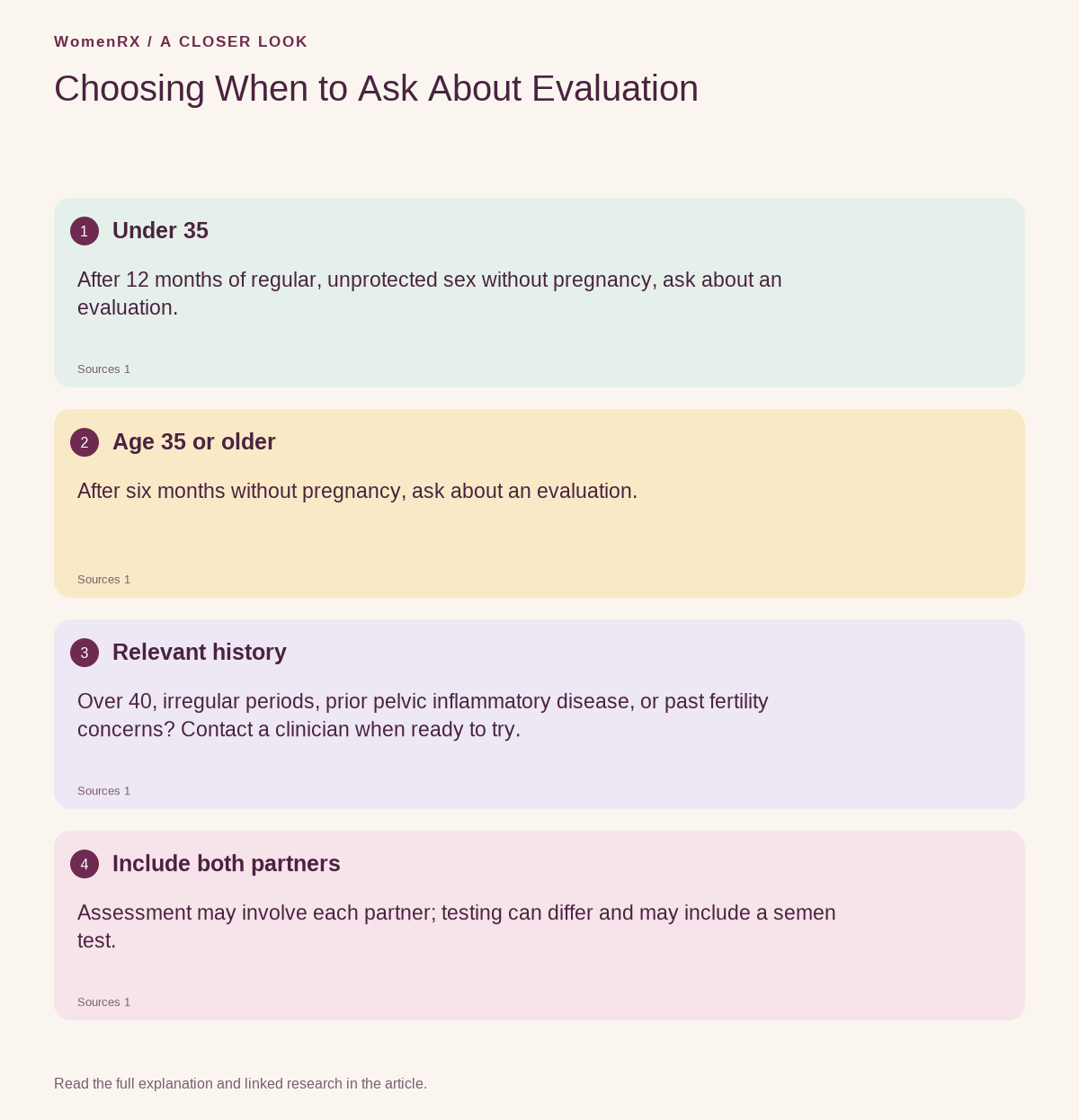
Choosing When to Ask About Evaluation
Under 35: After 12 months of regular, unprotected sex without pregnancy, ask about an evaluation.1
Age 35 or older: After six months without pregnancy, ask about an evaluation.1
Relevant history: Over 40, irregular periods, prior pelvic inflammatory disease, or past fertility concerns? Contact a clinician when ready to try.1
Include both partners: Assessment may involve each partner; testing can differ and may include a semen test.1
Read the figure as text
Start with how long you’ve been trying, then check whether age or reproductive history makes an earlier conversation sensible.- Under 35: After 12 months of regular, unprotected sex without pregnancy, ask about an evaluation.1
- Age 35 or older: After six months without pregnancy, ask about an evaluation.1
- Relevant history: Over 40, irregular periods, prior pelvic inflammatory disease, or past fertility concerns? Contact a clinician when ready to try.1
- Include both partners: Assessment may involve each partner; testing can differ and may include a semen test.1
More questions, answered
Does a previous pregnancy mean you can’t have fertility concerns now?
No. Difficulty conceiving after a previous pregnancy is called secondary infertility. If that’s your situation, share the history when you ask about an evaluation. 2
Does an evaluation mean both partners will get the same tests?
No. Testing differs for women and men and depends on the situation. An evaluation may include a semen test for the male partner, along with other tests as indicated. 1
Sources you can check
- Infertility | Infertility Treatments | MedlinePlusAccessed 2026-09-25Return to first citation
- Infertility - NHSAccessed 2026-09-25Return to first citation