Vitamin D and Fertility: What Supplementation Can Do
Low vitamin D has been linked with fertility outcomes, but that link doesn’t show that supplements improve your chances of pregnancy.
Vitamin D isn’t an established fertility treatment. Lower blood levels have been associated with poorer reproductive outcomes, but supplementation trials haven’t shown reliable improvements in pregnancy outcomes. Testing may be relevant for general health if you have a condition or circumstance that raises your risk of deficiency; trying to conceive alone doesn’t establish that you need a test or a high-dose supplement. 1 4
A link isn’t proof of a treatment
Vitamin D has roles in the body that make a connection to reproduction biologically plausible. Research has also found associations between lower vitamin D levels and less favorable fertility outcomes. But an association can’t tell us whether low vitamin D contributes to fertility problems, reflects other health or lifestyle factors, or both. And it can’t show that taking a supplement will change the outcome. 4
That distinction matters when you’re deciding whether to add a supplement to your conception plan. In a 2026 systematic review of supplements for female infertility, the main analyses found no effect of supplements on pregnancy-related outcomes compared with placebo. The review’s secondary analyses suggested possible benefits for some supplements, including vitamin D, but combined placebo and no-treatment comparisons and were considered more vulnerable to bias. The authors said those findings need confirmation in adequately powered placebo-controlled trials, with live birth as the primary outcome. 4
What supplementation trials have found
One small randomized, placebo-controlled trial tested vitamin D in 70 women with vitamin D levels below 30 ng/mL who were considered poor responders and were undergoing IVF. Supplementation raised blood vitamin D levels, but the study found no significant differences in fertilization, egg maturity, embryo-transfer cancellations, or chemical pregnancy. The chemical pregnancy rates were similarly low in both groups. This trial speaks to a specific IVF population, not everyone trying to conceive, and it does not settle whether treating a documented deficiency has other health benefits. 3
A separate review describes earlier IVF trials with mixed results. One review of five randomized trials found more biochemical pregnancies with supplementation, but not more clinical or ongoing pregnancies, or fewer miscarriages. Another review reported an improvement in clinical pregnancy but not biochemical pregnancy. Differences in study findings and outcomes make it hard to use these results as a basis for vitamin D as a fertility treatment. 4
There’s also early research on a possible effect on the uterine lining. In a study involving human cells and vitamin D-deficient participants, supplementation was followed by a change in the cells’ capacity for decidualization, but the reported change was not statistically significant. This is a laboratory and biological finding, not evidence that supplementation improves the chance of pregnancy or live birth. 5
When a vitamin D test may be relevant
A blood test for vitamin D measures 25-hydroxyvitamin D, usually written as 25(OH)D. It’s the main marker used to assess vitamin D status. A test can make sense to discuss when you have a known deficiency or a reason your levels may be low, such as a condition that limits fat absorption or a history of gastric bypass surgery. Limited sun exposure and other factors can also affect vitamin D status. 1
Testing solely because you’re trying to conceive is a different question. Guidance summarized by the NIH Office of Dietary Supplements does not recommend routine testing for healthy people, and the U.S. Preventive Services Task Force has found insufficient evidence to assess the benefits and harms of screening asymptomatic adults. Those recommendations address general screening, not a fertility-specific testing strategy, and the research summarized here does not establish that testing everyone trying to conceive improves fertility outcomes. 1
If you do have a result, it needs context. The NIH fact sheet notes that vitamin D blood tests can vary by laboratory and that the levels tied to deficiency or overall health aren’t definitively settled. A result shouldn’t be treated as a fertility target on its own. 1
A practical way to use this evidence
If you have a condition that can affect vitamin D absorption, a prior low result, or another reason to worry about deficiency, ask whether testing or treatment is appropriate for your general health. Vitamin D supports calcium absorption and bone health, so addressing deficiency may matter for reasons separate from fertility. 1
If you’re considering a supplement only to improve your odds of conception, the current evidence doesn’t establish that it will help. Avoid assuming that more is better: excessive vitamin D from supplements can cause toxicity, including high blood calcium, and high-dose use shouldn’t be treated as a do-it-yourself fertility strategy. 1
And don’t let a vitamin D test or supplement stand in for a fertility evaluation when one is due. In the U.S., evaluation is generally appropriate after a year of trying if you’re under 35, or after six months if you’re 35 or older; seek advice sooner if you’re over 40 or already have fertility concerns. 2
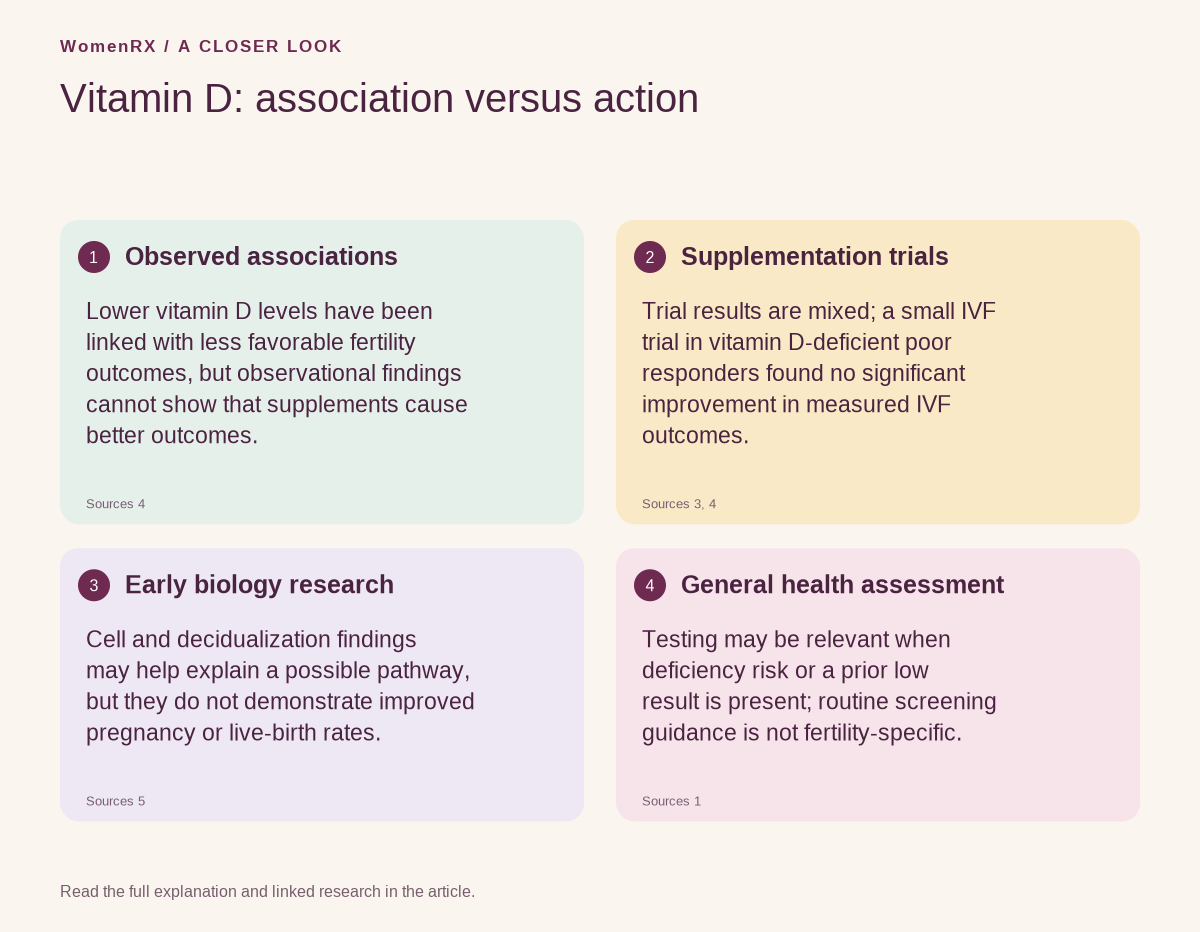
Vitamin D: association versus action
Observed associations: Lower vitamin D levels have been linked with less favorable fertility outcomes, but observational findings cannot show that supplements cause better outcomes.4
Supplementation trials: Trial results are mixed; a small IVF trial in vitamin D-deficient poor responders found no significant improvement in measured IVF outcomes.34
Early biology research: Cell and decidualization findings may help explain a possible pathway, but they do not demonstrate improved pregnancy or live-birth rates.5
General health assessment: Testing may be relevant when deficiency risk or a prior low result is present; routine screening guidance is not fertility-specific.1
Read the figure as text
These evidence categories answer different questions: a link with fertility is not the same as proof that supplementation changes outcomes.- Observed associations: Lower vitamin D levels have been linked with less favorable fertility outcomes, but observational findings cannot show that supplements cause better outcomes.4
- Supplementation trials: Trial results are mixed; a small IVF trial in vitamin D-deficient poor responders found no significant improvement in measured IVF outcomes.34
- Early biology research: Cell and decidualization findings may help explain a possible pathway, but they do not demonstrate improved pregnancy or live-birth rates.5
- General health assessment: Testing may be relevant when deficiency risk or a prior low result is present; routine screening guidance is not fertility-specific.1
More questions, answered
What vitamin D test measures your status?
The usual test is blood 25-hydroxyvitamin D, or 25(OH)D. The active form, 1,25-dihydroxyvitamin D, is generally not a good measure of vitamin D status. 1
Can a vitamin D supplement replace a fertility evaluation?
No. Supplementation hasn’t been established as a fertility treatment, and fertility evaluation can identify causes involving either partner or both. 2 4
Sources you can check
- Vitamin D - Health Professional Fact SheetAccessed 2026-09-25Return to first citation
- Infertility | Infertility Treatments | MedlinePlusAccessed 2026-09-25Return to first citation
- Impact of Vitamin D Supplementation on IVF Outcomes in Vitamin D-Deficient Poor Responders: a Randomized Controlled Trial.Mirsharifi MS, Shirdel S, Ghaderi E, Masroor MJ. · Reproductive sciences (Thousand Oaks, Calif.) · 2026Return to first citation
- The Effect of Dietary Supplements on Female Infertility in Terms of Endometrial Thickness, Pregnancy, Live Birth and Miscarriage: A Systematic Review and Meta-Analysis.Michaelsen MP, Poulsen M, Borgstrøm M, Wisby HB, Bjerregaard AA, Kesmodel US. · Nutrients · 2026Return to first citation
- Leveraging Menstrual Effluent to Investigate Vitamin D and Human Decidualization: A Potential Link with Fertility.Metz CN, Chatterjee PK, Hyman N, Busch S, Tarasenko SA, Hoofnagle AN, Gregersen PK, Steiner AZ, Jukic AMZ. · The Journal of clinical endocrinology and metabolism · 2026Return to first citation