Vitamin D and Body Weight: What Studies Show
Vitamin D supplements haven’t been shown to reliably change body weight, even though lower vitamin D levels are associated with higher body weight.
Vitamin D supplements haven’t been shown to reliably cause weight loss or weight gain. Reviews of randomized trials found no significant overall effect on body weight, including when vitamin D was added to exercise. Lower blood vitamin D is associated with higher body weight, but that link doesn’t show that taking a supplement will change your weight. 345
A link on a blood test isn’t a weight-loss effect
People with higher BMI often have lower blood vitamin D levels. That finding can sound as though low vitamin D is holding back weight loss. But an association can’t tell you which came first. Researchers have proposed several explanations, including differences in how vitamin D is distributed in the body and stored in fat tissue. Those possibilities don’t establish that taking vitamin D changes body weight. 56
There’s evidence that the relationship can run in the other direction. In a study of adults with obesity, blood vitamin D rose in both women and men after an initial period of diet-related weight loss. The researchers were examining how weight loss affected vitamin D status, not whether vitamin D supplements caused weight loss. 6
What happened when people took supplements?
In a systematic review of 28 studies involving 1,675 adults, adding vitamin D to exercise raised blood vitamin D levels but did not significantly improve body weight, BMI, fat mass, or body-fat percentage compared with exercise alone. 4
A smaller review of eight randomized trials involving 481 adults with overweight or obesity also found no significant overall added effect on weight loss from combining vitamin D with exercise. It did find a difference in waist circumference, as well as favorable weight or BMI results in some age and exercise subgroups. Those narrower findings are worth studying, but they aren’t a dependable prediction of what will happen to an individual’s weight. 3
A separate review of trials in adults with overweight, obesity, or related metabolic conditions found no significant overall effect on body weight or waist circumference. It reported a BMI reduction after adjusting for publication bias. Taken together, these mixed findings don’t support using vitamin D as a weight-management supplement. 5
What the evidence means for you
The trial that reported results separately for women and men tells us something about vitamin D levels after weight loss. It cannot establish whether supplements change weight for women at any reproductive life stage. The pooled adult supplement results likewise don’t provide a reliable women-specific weight benefit to act on. 46
That doesn’t mean vitamin D has no reason to be in your health plan. It helps your body absorb calcium, and some people, including people with obesity, may need extra vitamin D. Whether you need it is a separate question from whether you want to change your weight. 2
If the number on your scale changes after you start a supplement, timing alone won’t tell you why. Body weight includes water, muscle, bone, and fat. An unexpected gain or loss is worth discussing with a health care provider rather than assuming vitamin D caused it. 1
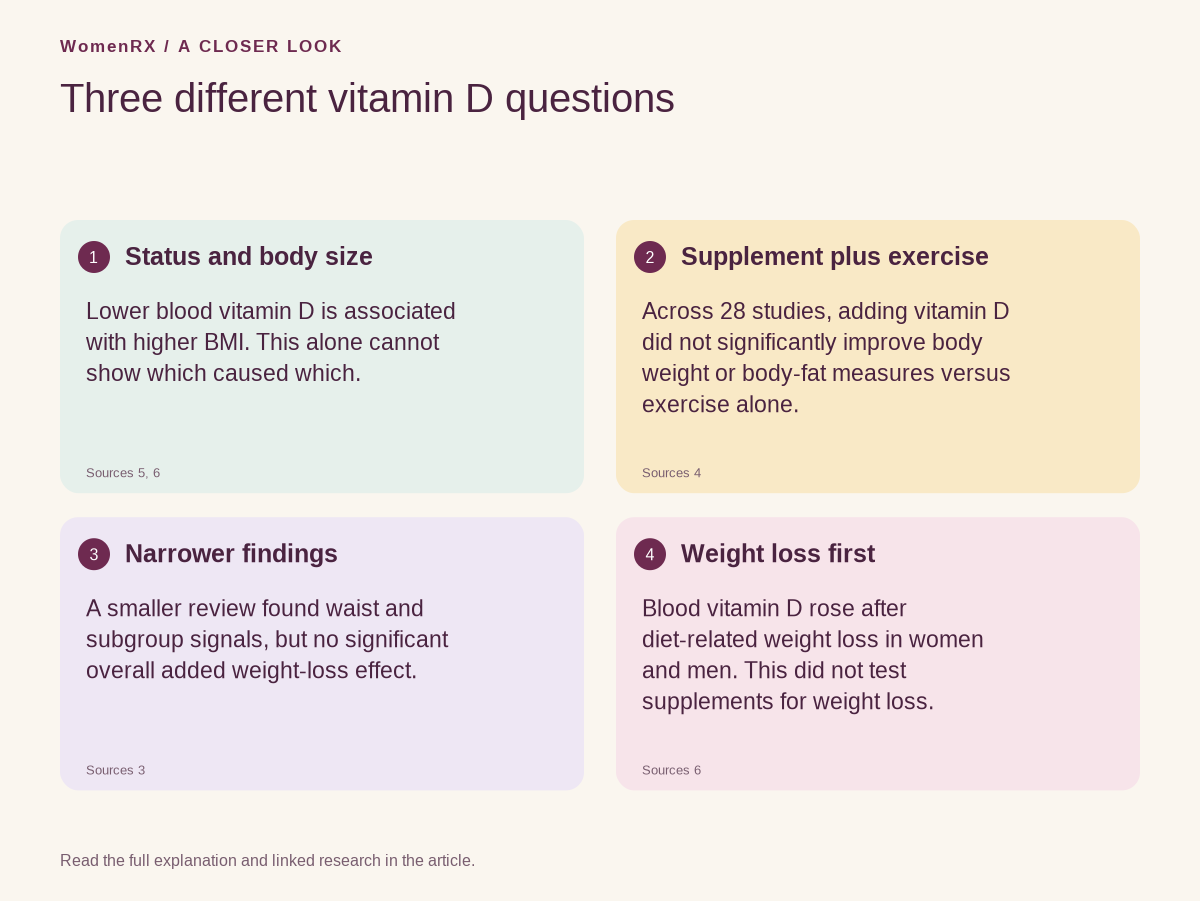
Three different vitamin D questions
Status and body size: Lower blood vitamin D is associated with higher BMI. This alone cannot show which caused which.56
Supplement plus exercise: Across 28 studies, adding vitamin D did not significantly improve body weight or body-fat measures versus exercise alone.4
Narrower findings: A smaller review found waist and subgroup signals, but no significant overall added weight-loss effect.3
Weight loss first: Blood vitamin D rose after diet-related weight loss in women and men. This did not test supplements for weight loss.6
Read the figure as text
A blood-level association, a supplement trial, and a study of weight loss answer different questions.- Status and body size: Lower blood vitamin D is associated with higher BMI. This alone cannot show which caused which.56
- Supplement plus exercise: Across 28 studies, adding vitamin D did not significantly improve body weight or body-fat measures versus exercise alone.4
- Narrower findings: A smaller review found waist and subgroup signals, but no significant overall added weight-loss effect.3
- Weight loss first: Blood vitamin D rose after diet-related weight loss in women and men. This did not test supplements for weight loss.6
More questions, answered
Does low vitamin D make weight loss harder?
Lower vitamin D levels and higher body weight are associated, but that doesn’t establish that low vitamin D makes weight loss harder. Trials haven’t found a consistent overall weight-loss benefit from supplementation. 345
Sources you can check
- Body Weight: MedlinePlusAccessed 2026-09-25Return to first citation
- Vitamin D: MedlinePlusAccessed 2026-09-25Return to first citation
- Can Vitamin D supplementation enhance the effectiveness of exercise-induced weight loss in overweight or obese adults? Evidence from integrated transcriptomic and meta-analysis.Peng T, Zhang Z, Liang W, Zhang J. · Frontiers in nutrition · 2025Return to first citation
- Effects of Vitamin D Supplementation in Combination With Exercise Training on Body Composition and Muscular Strength in Adults: A Systematic Review and Dose-Response Meta-Analysis of Randomized Controlled Trials.Kazeminasab F, Moein AR, Baharlooie M, Moradi S, Camera DM, Tinsley GM, Rosenkranz SK, Bagheri R. · Nutrition reviews · 2025Return to first citation
- Effect of vitamin D supplementation on body composition, lipid profile, and glycemic indices in patients with obesity-associated metabolic syndrome: a systematic review and meta-analysis.Ge L, Gao S, Kia N, Wang Y, Hua L. · Diabetology & metabolic syndrome · 2025Return to first citation
- Weight Loss Induces Changes in Vitamin D Status in Women With Obesity But Not in Men: A Randomized Clinical Trial.Holt R, Holt J, Jorsal MJ, Sandsdal RM, Jensen SBK, Byberg S, Juhl CR, Lundgren JR, Janus C, Stallknecht BM, Holst JJ, Juul A, Madsbad S, Jensen MB, Torekov SS. · The Journal of clinical endocrinology and metabolism · 2025Return to first citation