Vitamin K2 and Weight: What Human Studies Show
A small change in one study and mixed findings in others don’t establish vitamin K2 as a way to lose weight or change body composition.
Vitamin K2 hasn’t been shown to reliably cause weight loss or weight gain. A one-year study reported a small average BMI decrease, but its findings don’t establish what would have happened without supplementation. Other human findings are mixed, including a study in postmenopausal women with no overall body-composition effect. Taking K2 specifically for weight control isn’t justified by these results. 3
What changed in the one-year study?
A study report followed 243 adults with low vitamin K status, including 166 women, who took menaquinone-7 (MK-7), a form of vitamin K2, for one year. Average BMI fell by 0.66% across the group. Among participants whose vitamin K-status marker improved more, the report described a 1.25% decrease in weight and a 1.93% decrease in fat mass. Those larger changes were found in a subgroup, not across everyone who took MK-7. 3
The overall BMI change was small. More importantly, the reported before-and-after changes don’t establish how participants’ weight would have changed without MK-7. They also don’t show that the difference was large enough to improve health. The subgroup finding offers even less certainty for a decision you’d make today: you can’t know in advance whether you’ll be someone whose marker responds strongly. 3
BMI, scale weight, and body composition answer different questions. Weight includes fat, muscle, bone, and water. BMI uses height and weight but can’t distinguish those components, while a fat-mass measurement looks more directly at body composition. A change in a vitamin K-status marker isn’t, by itself, a change in body fat or weight. 23
Why the other human findings matter
The one-year paper’s authors describe earlier interventions with differing results. They report a positive body-composition finding in people with polycystic ovary syndrome (PCOS), but no body-composition effect in a study of people with type 2 diabetes. Those brief descriptions don’t provide enough detail to explain the difference or show that the PCOS result would apply to women without PCOS. 3
Another reported study found modest reductions in weight, body fat, and waist circumference, but its supplement contained MK-7 alongside vitamin D3, vitamins B6 and B12, and magnesium. That result can’t tell you what MK-7 did on its own. 3
For postmenopausal women, the paper describes a three-year MK-7 intervention with no overall effect on body composition. Reductions in abdominal and visceral fat appeared in a subgroup with a stronger response in a vitamin K-related marker. As with the one-year findings, a responder subgroup isn’t the same as a benefit for the whole group. 3
Does being a woman change the answer?
Possibly, but the evidence isn’t firm enough to act on that possibility for weight control. The one-year study reported greater reductions in BMI, fat mass, and weight among women, especially premenopausal women. That’s worth studying further, not a dependable prediction of what will happen if you take K2. The postmenopausal intervention’s lack of an overall body-composition effect is a reason not to assume the result extends across menopause stages. 3
The one-year study also found that, before supplementation, lower vitamin K status was associated with higher BMI and measures of body fat. An association can’t show whether vitamin K status affected body fat, body fat affected vitamin K status, or other factors influenced both. It doesn’t demonstrate that taking K2 reverses the pattern. 3
The practical bottom line
If your aim is to change your weight or body composition, K2 isn’t a proven tool for that job. The reported human changes are small or inconsistent, and several of the more promising findings come from selected subgroups or a supplement with multiple ingredients. There’s no clear evidence here that K2 causes weight gain, either. 3
If you’re thinking about K2 for a reason unrelated to weight, consider that as a separate question. For weight management itself, healthy eating and physical activity have a clearer role than K2 supplementation. 1
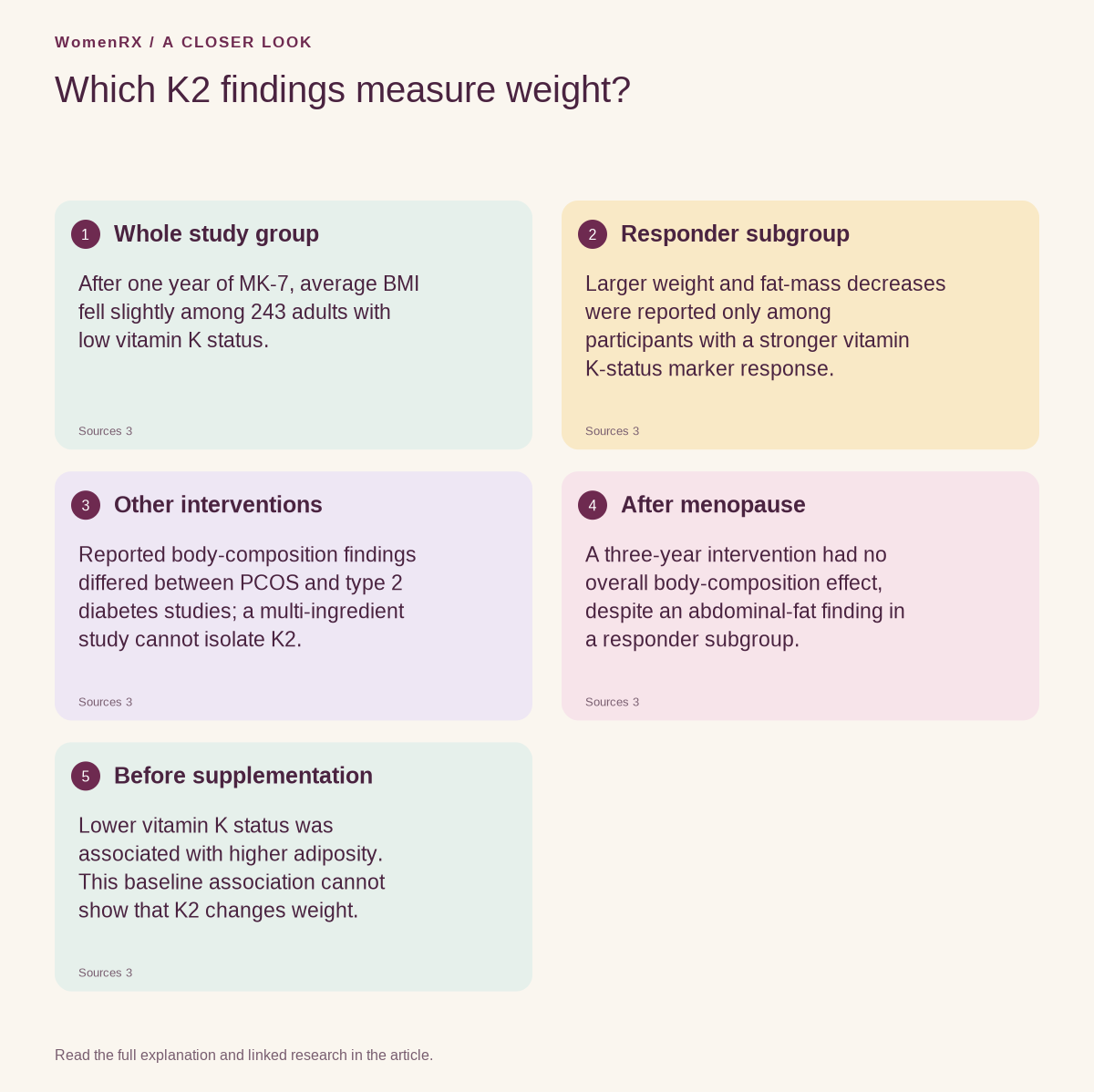
Which K2 findings measure weight?
Whole study group: After one year of MK-7, average BMI fell slightly among 243 adults with low vitamin K status.3
Responder subgroup: Larger weight and fat-mass decreases were reported only among participants with a stronger vitamin K-status marker response.3
Other interventions: Reported body-composition findings differed between PCOS and type 2 diabetes studies; a multi-ingredient study cannot isolate K2.3
After menopause: A three-year intervention had no overall body-composition effect, despite an abdominal-fat finding in a responder subgroup.3
Before supplementation: Lower vitamin K status was associated with higher adiposity. This baseline association cannot show that K2 changes weight.3
Read the figure as text
These findings answer different questions: some measured weight or body composition after supplementation, while another measured an association before it.- Whole study group: After one year of MK-7, average BMI fell slightly among 243 adults with low vitamin K status.3
- Responder subgroup: Larger weight and fat-mass decreases were reported only among participants with a stronger vitamin K-status marker response.3
- Other interventions: Reported body-composition findings differed between PCOS and type 2 diabetes studies; a multi-ingredient study cannot isolate K2.3
- After menopause: A three-year intervention had no overall body-composition effect, despite an abdominal-fat finding in a responder subgroup.3
- Before supplementation: Lower vitamin K status was associated with higher adiposity. This baseline association cannot show that K2 changes weight.3
More questions, answered
Did any study find that K2 increased body fat?
In the one-year report, participants whose vitamin K-status marker did not improve enough to meet the study’s responder definition had an increase in visceral fat. That subgroup change doesn’t establish that K2 caused the increase, just as the responder subgroup’s decreases don’t prove it caused fat loss. 3
Sources you can check
- Weight Control: MedlinePlusAccessed 2026-09-25Return to first citation
- Body Weight: MedlinePlusAccessed 2026-09-25Return to first citation
- Sex-Specific Effects of Menaquinone-7 (MK-7) Supplementation on Body Composition and Adiposity Markers.Bittner R, de Vries F, Machuron F, Maresz K, Gåserød O, Schurgers L. · Nutrients · 2026Return to first citation