Choline and Weight: What Human Studies Actually Show
Choline is an essential nutrient, but that role doesn’t show that taking more of it changes body weight.
Human evidence here doesn’t establish choline supplements as a way to lose weight or change body composition. One randomized trial measured weight during alternate-day fasting, but tested a krill-oil blend containing choline, omega-3s, and astaxanthin, so it can’t show what choline alone did. The study included women and men, but didn’t report pregnancy, lactation, or results by sex. 3
Choline is necessary for normal body functions, including making phosphatidylcholine, which helps transport fats out of the liver. But a nutrient’s role in fat metabolism is not proof that extra choline reduces body fat or body weight. 1
That distinction is the key takeaway: choline supports essential processes, while a weight-control claim needs human studies that measure weight or body composition and can separate choline’s effects from other ingredients and lifestyle changes.
The human weight trial tested a blend
A randomized trial enrolled 41 adults with overweight or obesity, including 25 women and 16 men. Everyone followed an eight-week alternate-day fasting plan and received either krill oil or a vegetable-oil placebo. The krill-oil capsules also contained choline and astaxanthin, alongside EPA and DHA, so this was not a trial of choline by itself. 3
Both groups lost weight during the fasting period: average body-weight change was −4.6 kg with krill oil and −4.5 kg with placebo. The difference between groups was not statistically significant. In other words, the trial did not show that the krill-oil blend added weight loss to the fasting plan. 3
The study did report a difference in fat-free mass: the krill-oil group had no significant change, while the placebo group had a reduction, and the change differed between groups. But the intervention combined several ingredients, so this finding cannot be attributed to choline. It also doesn’t establish that choline supplements preserve muscle during weight loss. 3
Body weight and body composition are related but not interchangeable. A scale measures total body mass, while body-composition measures estimate different parts of it. That’s why a change in weight alone doesn’t explain whether fat, muscle, or other components changed. 2
Choline’s nutrient role is a different question
Choline is involved in cell structure and other biological functions, and it is needed to transport lipids from the liver. Severe inadequacy can contribute to fat accumulation in the liver. That is a reason to care about adequate choline intake, not evidence that supplementation causes weight loss. Liver fat and overall body weight are different outcomes. 1
Choline needs also vary by life stage. The NIH Office of Dietary Supplements lists different adequate-intake reference values for adult women, pregnancy, and lactation. Those values address nutrient adequacy; they are not weight-loss targets. 1
The weight trial included women, but its reported results combined women and men. It did not provide weight outcomes separately by sex or identify pregnant or lactating participants as study groups. So its findings shouldn’t be treated as evidence about weight change during pregnancy or breastfeeding. 3
What to take from this
If you’re considering choline specifically to change your weight, the available trial evidence described here doesn’t support that use. The one relevant randomized trial tested a multi-ingredient krill-oil product during fasting, found no added weight reduction compared with placebo, and could not isolate choline’s contribution. 3
If your concern is getting enough choline, that’s a separate nutrition question. Many foods contain it, including eggs, meat, fish, dairy, beans, and some vegetables. Meeting a nutrient need should not be confused with taking extra in hopes of changing body weight. 1
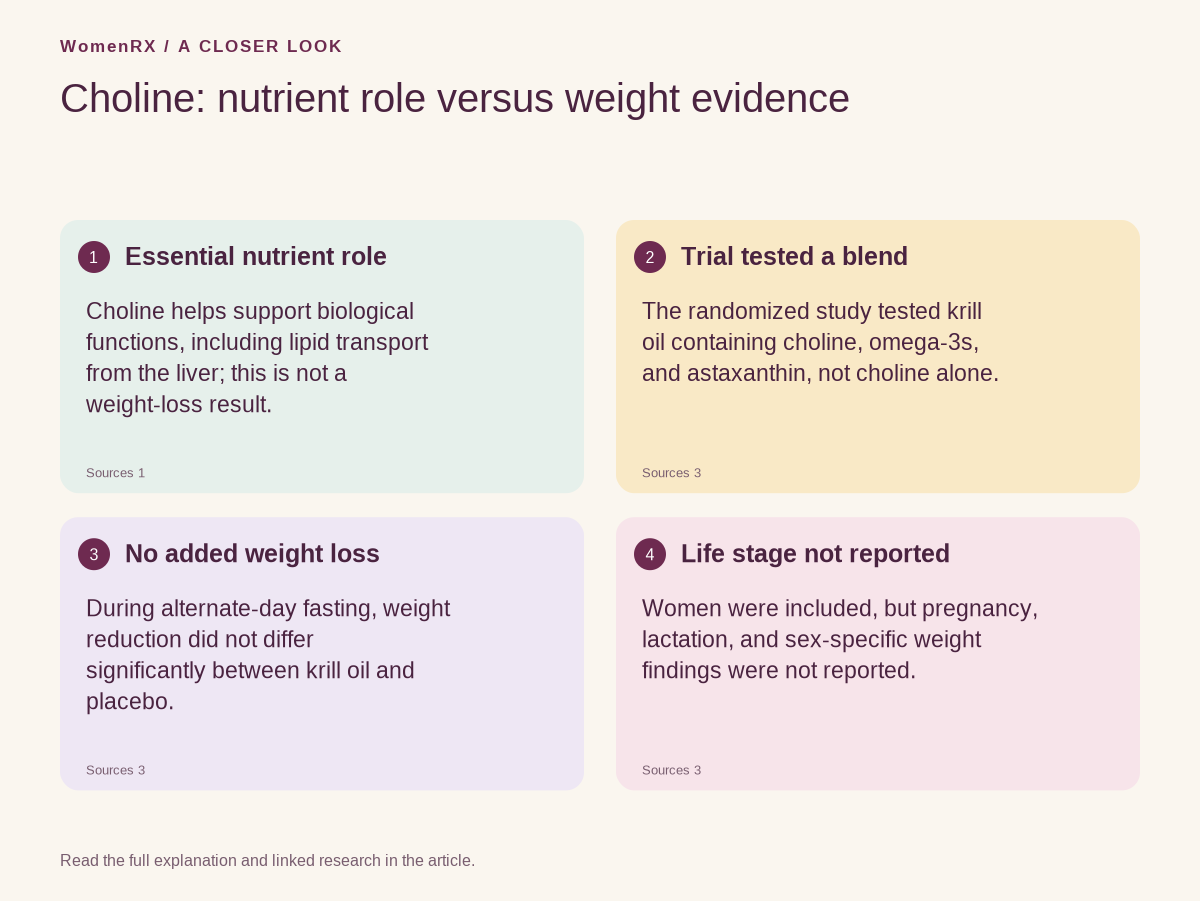
Choline: nutrient role versus weight evidence
Essential nutrient role: Choline helps support biological functions, including lipid transport from the liver; this is not a weight-loss result.1
Trial tested a blend: The randomized study tested krill oil containing choline, omega-3s, and astaxanthin, not choline alone.3
No added weight loss: During alternate-day fasting, weight reduction did not differ significantly between krill oil and placebo.3
Life stage not reported: Women were included, but pregnancy, lactation, and sex-specific weight findings were not reported.3
Read the figure as text
These distinctions show why a metabolic role or a result from a multi-ingredient product does not establish that choline alone changes weight.- Essential nutrient role: Choline helps support biological functions, including lipid transport from the liver; this is not a weight-loss result.1
- Trial tested a blend: The randomized study tested krill oil containing choline, omega-3s, and astaxanthin, not choline alone.3
- No added weight loss: During alternate-day fasting, weight reduction did not differ significantly between krill oil and placebo.3
- Life stage not reported: Women were included, but pregnancy, lactation, and sex-specific weight findings were not reported.3
More questions, answered
Does choline’s role in liver fat mean it burns body fat?
No. Choline is needed to help transport lipids from the liver, and inadequate intake can contribute to fat accumulation there. That does not demonstrate that extra choline reduces body fat or body weight. 1
Sources you can check
- Choline - Health Professional Fact SheetAccessed 2026-09-25Return to first citation
- Body Weight: MedlinePlusAccessed 2026-09-25Return to first citation
- Benefits of Krill Oil Supplementation During Alternate-Day Fasting in Adults With Overweight and Obesity: A Randomized Trial.Alblaji M, Gray SR, Almesbehi T, Morrison DJ, Malkova D. · Obesity (Silver Spring, Md.) · 2025Return to first citation