Fish Oil or Krill Oil? Compare the Label, Not the Hype
The most useful comparison is how much EPA and DHA you get per serving, not whether the bottle says fish oil or krill oil.
Neither oil is a proven universal winner. Compare labeled EPA and DHA per serving, then price for that amount. Absorption studies disagree: one matched-dose trial found similar blood levels, while another found higher increases with krill oil, which doesn’t prove better health outcomes. In one 12-week trial, no healthy adult reported side effects in either group; that doesn’t establish equal tolerability or suitability in pregnancy or breastfeeding. 2 3
Start with EPA and DHA, not total oil
On the Supplement Facts panel, look for eicosapentaenoic acid (EPA) and docosahexaenoic acid (DHA). Add those amounts to get the EPA+DHA total per serving. The larger number on the front of a bottle may describe the amount of oil, not the amount of these omega-3s. Products vary widely, so compare serving sizes and EPA and DHA amounts directly. 1
As a reference point, NIH’s Office of Dietary Supplements says a typical fish oil supplement provides about 1,000 mg of fish oil containing 180 mg EPA and 120 mg DHA, but amounts vary widely. That example is not a standard for every fish oil, and it doesn’t show how a particular fish oil compares with a particular krill oil. 1
Does krill oil absorb better?
Krill oil contains omega-3s mainly in phospholipids, while fish oil commonly provides them as triglycerides. That difference is a plausible reason for testing whether the oils affect absorption differently. But the evidence doesn’t support treating “phospholipid” as a guaranteed advantage: NIH describes findings as mixed. 1
The head-to-head trials help explain why. In a four-week randomized study of 66 healthy adults, participants taking matched amounts of EPA and DHA from fish oil or krill oil reached similar plasma and red blood cell levels. 3 A later 12-week randomized trial of 72 healthy adults found about 1.5 times higher increases in plasma EPA and DHA with krill oil than with fish oil. The trial included 53 women, with a median participant age of 59, but measured blood levels, not whether either oil improved health. 2
These results aren’t interchangeable: the studies differed in duration and reported different biomarker findings. Taken together, they show that formulation may affect blood levels in some comparisons, but not that krill oil reliably works better or delivers better health outcomes. 2 3
What about tolerability?
In the 12-week trial of 72 healthy adults, participants in neither the fish oil nor krill oil group reported side effects. That’s reassuring for those participants during that study, but it doesn’t prove the oils are equally well tolerated for everyone. The trial also doesn’t establish how either product is tolerated or suited to use during pregnancy or breastfeeding. 2
Blood levels aren’t the same as health benefits
An increase in blood EPA or DHA is a measure of omega-3 status, not proof that a supplement prevents or treats a condition. One small trial studied people with mild to moderate dry eye disease. After 90 days, both the krill oil and fish oil groups had reduced tear osmolarity compared with their own starting levels and placebo. Dry-eye symptom scores improved significantly compared with placebo in the krill oil group, but that finding alone doesn’t establish that krill oil is better than fish oil. The result applies to this specific condition and study, not to general health or women as a group. 4
Be cautious with comparisons based on products taken at their manufacturers’ recommended servings. In one trial, the tested concentrated fish oil provided substantially more EPA and DHA per day than the krill oil. Its results compare those particular products and amounts, not the oils on an equal-dose basis. 5
Make the price comparison fair
Compare the price of the bottle with the total EPA+DHA in the bottle, rather than comparing capsule count or total oil weight. A practical calculation is: bottle price ÷ grams of EPA+DHA in the bottle = price per gram of EPA+DHA. Use the labeled serving size and serving count to work out the total. This won’t tell you which oil will help with a health goal, but it does show whether a higher-priced product supplies more of the omega-3s you’re comparing.
Also check whether a product lists EPA and DHA separately, what other ingredients it contains, and how many capsules make up a serving. A different formulation or serving size can make two front-label claims look more alike than their EPA+DHA amounts actually are. 1
What this means for women
The comparative trials don’t establish a special health advantage for women, and they don’t answer whether either oil is preferable during pregnancy or breastfeeding. One 12-week trial included mostly women and reported a greater increase in EPA in females than males at 12 weeks. That was a blood-marker finding, not evidence that krill oil works better for women or improves a health outcome. 2
NIH notes that intake guidance for adults and for pregnancy and lactation does not set a specific recommended intake for EPA or DHA; the adult and pregnancy/lactation adequate intakes listed are for alpha-linolenic acid (ALA), a different omega-3. That information should not be mistaken for a recommendation to take either fish oil or krill oil. If pregnancy or breastfeeding is relevant to your choice, don’t use a general fish-versus-krill comparison as a substitute for guidance specific to that situation. 1
For a straightforward label decision, choose the product whose EPA and DHA amounts and serving instructions fit what you’re looking for, then compare its cost per gram of EPA+DHA. Pay extra for krill oil only if its specific label or other product features are worth that cost to you, not because absorption claims prove it is universally better.
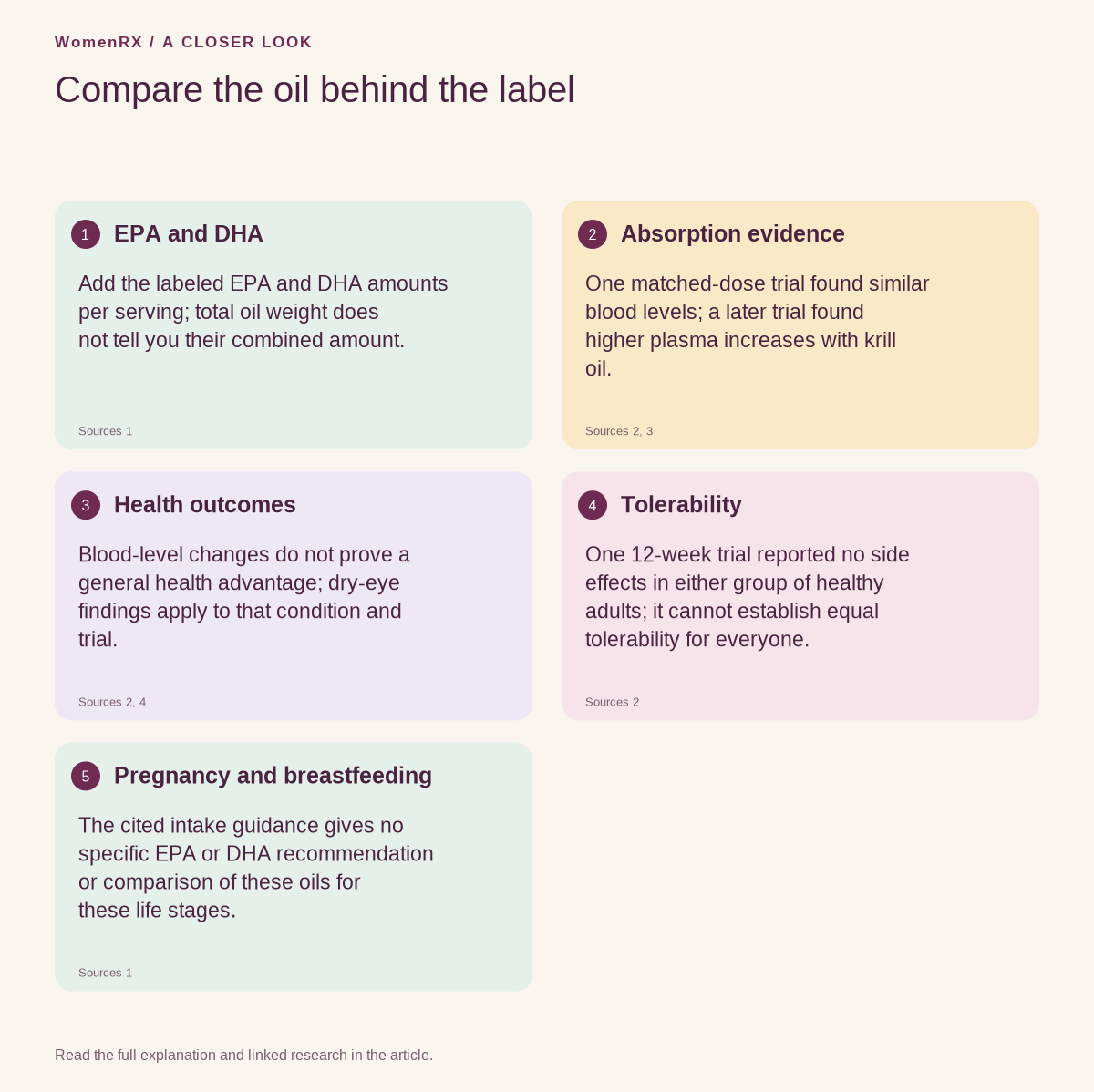
Compare the oil behind the label
EPA and DHA: Add the labeled EPA and DHA amounts per serving; total oil weight does not tell you their combined amount.1
Absorption evidence: One matched-dose trial found similar blood levels; a later trial found higher plasma increases with krill oil.23
Health outcomes: Blood-level changes do not prove a general health advantage; dry-eye findings apply to that condition and trial.24
Tolerability: One 12-week trial reported no side effects in either group of healthy adults; it cannot establish equal tolerability for everyone.2
Pregnancy and breastfeeding: The cited intake guidance gives no specific EPA or DHA recommendation or comparison of these oils for these life stages.1
Read the figure as text
Use these distinctions to compare actual EPA and DHA content, understand what absorption studies can show, and keep tolerability and life-stage claims in perspective.- EPA and DHA: Add the labeled EPA and DHA amounts per serving; total oil weight does not tell you their combined amount.1
- Absorption evidence: One matched-dose trial found similar blood levels; a later trial found higher plasma increases with krill oil.23
- Health outcomes: Blood-level changes do not prove a general health advantage; dry-eye findings apply to that condition and trial.24
- Tolerability: One 12-week trial reported no side effects in either group of healthy adults; it cannot establish equal tolerability for everyone.2
- Pregnancy and breastfeeding: The cited intake guidance gives no specific EPA or DHA recommendation or comparison of these oils for these life stages.1
More questions, answered
Does a higher blood omega-3 level mean krill oil is healthier?
Not by itself. Blood EPA and DHA levels are biomarkers; a higher level does not establish better health outcomes. The head-to-head trials found different biomarker results, and those results don’t prove a universal health advantage for either oil. 2 3
Can I compare products by the milligrams on the front label?
Use the Supplement Facts panel to check EPA and DHA per serving. A front-label amount may describe total oil, and products vary in how much EPA and DHA that oil supplies. 1
Are fish oil and krill oil equally well tolerated?
One 12-week trial in 72 healthy adults reported no side effects in either group. That’s a limited finding from one study, not proof that the oils are equally well tolerated by everyone or during pregnancy or breastfeeding. 2
Sources you can check
- Omega-3 Fatty Acids - Health Professional Fact SheetAccessed 2026-09-25Return to first citation
- Krill oil increases plasma omega-3 fatty acids more than fish oil in healthy adults: a double-blind randomized controlled trial.Loukil I, Vachon A, Çaku A, Plourde M. · The American journal of clinical nutrition · 2026Return to first citation
- Similar eicosapentaenoic acid and docosahexaenoic acid plasma levels achieved with fish oil or krill oil in a randomized double-blind four-week bioavailability study.Yurko-Mauro K, Kralovec J, Bailey-Hall E, Smeberg V, Stark JG, Salem N. · Lipids in health and disease · 2015Return to first citation
- A Randomized, Double-Masked, Placebo-Controlled Clinical Trial of Two Forms of Omega-3 Supplements for Treating Dry Eye Disease.Deinema LA, Vingrys AJ, Wong CY, Jackson DC, Chinnery HR, Downie LE. · Ophthalmology · 2017Return to first citation
- A randomized clinical trial to determine the efficacy of manufacturers' recommended doses of omega-3 fatty acids from different sources in facilitating cardiovascular disease risk reduction.Laidlaw M, Cockerline CA, Rowe WJ. · Lipids in health and disease · 2014Return to first citation