When Does Fish Oil Make a Measurable Difference?
Fish oil can lower triglycerides, but the goal and the product matter more than the words “omega-3” on the bottle.
Fish oil can make a measurable difference to triglyceride levels, particularly when a prescription-strength product is used to treat high levels. That’s different from proving a regular supplement prevents heart attacks. If your goal is to get more omega-3s in your diet, fish or an appropriate supplement may help, but check how much EPA and DHA you’re actually getting. 138
Start with the result you want
“Omega-3” describes a family of fats, not one interchangeable ingredient. Flaxseed and walnuts provide alpha-linolenic acid (ALA). Fish provides the long-chain omega-3s EPA and DHA; fish-oil supplements usually provide both, while algal-oil supplements often emphasize DHA. Most supplement research has focused on EPA and DHA, so a claim about fish oil shouldn’t automatically be applied to flaxseed oil, or the other way around. 1
That distinction gives you a practical first question: are you trying to eat more seafood, get EPA or DHA without seafood, lower a high triglyceride result, or prevent a heart attack? The answer changes what counts as a meaningful result.
For high triglycerides, look beyond the front of the bottle
Prescription omega-3 products can lower triglycerides in people with high levels. An older review reported an average 45% triglyceride reduction with a particular prescription EPA-and-DHA product at 4 grams daily in patients whose triglycerides were at least 500 mg/dL. That result describes a specific treatment and population, not what to expect from a standard fish-oil capsule. 3
The label can make the difference easy to miss. A typical supplement described by the NIH contains about 1,000 mg of fish oil, but only about 180 mg EPA and 120 mg DHA. Amounts vary by product. A prescription product described in the triglyceride review contained 840 mg EPA plus DHA per 1-gram capsule. “1,000 mg fish oil” and “1,000 mg EPA plus DHA” are not the same thing. 13
If you have a high triglyceride result, this is a treatment question rather than a reason to keep adding over-the-counter capsules. The size of the effect depends in part on how high triglycerides were to begin with, and the studies of prescription products don’t establish an equivalent effect for whichever supplement is on the shelf. 38
A lower lab number isn’t the same as fewer heart attacks
Triglycerides are a blood-test result. Heart attacks and strokes are clinical outcomes. Improving the first doesn’t guarantee improvement in the second: a review of major trials notes that a high-dose EPA-and-DHA product lowered triglycerides without showing a cardiovascular-event benefit in the STRENGTH trial. 48
There is a more specific positive result. In REDUCE-IT, the purified EPA prescription medicine icosapent ethyl reduced cardiovascular events in selected people with elevated triglycerides who were already taking statins and had established cardiovascular disease, or diabetes with additional risk factors. That finding does not mean an ordinary fish-oil supplement has the same effect. Other large trials using different omega-3 preparations have not shown the same overall cardiovascular benefit. 258
Safety is part of that distinction, too. A review of omega-3 trials flags gastrointestinal effects, possible bleeding, and a possible increased risk of atrial fibrillation as concerns to monitor with omega-3 products. It does not establish that every supplement carries the same risk as a high-dose prescription treatment. 8
If the goal is dietary intake, food and supplements answer different needs
If you eat fish, it can provide EPA and DHA as food rather than as a capsule. If you don’t eat seafood, an algal-oil product may provide DHA; some also contain EPA. Check the amounts of each on the label instead of comparing products by total oil alone. Cod liver oil also supplies vitamins A and D, so it isn’t simply another name for fish oil. 1
Plant foods such as flaxseed and walnuts are useful sources of ALA, but they aren’t direct sources of the EPA and DHA supplied by fish. That’s why a tablespoon of flaxseed oil and an EPA-and-DHA supplement shouldn’t be treated as equivalent products for a goal studied with EPA and DHA. 17
Pregnancy and breastfeeding deserve their own questions
During pregnancy, DHA matters for fetal brain and eye development. Many expert groups recommend 8 to 12 ounces of seafood per week, while seafood varies in methylmercury content. A DHA-containing fish-oil or algal-oil supplement can help someone who doesn’t eat seafood increase her intake, but it doesn’t make every prenatal supplement necessary or interchangeable. Pregnancy trials haven’t consistently shown better infant cognition or vision from EPA or DHA supplements, although evidence indicates long-chain omega-3 supplementation, particularly DHA, can reduce preterm and early preterm birth risk. 7
Breastfeeding is a different question. Maternal intake affects the DHA and EPA content of breast milk, and supplementation can raise those milk levels. That measurable change isn’t a promise of a particular developmental outcome for your baby. If you’re choosing a product while breastfeeding, the useful comparison is its stated DHA and EPA content against what you’re already getting from food. 6
Fish oil, then, isn’t a default yes-or-no purchase. Match the form of omega-3 and the amount of EPA and DHA to the result you care about. A dietary-intake gap, a high triglyceride result, and cardiovascular-event prevention are three different decisions. 138
What the omega-3 amount describes
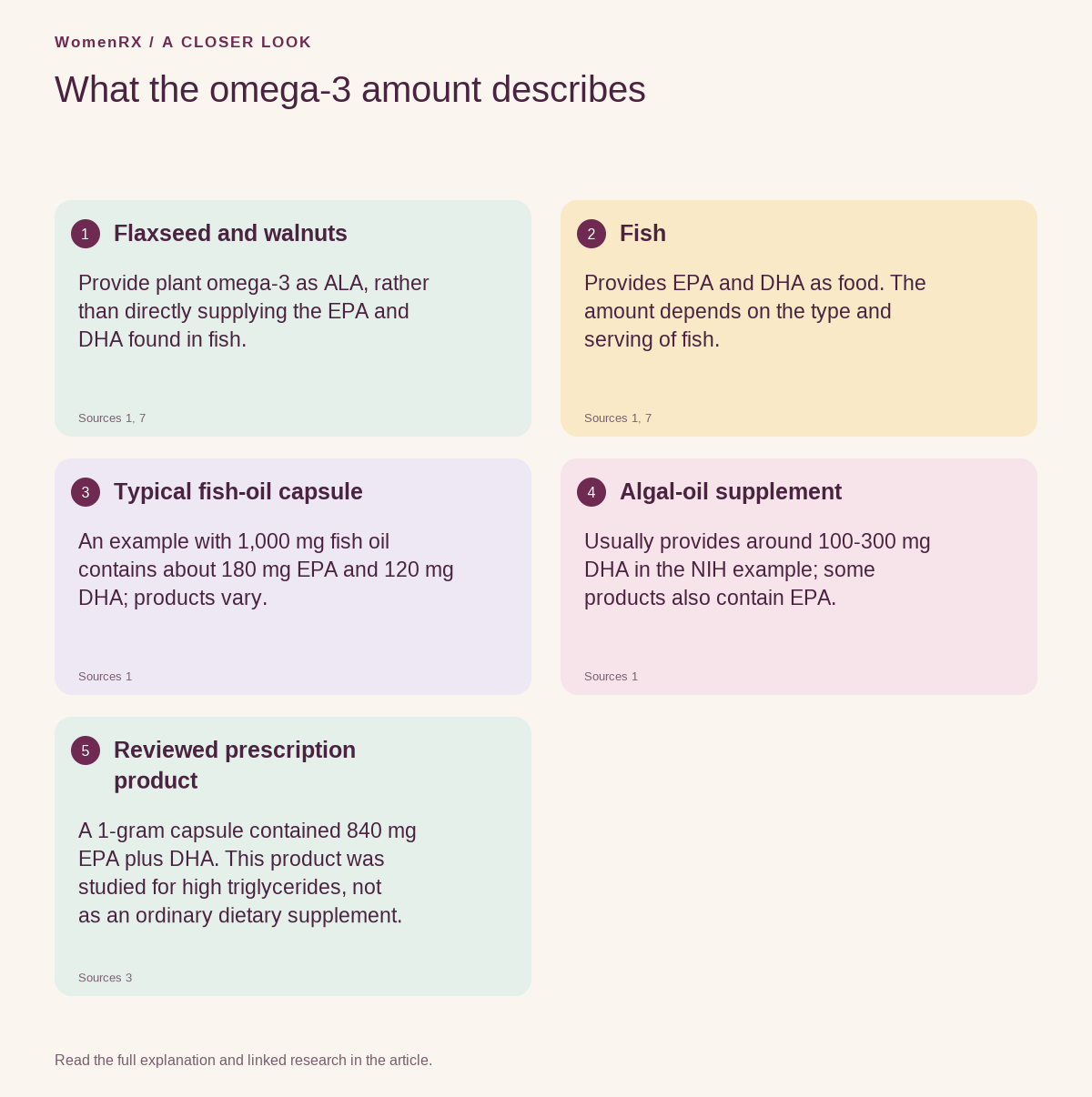
Flaxseed and walnuts: Provide plant omega-3 as ALA, rather than directly supplying the EPA and DHA found in fish.17
Fish: Provides EPA and DHA as food. The amount depends on the type and serving of fish.17
Typical fish-oil capsule: An example with 1,000 mg fish oil contains about 180 mg EPA and 120 mg DHA; products vary.1
Algal-oil supplement: Usually provides around 100-300 mg DHA in the NIH example; some products also contain EPA.1
Reviewed prescription product: A 1-gram capsule contained 840 mg EPA plus DHA. This product was studied for high triglycerides, not as an ordinary dietary supplement.3
Read the figure as text
Compare sources for dietary intake with a prescription example for triglyceride treatment. The amounts alone don’t establish cardiovascular-event prevention.- Flaxseed and walnuts: Provide plant omega-3 as ALA, rather than directly supplying the EPA and DHA found in fish.17
- Fish: Provides EPA and DHA as food. The amount depends on the type and serving of fish.17
- Typical fish-oil capsule: An example with 1,000 mg fish oil contains about 180 mg EPA and 120 mg DHA; products vary.1
- Algal-oil supplement: Usually provides around 100-300 mg DHA in the NIH example; some products also contain EPA.1
- Reviewed prescription product: A 1-gram capsule contained 840 mg EPA plus DHA. This product was studied for high triglycerides, not as an ordinary dietary supplement.3
More questions, answered
Does a “1,000 mg fish oil” capsule contain 1,000 mg of omega-3s?
Not necessarily. The typical example in the NIH fact sheet contains about 180 mg EPA and 120 mg DHA in 1,000 mg of fish oil, and products vary. Read the EPA and DHA amounts separately. 1
Which omega-3 do flaxseed and walnuts provide?
They provide ALA, a plant omega-3. Fish supplies EPA and DHA, while algal-oil supplements commonly supply DHA and sometimes EPA. Those distinctions matter when you’re comparing products for a specific goal. 17
Sources you can check
- Omega-3 Fatty Acids - Health Professional Fact SheetAccessed 2026-09-25Return to first citation
- Emphasis on Icosapent Ethyl for Cardiovascular Risk Reduction: A Systematic Review.Sutariya B, Montenegro DM, Chukwu M, Ehsan P, Aburumman RN, Muthanna SI, Menon SR, Vithani V, Penumetcha SS. · Cureus · 2022Return to first citation
- Prescription omega-3 fatty acids for the treatment of hypertriglyceridemia.McKenney JM, Sica D. · American journal of health-system pharmacy : AJHP : official journal of the American Society of Health-System Pharmacists · 2007Return to first citation
- Anti-apoC-III Therapies and Implications for Treatment of Pancreatitis and Cardiovascular Disease.Tsimikas S. · Current atherosclerosis reports · 2025Return to first citation
- Omega-3 Fatty Acids in Cardiovascular Disease and Diabetes: a Review of Recent Evidence.Bhat S, Sarkar S, Zaffar D, Dandona P, Kalyani RR. · Current cardiology reports · 2023Return to first citation
- Marine Oils2006Return to first citation
- Dietary Supplements and Life Stages: Pregnancy - Health Professional Fact SheetAccessed 2026-09-25Return to first citation
- Omega-3 fatty acids for the prevention of atherosclerotic cardiovascular disease.Barry AR, Dixon DL. · Pharmacotherapy · 2021Return to first citation