Fish Oil Supplements: What’s in Them and When They Help
The EPA and DHA on a fish-oil label matter more than the amount of fish oil, and evidence of benefit depends on the health goal and formulation.
Fish oil supplies EPA and DHA, but “1,000 mg fish oil” does not mean 1,000 mg of those omega-3 fats. For general heart prevention, several supplement trials have not improved their primary cardiovascular outcomes; eating fish is a different dietary choice. Results with prescription EPA in higher-risk people don’t transfer to ordinary capsules. During pregnancy and breastfeeding, lower-mercury seafood offers nutrients a supplement lacks.178
Start with the EPA and DHA, not the front label
Fish oil contains omega-3 fatty acids, chiefly eicosapentaenoic acid (EPA) and docosahexaenoic acid (DHA). Those are different from the omega-3 fat ALA found in foods such as flaxseed. Fish-oil supplements also vary widely. As an example of how to read a label, a typical capsule containing 1,000 mg of fish oil may provide about 180 mg EPA plus 120 mg DHA. The fish-oil weight is not the EPA-and-DHA amount.1
Look for EPA and DHA separately on the Supplement Facts label, then check how many capsules make up the labeled serving. That lets you compare products without assuming two bottles marked “fish oil” contain the same amounts. Cod liver oil is another distinct choice: it contains vitamins A and D as well as omega-3s, so it shouldn’t be treated as a plain fish-oil substitute.1
Two current US product listings show why the serving matters. As listed in September 2026, NOW Omega-3 Fish Oil provides 360 mg EPA plus 240 mg DHA in a two-softgel serving containing 2,000 mg fish oil concentrate. Its 100-softgel bottle was listed at $12.99, or about $0.26 per two-softgel serving and $0.43 per 1,000 mg EPA plus DHA. Nordic Naturals Ultimate Omega lemon soft gels list 650 mg EPA plus 450 mg DHA and 1,280 mg total omega-3s per two-softgel serving. Its 60-count bottle was listed at $29.95, or about $1.00 per serving and $0.91 per 1,000 mg EPA plus DHA. These are label-and-price comparisons, not recommended amounts or evidence that either product produces better health outcomes. Prices can change, and another formulation from the same brand may have different contents.1011
Match the evidence to the reason you’re considering it
For general heart prevention, an ordinary supplement is not a proven stand-in for eating fish or a reliable improvement over not supplementing. Several trials using roughly 1 g a day of omega-3s did not improve their primary cardiovascular outcomes compared with placebo. Fish provides protein, vitamins, and minerals that fish oil does not. Eating fish as part of a healthy diet may benefit heart health, but that dietary finding cannot establish that a capsule has the same effect.18 A review of trials in people who had already experienced a cardiovascular event found reductions in some outcomes, including heart attack and cardiac death. That finding concerns secondary prevention, not a promise that an ordinary store-bought capsule will prevent a first heart attack.5
For established disease or higher cardiovascular risk, the formulation matters. In an analysis of trials involving people with diabetes, EPA alone was associated with lower cardiovascular-event risk, while combined EPA and DHA was not associated with a significant reduction in that analysis. A separate formulation-focused review found that, among blinded, placebo-controlled cardiovascular-outcome trials it assessed, the demonstrated event reduction was specific to icosapent ethyl. These findings don’t make an over-the-counter fish-oil blend equivalent to icosapent ethyl. The cardiovascular estimates discussed here are not women-specific.67
For blood fats, distinguish a lab change from a heart outcome. In one open-label trial, 106 people with high blood lipids were assigned either fish-oil capsules or trout meals for eight weeks; results from 95 people were analyzed. Both groups saw changes in several lipid measures, but the fish group had a larger triglyceride reduction, and LDL cholesterol rose in the capsule group while falling in the fish group. This was a short study of blood tests, not heart attacks or strokes. The reported results don’t establish that fish will outperform every supplement in every setting.2
Fish also provides food, not just EPA and DHA. Its protein, vitamins, and minerals are part of what you get from a seafood meal, not from fish oil alone. That’s one reason the choice between a meal and a capsule is more than a comparison of milligrams.8
Pregnancy and breastfeeding are separate decisions
During pregnancy, DHA is relevant to fetal development, and seafood can supply both DHA and EPA. US advice for someone who might become or is pregnant is 8-12 ounces a week of varied, lower-mercury fish. Salmon, sardines, trout, and canned light tuna are examples in the FDA/EPA “Best Choices” category. Bigeye tuna is a “Choice to Avoid”; albacore tuna is a “Good Choice,” limited to one serving with no other fish that week. The choice of fish matters as well as the amount.8
A capsule changes the tradeoff, but it doesn’t reproduce a seafood meal. The NIH Office of Dietary Supplements reports that methylmercury has not been found in omega-3 supplements because it is removed during processing and purification. Fish oil still doesn’t supply all the other nutrients in fish. And while DHA and EPA have biological roles in development, a systematic review and meta-analysis of 11 randomized trials found no significant improvement in the children’s cognitive measures it assessed when pregnant or breastfeeding women took DHA/EPA supplements. That result doesn’t mean DHA is unneeded; it means a supplement’s developmental benefit shouldn’t be promised on the basis of its contents alone.148
During breastfeeding, the same lower-mercury fish guidance applies, but the question about a supplement is different. Maternal intake affects DHA and EPA levels in breast milk, and supplementation can raise them. Evidence about child outcomes is less settled: the 11-trial analysis pooled studies of supplementation during pregnancy and/or breastfeeding and found no significant improvement in the cognitive outcomes it assessed. A review discussing lactation-specific research reports favorable findings for some language and psychomotor outcomes. Neither finding makes improved cognition an assured result for a breastfed child.348
Compare safety along with the label
Seafood and capsules bring different considerations. Mercury varies by fish, which is why lower-mercury choices matter especially during pregnancy and breastfeeding. Purified omega-3 supplements have not been found to contain methylmercury, but they don’t provide the other nutrients in a fish meal. Cod liver oil adds vitamins A and D, so check whether you’re already getting those from another product.18
Purification doesn’t answer every safety question. Fish-oil supplements can cause unpleasant taste, heartburn, nausea, or diarrhea. If you take warfarin, discuss fish oil before adding it: high amounts can affect platelet function, and prescription omega-3 labeling calls for monitoring clotting measures when omega-3s are used with anticoagulants. That does not mean every fish-oil capsule has been shown to cause bleeding.9 In two large trials of people with cardiovascular disease or high cardiovascular risk, 4 g a day of omega-3s taken for years slightly increased atrial fibrillation risk. Those findings are a reason not to treat concentrated products as risk-free, not a risk estimate for every woman taking a lower-dose capsule.9
The useful next question is specific: Am I trying to add seafood to my diet, change a blood-lipid result, or address an established cardiovascular risk? A label can tell you what’s in a capsule. It cannot tell you that the capsule will deliver the outcome seen with fish meals or with a different, studied formulation.127
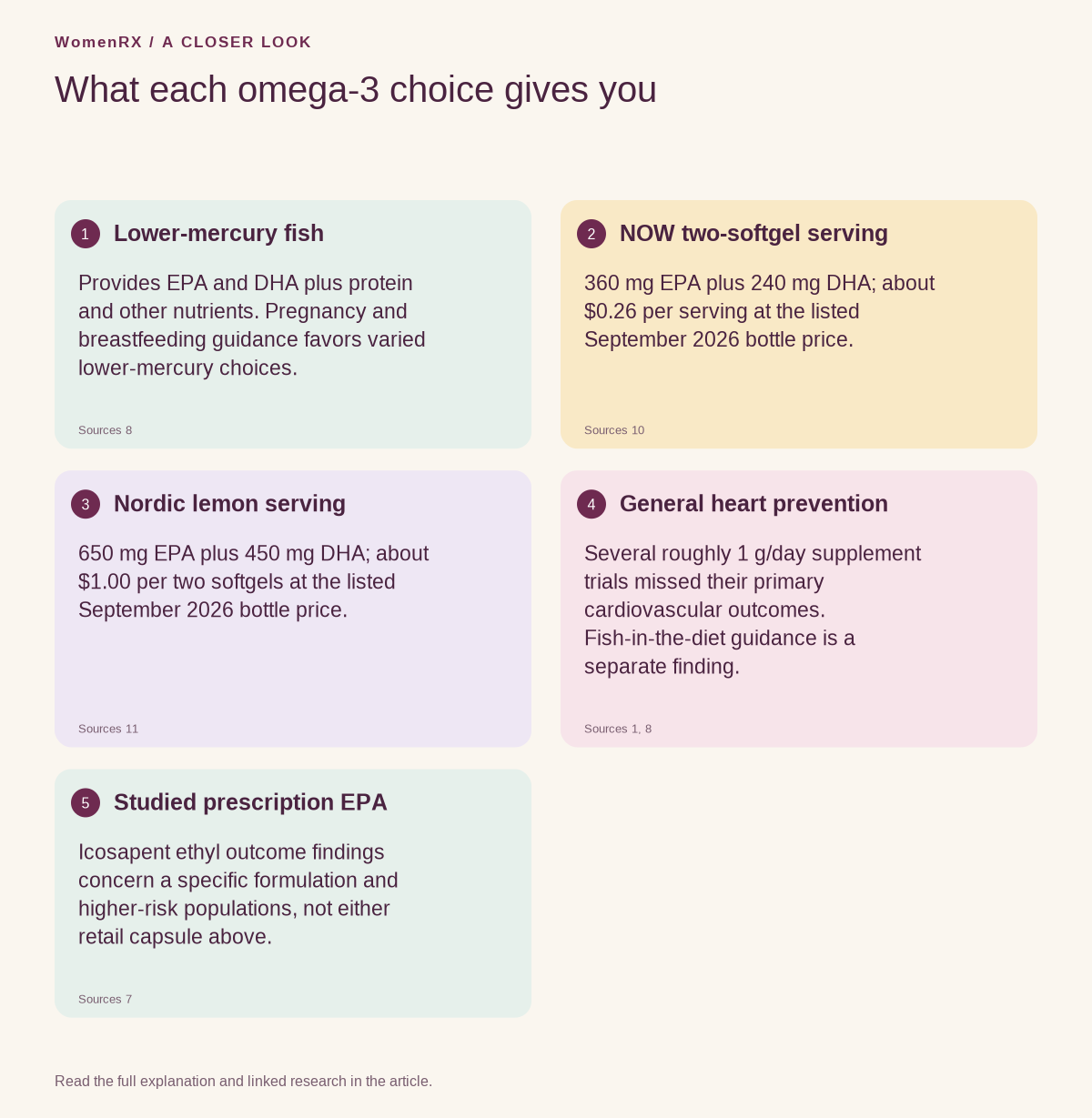
What each omega-3 choice gives you
Lower-mercury fish: Provides EPA and DHA plus protein and other nutrients. Pregnancy and breastfeeding guidance favors varied lower-mercury choices.8
NOW two-softgel serving: 360 mg EPA plus 240 mg DHA; about $0.26 per serving at the listed September 2026 bottle price.10
Nordic lemon serving: 650 mg EPA plus 450 mg DHA; about $1.00 per two softgels at the listed September 2026 bottle price.11
General heart prevention: Several roughly 1 g/day supplement trials missed their primary cardiovascular outcomes. Fish-in-the-diet guidance is a separate finding.18
Studied prescription EPA: Icosapent ethyl outcome findings concern a specific formulation and higher-risk populations, not either retail capsule above.7
Read the figure as text
Compare the food, the amounts on two actual labels, and the outcome each kind of evidence can address.- Lower-mercury fish: Provides EPA and DHA plus protein and other nutrients. Pregnancy and breastfeeding guidance favors varied lower-mercury choices.8
- NOW two-softgel serving: 360 mg EPA plus 240 mg DHA; about $0.26 per serving at the listed September 2026 bottle price.10
- Nordic lemon serving: 650 mg EPA plus 450 mg DHA; about $1.00 per two softgels at the listed September 2026 bottle price.11
- General heart prevention: Several roughly 1 g/day supplement trials missed their primary cardiovascular outcomes. Fish-in-the-diet guidance is a separate finding.18
- Studied prescription EPA: Icosapent ethyl outcome findings concern a specific formulation and higher-risk populations, not either retail capsule above.7
More questions, answered
Does “1,000 mg fish oil” mean 1,000 mg of omega-3s?
No. A typical 1,000 mg fish-oil supplement may contain about 180 mg EPA and 120 mg DHA, though products vary widely. Compare the EPA and DHA amounts for the labeled serving, not just the fish-oil weight on the front.1
Sources you can check
- Omega-3 Fatty Acids - Health Professional Fact SheetAccessed 2026-09-25Return to first citation
- Comparison of the effect of omega-3 supplements and fresh fish on lipid profile: a randomized, open-labeled trial.Zibaeenezhad MJ, Ghavipisheh M, Attar A, Aslani A. · Nutrition & diabetes · 2017Return to first citation
- Marine Oils2006Return to first citation
- Impact of omega-3 fatty acid DHA and EPA supplementation in pregnant or breast-feeding women on cognitive performance of children: systematic review and meta-analysis.Lehner A, Staub K, Aldakak L, Eppenberger P, Rühli F, Martin RD, Bender N. · Nutrition reviews · 2021Return to first citation
- Omega-3 polyunsaturated fatty acids supplementation and cardiovascular outcomes: do formulation, dosage, and baseline cardiovascular risk matter? An updated meta-analysis of randomized controlled trials.Casula M, Olmastroni E, Gazzotti M, Galimberti F, Zambon A, Catapano AL. · Pharmacological research · 2020Return to first citation
- Effect of Omega-3 Polyunsaturated Fatty Acids on Cardiovascular Outcomes in Patients with Diabetes: A Meta-analysis of Randomized Controlled Trials.Huang L, Zhang F, Xu P, Zhou Y, Liu Y, Zhang H, Tan X, Ge X, Xu Y, Guo M, Long Y. · Advances in nutrition (Bethesda, Md.) · 2023Return to first citation
- Formulation-Specific Cardiovascular Outcomes with High-Dose Eicosapentaenoic Acid: A Systematic Review and Meta-analysis.Faheem MA, Azeem B, Ali T, Asim R, Muhammad TS, Dogar ME, Naveed MA. · American journal of cardiovascular drugs : drugs, devices, and other interventions · 2026Return to first citation
- Questions & Answers from the FDA/EPA Advice about Eating Fish for Those Who Might Become or Are Pregnant or Breastfeeding and Children Ages 1 to 11 Years | FDAAccessed 2026-09-25Return to first citation
- NIH ODS Omega-3 Fatty Acids: safety and interactionsAccessed 2026-09-26Return to first citation
- NOW Omega-3 Fish Oil, Molecularly Distilled Softgels: current product factsAccessed 2026-09-26Return to first citation
- Nordic Naturals Ultimate Omega lemon soft gels: current product factsAccessed 2026-09-26Return to first citation