Vitamin D and Infection Prevention: What Studies Show
The infection-prevention findings depend on who took vitamin D and which outcome researchers measured.
Vitamin D supplements aren’t a proven all-purpose way to prevent respiratory infections. Children’s respiratory-infection studies and a COVID-19 trial give different answers to the prevention question. They don’t establish that adults, including women, get the same benefit, or that a low starting vitamin D level predicts who will benefit. A blood-level threshold used for general health isn’t an established infection-prevention target. 1 2 3 4
The short answer: prevention evidence is mixed
Vitamin D has roles in immune function, but that biological role doesn’t establish that taking extra vitamin D will stop you from catching a respiratory infection. The useful distinction is between correcting inadequate vitamin D for established health reasons and taking supplements specifically to prevent infections. Trials haven’t shown a consistent benefit across populations and outcomes, and they don’t establish the same effect for adult women. 1 2 3 4
In a 2025 review of 17 randomized trials involving 18,372 children, supplementation did not significantly reduce respiratory infection incidence overall. The review also found no clear improvement in hospitalization duration, recovery time, or all-cause mortality. A subgroup of trials using daily lower-dose regimens showed a possible reduction in infection incidence, but the overall result was not significant, and the review’s authors said vitamin D shouldn’t be used as a universal prevention measure for children. 2
A separate Cochrane review focused on children up to age five and examined a different practical outcome: whether children made healthcare visits for respiratory infections. It found low-certainty evidence of a slight reduction in the proportion of children who made at least one such visit, but probably no reduction in the average number of visits per child. Comparing higher with lower doses did not show a clear benefit. These results suggest, at most, a modest possible effect on one measure of illness burden, not reliable protection from infection. 3
A low blood level is not an infection threshold
A blood test for vitamin D usually measures 25-hydroxyvitamin D, or 25(OH)D. The National Academies’ thresholds describe vitamin D status in relation to bone and general health: levels below 12 ng/mL are associated with deficiency risk, while 20 ng/mL or more is considered adequate for most people. Those cutoffs aren’t established targets for preventing respiratory infections, and the relationship between 25(OH)D and health effects isn’t fully defined. 1
So if a result is low, that may be relevant to your overall nutritional and bone health. It doesn’t, by itself, show that vitamin D caused repeated infections or that taking supplements will prevent the next one. Neither the children’s infection findings nor the COVID-19 trial establishes a reliable infection-prevention benefit specifically for people with low baseline vitamin D. 1 2 4
This distinction also helps explain why observational findings can sound more persuasive than supplement trials. An association between lower vitamin D levels and infections doesn’t prove that raising vitamin D with a supplement will change infection risk. Trials are a more direct test of that prevention claim, and their results remain mixed. 2 4
What the COVID-19 comparison can tell you
A randomized trial compared moderate or high daily vitamin D with a low-dose comparison for up to nine months, measuring time to COVID-19 infection. In the combined comparison, COVID-19 occurred in 10.9% of participants receiving moderate or high amounts and 14.7% receiving the low amount; the difference wasn’t statistically significant. A prespecified secondary comparison found lower risk with the moderate amount, but not the high amount. That finding is worth further study, not proof that supplementation reliably prevents COVID-19 or other respiratory infections. 4
These results don’t establish a women-specific effect or show that a low starting vitamin D level identifies who benefits. They also can’t answer whether supplements prevent other respiratory infections. 4
Pregnancy findings are about children’s healthcare visits
The Cochrane review included trials where supplementation was given during pregnancy, early childhood, or both. Its possible benefit concerned the proportion of children under five who later made a healthcare visit for an acute respiratory infection. This finding doesn’t show that taking vitamin D in pregnancy prevents respiratory infections in the pregnant person, and it can’t be attributed to pregnancy-only supplementation. 3
Pregnancy is a distinct life stage, and vitamin D intake recommendations may apply for reasons beyond infection prevention. But the child healthcare-visit finding isn’t a reason to treat vitamin D as a guaranteed infection shield for you or your baby. 1 3
A practical way to use this evidence
If you’re weighing a supplement, separate two questions: “Am I getting enough vitamin D for my health?” and “Will taking more prevent infections?” The first may depend on your diet, life stage, health conditions, and vitamin D status. The second has no consistent answer across infection studies, and neither a women-specific effect nor an effect based on starting vitamin D status has been established. 1 2 3 4
More isn’t automatically better. Excessive vitamin D from supplements can cause harmful calcium levels and other serious problems, so trying high amounts for prevention isn’t a risk-free shortcut. 1
The grounded takeaway: address vitamin D inadequacy for its established nutritional and bone-health reasons, but don’t count on supplements alone to prevent respiratory infections.
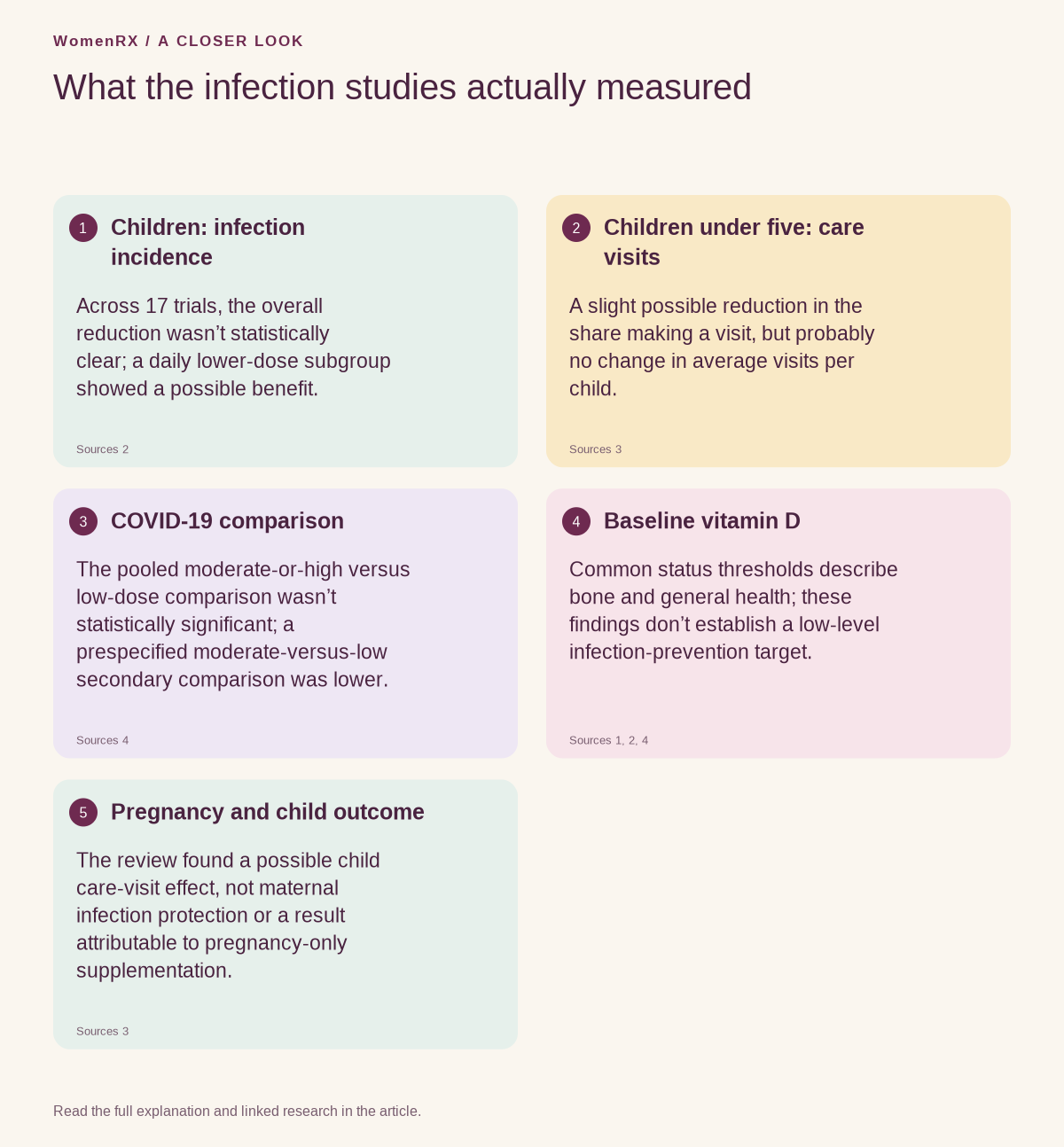
What the infection studies actually measured
Children: infection incidence: Across 17 trials, the overall reduction wasn’t statistically clear; a daily lower-dose subgroup showed a possible benefit.2
Children under five: care visits: A slight possible reduction in the share making a visit, but probably no change in average visits per child.3
COVID-19 comparison: The pooled moderate-or-high versus low-dose comparison wasn’t statistically significant; a prespecified moderate-versus-low secondary comparison was lower.4
Baseline vitamin D: Common status thresholds describe bone and general health; these findings don’t establish a low-level infection-prevention target.124
Pregnancy and child outcome: The review found a possible child care-visit effect, not maternal infection protection or a result attributable to pregnancy-only supplementation.3
Read the figure as text
The findings differ by population and outcome. These studies don’t establish a general prevention effect for adult women or show that low baseline vitamin D predicts benefit.- Children: infection incidence: Across 17 trials, the overall reduction wasn’t statistically clear; a daily lower-dose subgroup showed a possible benefit.2
- Children under five: care visits: A slight possible reduction in the share making a visit, but probably no change in average visits per child.3
- COVID-19 comparison: The pooled moderate-or-high versus low-dose comparison wasn’t statistically significant; a prespecified moderate-versus-low secondary comparison was lower.4
- Baseline vitamin D: Common status thresholds describe bone and general health; these findings don’t establish a low-level infection-prevention target.124
- Pregnancy and child outcome: The review found a possible child care-visit effect, not maternal infection protection or a result attributable to pregnancy-only supplementation.3
More questions, answered
If my vitamin D level is low, should I take it to prevent infections?
A low result may matter for your overall health, but it doesn’t show that supplementation will prevent respiratory infections. Neither the children’s infection findings nor the COVID-19 trial establishes a reliable prevention benefit specifically for people with low baseline levels. 1 2 4
Does the pregnancy research show vitamin D protects pregnant people from respiratory infections?
No. The possible benefit in the review was a slight reduction in the proportion of children under five who made a healthcare visit for an acute respiratory infection. It doesn’t establish protection for the pregnant person or show that pregnancy-only supplementation caused the child outcome. 3
Sources you can check
- Vitamin D - Health Professional Fact SheetAccessed 2026-09-25Return to first citation
- The role of vitamin D in the prevention and treatment of acute respiratory infections in pediatric populations: a systematic review and meta-analysis of randomized controlled trials.Wang L, Yu Y, Liu K, Yu X, Li Y. · BMC pediatrics · 2025Return to first citation
- Vitamin D for preventing acute respiratory infections in children up to five years of age.van Arragon M, Grant CC, Scragg RK, Jordan VM. · The Cochrane database of systematic reviews · 2026Return to first citation
- Effect of moderate or high versus low dose daily vitamin D on COVID-19 incidence: A double-blind, parallel-group randomized clinical trial.Meltzer DO, Moy JN, Schram AW, Tate A, Hyman MJ, Cursio JF, Vokes T, Yeo KJ, Prochaska M, Jacobs JJ, Solway J. · Clinical nutrition (Edinburgh, Scotland) · 2026Return to first citation